

The promise of effortless investing has always been a powerful one. 5StarsStocks.com leans heavily into that idea. It markets itself as an AI-driven stock research site offering curated ideas, quick star ratings, and simplified categories such as “Blue Chip,” “AI Stocks,” and “Income Picks.”
Its message is straightforward: You don’t need to analyze - we’ve done it for you.
Yet when we actually dig into the data, the claims of precision, authority, and verified insight begin to unravel. What remains is an intriguing but risky platform: a tool that can spark ideas, but one that serious investors should approach with measured skepticism.

The site launched in 2023 as an unregulated research and stock-picking portal. It uses algorithmic models and a five-star rating system to identify “top opportunities” across several investing themes.
At its core, it appeals to three types of readers:
➤ Casual investors seeking quick validation for their stock ideas.
➤ Retail traders who prefer digestible lists over deep balance-sheet reading.
➤ Beginners drawn in by phrases like AI-powered accuracy or real-time insights.
But these appeals hide a structural issue: there is no public evidence that any of its models are independently verified. The “AI” angle sounds impressive but operates more as branding than measurable research.
The platform’s star rating simplifies complex fundamentals into a single score. On paper, this helps users compare companies quickly. In practice, it conceals how those scores are determined, leaving users guessing whether the stars reflect valuation metrics, technical signals, or mere keyword frequency in financial news.

Before assessing the site’s “Blue Chip” section, it’s worth recalling what blue-chip stocks really represent in mainstream finance.
They’re not a theme — they’re a standard. Blue chips are:
1. Large, established companies with consistent profitability and strong governance.
2. Dividend payers with predictable cash flows.
3. Industry leaders whose performance anchors benchmark indices like the S&P 500.
4. Relatively low-volatility holdings that preserve wealth across cycles.
Think of firms like Procter & Gamble, Microsoft, or Johnson & Johnson, businesses that survive recessions and compound quietly.
That baseline definition is crucial because it reveals the first friction point: 5StarsStocks.com stretches the term “blue chip” far beyond its accepted boundaries.
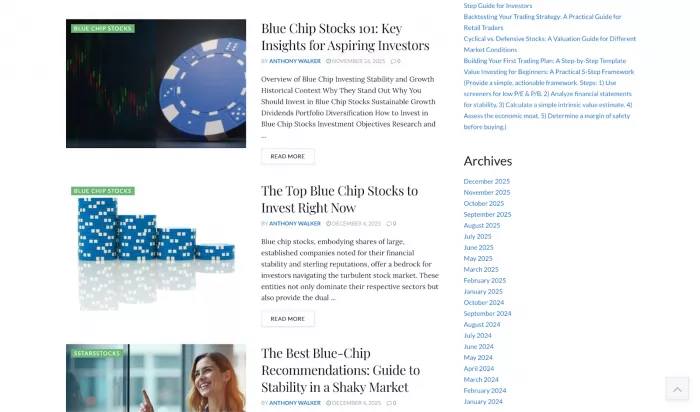
The “Blue Chip” category on the site is structured more like a content marketing funnel than a research module.
It features articles titled “The Top Blue Chip Stocks to Invest Right Now” and “Blue Chip Stocks 101,” both written in the same confident tone by staff writer Anthony Walker. The copy reads smoothly, and the list includes legitimate blue chips like Apple, Coca-Cola, and Johnson & Johnson.
However, analysis of their content and metadata shows several issues:
a) Repetition and keyword padding – The same phrases appear across different posts, hinting at SEO optimization rather than editorial depth.
b) Generic explanations – Descriptions of dividends, stability, and resilience are accurate but textbook-level. No valuation data or price multiples accompany them.
c) No disclosure – The articles mention stocks but never clarify whether these are paid placements, algorithmic picks, or independent editorial choices.
In short, the blue chip coverage functions more as surface-level education than as actionable research.
Below is a rating table derived from independent reviews and observed platform behavior.
| Evaluation Area | Score (out of 5) | Observations |
| Credibility of Content | ⭐⭐ | Reads well, but sources and data verification are missing. |
| Blue Chip Definition Consistency | ⭐⭐ | Uses standard names yet mixes them with speculative sectors. |
| Transparency | ⭐ | Ownership, methodology, and author credentials are undisclosed. |
| Educational Value | ⭐⭐⭐ | Provides basic investing literacy for beginners. |
| Performance Track Record | ⭐⭐ | Independent tests show roughly 35 % success rate, below index performance. |
| User Experience | ⭐⭐⭐⭐ | Clean interface, simple navigation, suitable for entry-level readers. |
| Trust & Compliance | ⭐⭐ | Average ScamAdviser score (~66/100), no regulatory registration. |
| Overall Rating | ⭐⭐½ | Decent for inspiration, unreliable for investment decisions. |
Articles reference financial concepts correctly but never cite original data or SEC filings. Claimed accuracy rates around 70 % have not been verified by any third-party audit. Without publication of model backtests or live portfolios, accuracy remains a marketing number, not a metric.
The platform lumps conservative and speculative sectors together. “Blue Chip” sits beside categories like Cannabis or Crypto Stocks, which dilutes the brand of safety the term implies. A true blue-chip filter would exclude high-volatility equities entirely.
The site hides its ownership behind privacy-protected WHOIS data. It also offers no contact details for analysts beyond first names. For an entity publishing investment opinions, that opacity is a major credibility gap.
Where the site succeeds is accessibility. The guides explaining dividend yields or diversification are genuinely readable. For beginners, this can serve as a gentle entry into financial vocabulary, provided they recognize it as education, not advice.
Across multiple pages, 5StarsStocks.com claims its AI models achieve 70 % pick accuracy. That figure appears repeatedly but never links to a transparent audit.
Independent reviewers who tested sample portfolios based on site recommendations found that:
❖ Only about 35 % of picks turned profitable over four months.
❖ Portfolios underperformed the S&P 500 by roughly 13 points.
❖ Some “strong buy” calls lost over 60 % during the same window.
In fairness, a few winners, particularly in lithium and income categories — delivered solid short-term gains, suggesting the algorithms can surface interesting names. But the variance is too wide to treat the platform as a primary decision engine.
When analyzing the two flagship pieces — “Blue Chip Stocks 101” and “The Top Blue Chip Stocks to Invest Right Now” — several editorial patterns emerge:
➢ Reused introductions: Nearly identical openings discussing stability and dividends.
➢ Predictable stock lists: Apple, Johnson & Johnson, Coca-Cola, and Berkshire Hathaway appear in almost every list.
➢ Absence of valuation logic: No discussion of P/E ratios, payout ratios, or growth projections.
➢ Strong visual marketing: Images show poker chips and financial graphs, merging gambling imagery with investing language.
While this aesthetic is engaging, it cheapens the notion of “blue chip” investing by making it feel like an entertainment theme instead of disciplined capital allocation.
External trust tools classify the site as “moderate risk.” It isn’t blacklisted, but neither is it endorsed by any regulator or exchange authority.
Red flags include:
User reviews echo the same themes: polished design, but pushy sales tactics and poor response times during volatile markets.
Until the company discloses its management or submits to independent auditing, its content should be treated as unverified commentary.
| Category | Strengths | Weaknesses |
| Accessibility | Straightforward design, clear categories, beginner-friendly tone. | Simplistic content may mislead users into overconfidence. |
| Educational Tone | Explains investing basics and common terminology. | Overlaps with SEO copywriting, lacking analytical rigor. |
| Idea Generation | Can surface mainstream large-caps worth independent review. | No proprietary insight beyond what is publicly available. |
| Performance Claims | Occasionally identifies trending sectors early. | Track record not verified, inflated accuracy claims. |
| Trust Factors | No major fraud evidence so far. | Hidden ownership and no regulation make due diligence essential. |
Treat it as a starting point, not a guidebook.
✔ Cross-verify every pick labeled “Blue Chip.” Check fundamentals on official sources like Morningstar, Yahoo Finance, or SEC filings.
✔ Ignore the star rating until methodology is disclosed. Ratings without data are opinions, not metrics.
✔ Do your own screening. Use established platforms with transparent models when evaluating large-cap stocks.
✔ View it as content marketing. The educational material is fine for learning definitions, but investing decisions should rest on independent research.
For experienced investors, 5StarsStocks.com might serve as a sentiment indicator — a reflection of what retail excitement clusters around. For newcomers, it’s a learning sandbox that must be accompanied by skepticism and external verification.
The pattern seen here is not unique. Many unregulated “AI stock-picking” sites blur the line between information portals and sales engines. They attract traffic through buzzwords like “machine learning” and “smart alerts,” but their inner workings remain opaque.
The danger lies in false precision — implying algorithmic certainty in a market defined by uncertainty. Reliable financial analysis demands transparency, not mystique.
5StarsStocks.com presents itself as a hub for quality stock discovery, but its blue chip coverage functions more like keyword-optimized education than rigorous research.
Its strengths lie in simplicity and accessibility. Its weaknesses are accuracy claims, transparency gaps, and conceptual stretching of conservative investing terms.
Bottom line:
Use it to learn the vocabulary of investing, not to build a portfolio.
| Verdict Summary | Rating |
| Overall Credibility | ⭐⭐½ / 5 |
| Reliability of “Blue Chip” Lists | ⭐⭐ / 5 |
| Educational Usefulness | ⭐⭐⭐ / 5 |
| Investment Research Value | ⭐⭐ / 5 |
The platform has potential as a financial content brand, but not as a trusted advisory voice. Until it opens its models to scrutiny and reveals its team, its “five-star” system remains more marketing metaphor than measurable truth.
In a market obsessed with instant insight, 5StarsStocks.com sells simplicity as sophistication. Its Blue Chip section borrows the language of safety while operating in a realm of speculation and opacity.
There’s value here but only for readers who know how to separate education from advice. A careful investor will treat the site’s ratings as a conversation starter, never a verdict.
True blue-chip investing demands patience, verifiable data, and transparent methodology, qualities that no star system can compress into a single score.

WhatsApp is preparing to allow third-party artificial intelligence cha...

BrandCrowd built its name as a go-to logo tool for small business...

There is a specific kind of disappointment that comes from opening a b...

AI companion apps have moved well beyond novelty status. What started...

Let’s start with an uncomfortable truth. Most people want their photos...

The U.S. Commerce Department is considering a new set of export contro...
Discussion