

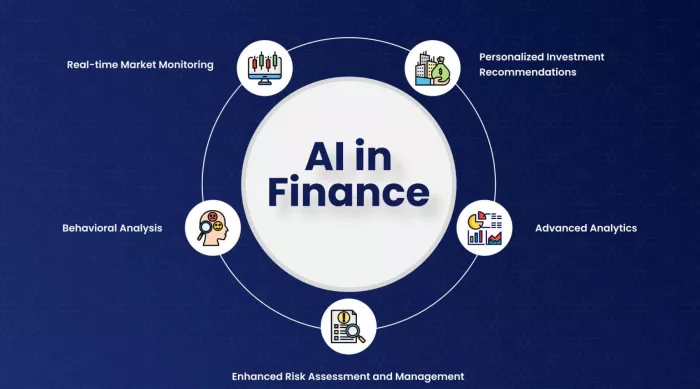
AI in finance refers to the use of computational algorithms — notably machine learning (ML), deep learning, natural language processing (NLP), and other forms of artificial intelligence — to perform tasks traditionally done by humans, especially where decisions can be improved by analyzing large volumes of data, learning patterns, or making predictions. In practice:
● AI systems learn from historical financial data and adapt (ML).
● AI systems interpret text or speech for tasks like compliance and customer support (NLP).
● AI systems optimize actions such as trading or credit decisions.
Purpose: to improve accuracy, speed, efficiency, and insights in financial operations.
| Use Case | What It Does | Data & Adoption Stats |
| Fraud Detection & Prevention | Detects anomalous transactions in real time to stop fraud before loss occurs. | ~87% of global financial institutions use AI for fraud detection as of 2025. 92% of fraudulent activities are intercepted before approval in some systems. False positives can drop 80%. |
| Risk Management (Credit & Market) | Predicts credit defaults, market risk, and operational exposures. | Over 60% of credit risk teams use ML to adjust risk thresholds; credit risk prediction accuracy improves ~30–50%. |
| Credit Scoring & Underwriting | Evaluates borrower creditworthiness faster and more accurately | AI credit risk models cover ~80% of all assessments; scoring accuracy improved by ~50% in some cases. |
| Algorithmic & Automated Trading | Executes trades automatically based on models and signals | AI trading algorithms account for ~70% of high-frequency trading volume. |
| Customer Service (Chatbots & Assistants) | Handles routine inquiries, basic financial tasks, and account help. | AI chatbots may manage up to 80% of routine queries; 65% of banking customers prefer AI-based chat support. |
| Regulatory Compliance (RegTech) | Automates document analysis, sanctions screening, and reporting. | AML detection increased by up to 65% with AI; KYC review times halved. |
| Operational Efficiency (Back Office) | Automates reconciliations, reporting, and accounting tasks. | AI in finance helps reduce compliance costs ~15% and approvals ~60%. |
| Financial Advisory & Personalization | Provides recommendations and personalized product offers. | Usage of AI advisory platforms has grown ~150% recently |
Current Adoption Rates
● AI usage in finance rose from ~45% in 2022 to ~85% by 2025.
● ~80% of financial institutions are investing in AI.
● ~87% of firms globally use AI for fraud detection.
Efficiency & Accuracy Gains
● AI reduces false positives in fraud detection by ~70–80%.
● AI credit scoring extends coverage to ~96% of consumer profiles vs. ~85% traditional.
● Risk analysis and early warning systems improve ~40%.
Cost Savings & ROI
● Compliance costs cut ~15% with AI automation.
● KYC review times can fall by 50%.
● Some institutions report ROI exceeding expectations on AI investments.
Market Size
● The global AI in finance market is projected to grow from ~$14.8 B in 2024 to ~$21.2 B in 2026.
Traditional rule-based fraud systems:
● Rely on static thresholds (amounts, locations)
● Generate very high false positives
● React after fraud patterns are known
AI systems:
● Learn transaction behavior in real time
● Adapt to new fraud patterns (concept drift)
● Score transactions probabilistically, not binary rules
| Metric | Traditional Systems | AI-Based Systems | Source |
| Fraud detection rate | ~65–75% | 85–95% | IJIRSS, CoinLaw |
| False positives | Baseline | ↓ 60–80% | SupaLabs |
| Time to detect fraud | Minutes–hours | Milliseconds | CoinLaw |
| Annual fraud loss reduction | — | 20–40% | McKinsey (bank disclosures) |
Why this matters:
False positives cost banks millions annually in customer churn, manual reviews, and reputational damage. Reducing false positives by even 50% often delivers ROI faster than revenue-side AI use cases.
Traditional credit models:
● Use linear/logistic regression
● Depend on limited credit bureau data
● Perform poorly for thin-file or new borrowers
AI credit models:
● Use non-linear patterns
● Incorporate alternative data (transaction history, cash flow)
● Adapt to macroeconomic changes faster
| Metric | Impact |
| Prediction accuracy | ↑ 30–50% vs traditional models |
| Loan approval rates | ↑ 20–35% without higher default |
| Default prediction lead time | ↑ by weeks/months |
| Underbanked population coverage | ↑ from ~85% to ~95%+ |
Important nuance:
AI does not reduce default risk by being “smarter” alone — it works because it:
● Detects interaction effects humans cannot model
● Re-scores continuously as borrower behavior changes
● Early warning systems (before losses occur)
● Stress testing using millions of scenarios
● Dynamic risk limits instead of static ones
| Area | Improvement |
| Risk forecasting accuracy | ↑ 35–45% |
| Capital allocation efficiency | ↑ 10–20% |
| Time to produce risk reports | ↓ 50–70% |
Key insight:
Most value comes from speed, not just accuracy — reacting days earlier in volatile markets can save more than marginal prediction gains.
● KYC document review
● Transaction reconciliation
● Regulatory reporting
● Customer onboarding
| Metric | Reduction |
| Compliance costs | ↓ ~15–25% |
| Manual review workload | ↓ 40–60% |
| Onboarding time | ↓ from days to minutes |
| Error rates | ↓ 50%+ |
Where data is strongest:
KYC, AML screening, and reconciliations — these are structured, repetitive, and highly auditable tasks.
● Predicts intent (why a customer is contacting support)
● Automates responses for common issues
● Personalizes offers based on behavior, not demographics
| Metric | Impact |
| Routine queries handled by AI | ~70–80% |
| Average response time | ↓ 60–90% |
| Customer satisfaction (CSAT) | ↑ 10–20% |
| Cost per interaction | ↓ up to 80% |
Critical reality check:
AI improves CX only when escalation to humans is seamless. Poorly designed chatbots lower satisfaction.
● Historical data reflects past discrimination
● Proxy variables (ZIP code, spending patterns) re-encode bias
● Models optimize accuracy, not fairness by default
● Discriminatory credit outcomes
● Regulatory violations (e.g., fair lending laws)
● Legal and reputational damage.
Mitigation approaches (industry practice):
● Bias audits before deployment
● Feature explainability checks
● Human override mechanisms
Many high-performing models (e.g., deep neural networks):
● Are not inherently interpretable
● Cannot easily explain why a decision was made
● Credit decisions must be explainable to regulators
● Customers have legal rights to explanations
● Black-box models create compliance risk
| Model Type | Accuracy | Explainability |
| Linear models | Lower | High |
| Tree-based ML | High | Medium |
| Deep learning | Highest | Low |
● Rapidly evolving AI regulations (EU AI Act, etc.)
● Model accountability unclear in many jurisdictions
● Cross-border data usage restrictions
● ~40–45% of finance leaders cite regulation as the top AI adoption barrier
● Compliance costs increase when AI systems are undocumented
● Deepfake voice fraud
● Synthetic identities
● AI-generated phishing at scale
● Nearly half of financial institutions report AI-enabled fraud attempts
● Traditional fraud systems often fail against deepfakes.
● Data engineering (often underestimated)
● Model monitoring and retraining
● Governance and audit infrastructure
● Scarcity of skilled ML + finance professionals
Only ~35–40% of AI finance projects meet ROI targets on time.
Failure reasons are usually organizational, not technical.
❌ Wrong: “We want to use AI”
✅ Correct: “We want to reduce fraud losses by 30% within 12 months”
Actions
● Identify measurable KPIs
● Define acceptable risk trade-offs
● Set regulatory constraints upfront
● Data completeness
● Historical depth
● Label quality (fraud vs non-fraud)
● Bias indicators
● Privacy compliance
| Use Case | Preferred Models |
| Fraud detection | Gradient boosting, neural nets |
| Credit scoring | Tree-based ML + explainability |
| AML/KYC | NLP + rule hybrids |
| Trading | Reinforcement learning (with controls) |
Mandatory Components
● Model documentation
● Decision logs
● Bias testing
● Human escalation paths
● Audit readiness
This is non-negotiable in finance.
● Run AI in parallel with existing systems
● Compare decisions, not just accuracy
● Monitor false positives, edge cases
Typical pilot duration: 3–6 months
● Integrate with existing core systems
● Ensure latency requirements are met
● Train staff on AI-assisted decision-making
● Model drift
● Bias drift
● Regulatory changes
● Fraud pattern evolution
AI in finance is never “set and forget”.
| Metric | AI in Finance (2025) |
| Firms using AI | ~80–87% |
| Fraud detection accuracy | ~90%+ |
| Chatbots handling inquiries | ~80% |
| Efficiency improvement | ~40–60% for risk/credit tasks |
| Market size projection | ~$21.2B by 2026 |
Q: Is AI widely adopted in finance?
A: Yes — ~80–87% of institutions are using AI to automate key functions.
Q: Does AI actually reduce fraud?
A: Empirical data shows AI systems detect up to ~92% of fraudulent activity before it happens, and reduce false flags significantly.
Q: Can AI replace financial analysts?
A: Some routine tasks may be automated, but human oversight remains essential, especially for nuanced judgment and compliance.
Q: Is AI risk-free?
A: No — it introduces security, bias, and regulatory challenges that must be actively managed with governance.
AI in finance works best when:
● Problems are well-defined
● Data quality is high
● Governance is strong
● Humans remain in the loop
AI fails when:
● Treated as a magic solution
● Deployed without compliance planning
● Optimized only for accuracy

Let’s start with a small truth about storytelling: writing the first s...

WhatsApp is preparing to allow third-party artificial intelligence cha...

BrandCrowd built its name as a go-to logo tool for small business...

There is a specific kind of disappointment that comes from opening a b...

AI companion apps have moved well beyond novelty status. What started...

Let’s start with an uncomfortable truth. Most people want their photos...
Discussion