

Amazon-owned Ring is taking a major step beyond its roots in home security by launching a new in-app marketplace that allows third-party developers to build and deploy AI-powered applications on top of its camera network.
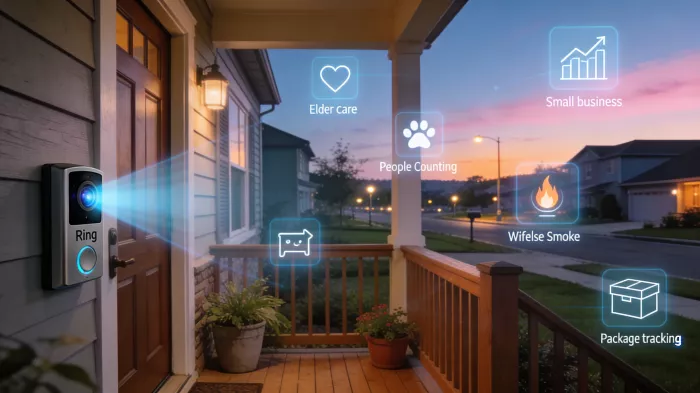
The new Ring Appstore, now rolling out within the Ring mobile app, introduces a platform model that transforms how the company’s cameras can be used. Instead of being limited to basic motion alerts and security monitoring, Ring devices can now support a wide range of AI-driven applications across industries such as elder care, business analytics, rentals, and even lifestyle use cases.
Ring has built one of the largest smart camera ecosystems in the world, with over 100 million devices installed globally. Until now, those cameras primarily powered Ring’s own features, including motion detection, package alerts, and smart home integrations.
With the introduction of the Appstore, Ring is opening that infrastructure to external developers for the first time.
The strategy reflects a broader shift. Ring is no longer positioning itself purely as a security hardware company. It is evolving into a platform where AI applications can interpret and act on real-world video data.
The company’s founder, Jamie Siminoff, has framed this as unlocking new possibilities for what cameras can do when combined with AI. Instead of focusing only on safety, the platform is now designed to support a wide range of practical and commercial use cases.
The Appstore appears as a new section within the existing Ring app on both iOS and Android devices. Users can browse available applications by category and connect them directly to their cameras or locations.
Categories include areas such as elder care, small business operations, rental monitoring, outdoor management, and pet tracking. Once selected, apps can analyze live or recorded video streams from connected devices.
Unlike traditional app marketplaces, the Ring Appstore does not handle payments directly. Users typically subscribe to services through the partner app or provider, allowing developers to avoid platform fees associated with Apple and Google’s in-app purchase systems.
This approach gives developers more control over pricing and monetization while keeping the Ring app focused on discovery and integration.
The Appstore is built around advances in computer vision and AI.
Instead of simply detecting motion, apps can now interpret what is happening in a scene. This includes identifying behaviors, objects, and patterns over time.
AI-powered applications can detect events such as falls, unusual movement, long queues in commercial spaces, pets entering restricted areas, or early signs of smoke and fire. These capabilities significantly expand the role of cameras from passive observers to active monitoring systems.
Ring has also introduced new AI-driven alerts, including “Unusual Event Alerts,” which learn typical activity patterns and notify users when something deviates from the norm. Another feature, Fire Watch, uses visual data to identify potential wildfire risks and share alerts within the Ring ecosystem.
Together, these developments position AI as the central layer that turns raw video into actionable insights.
The initial wave of apps highlights how far Ring is moving beyond traditional home security.
In elder care, applications can monitor daily routines and detect anomalies such as falls or irregular movement patterns, allowing caregivers to respond quickly.
In business environments, tools like queue monitoring and occupancy tracking help companies manage customer flow and staffing. These apps analyze video feeds to measure wait times, identify congestion, and improve operational efficiency.
Rental and property management apps focus on monitoring environments without intrusive indoor surveillance. They can detect unusual activity, potential damage risks, or noise issues in short-term rental properties.
Consumer-focused apps extend into lifestyle and hobbies. Some can identify birds captured on outdoor cameras, while others track package deliveries or monitor pet behavior when owners are away.
This diversity of applications illustrates the broader vision behind the Appstore. Cameras are no longer limited to security functions but are becoming data sources for a wide range of AI-driven services.
For developers, Ring is providing access to its underlying infrastructure through APIs and AI integration tools.
This allows third-party companies to build applications that use Ring’s camera feeds, event streams, and AI capabilities without having to develop their own hardware or cloud systems.
Developers can focus on building specialized AI models and business logic while relying on Ring for video capture, storage, and streaming. This significantly lowers the barrier to entry for creating camera-based applications.
The initial focus areas for developers include safety monitoring, business analytics, environmental tracking, and home automation scenarios. Over time, the ecosystem is expected to expand as more developers build niche applications on top of the platform.
The Appstore launch is part of a larger set of announcements made at CES 2026.
Amazon introduced several new features across its Ring ecosystem, including enhanced sensors connected through its Sidewalk network and advanced AI alert systems.
These updates align with the company’s broader strategy of embedding AI into physical environments. By combining cameras, sensors, and AI analysis, Amazon is creating a network of devices that continuously interpret and respond to real-world conditions.
The Ring Appstore plays a central role in this strategy by enabling third-party innovation on top of that infrastructure.
Ring’s move also places it in more direct competition with platforms like Google Nest and Apple HomeKit.
While those ecosystems rely on third-party integrations, they have not focused as heavily on building marketplaces specifically for camera-based AI applications.
By opening its platform, Ring is leveraging its large installed base to attract developers. With millions of cameras already in use, developers can reach a significant audience without requiring users to purchase new devices.
This creates a strong distribution advantage and positions Ring as a key player in the emerging market for AI-driven smart environments.
The expansion of AI capabilities raises important questions around privacy and data use.
Allowing third-party applications to access camera feeds introduces concerns about how data is handled, stored, and potentially used for training AI models. There are also questions about consent, particularly in environments such as workplaces, rental properties, and shared spaces.
Ring has stated that it will work with trusted developers and implement safeguards to protect user data. However, as the platform grows, managing these concerns will become increasingly complex.
There is also the risk of misinterpretation by AI systems. Incorrect detection of events such as falls or suspicious activity could lead to false alerts, which may reduce trust in the system over time.
The launch of the Ring Appstore marks a significant shift in how smart cameras are positioned in the market.
Instead of being standalone devices with limited functionality, they are becoming part of a broader AI ecosystem capable of supporting diverse applications.
For users, this means more flexibility and new use cases. For developers, it opens access to a large hardware base and new opportunities for innovation.
At the same time, it introduces new challenges around privacy, accuracy, and control.
What is clear is that Ring is no longer just a security brand.
It is becoming a platform for AI-driven interaction with the physical world.
Every meeting produces information that matters. Decisions get made, a...

AI note takers are tools designed to automatically capture what happen...
Most people meet Runway and Pika through short clips on social media....

South Korean President Lee Jae-myung has called for a deeper strategic...
AI avatar video tools are easy to get excited about.Type a script, pic...

Healthcare professionals are under constant pressure. Between patient...
Discussion