
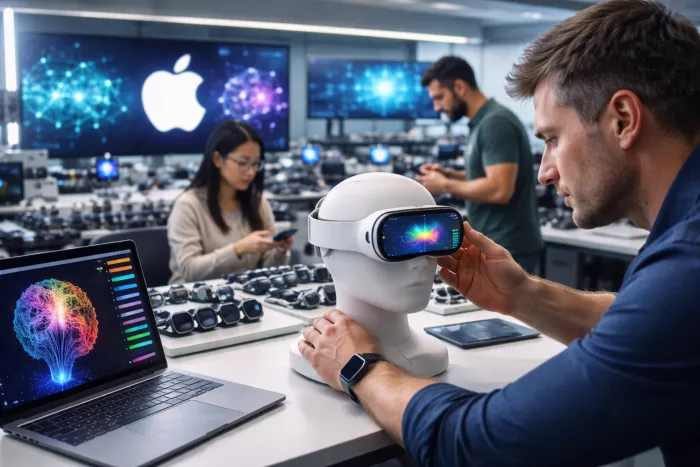
Apple is reportedly accelerating development of a new generation of AI-powered wearable devices, signaling a deeper push into the emerging “AI hardware” race. According to recent reporting, the company is simultaneously advancing smart glasses, an AI pendant or pin, and next-generation AirPods with enhanced artificial intelligence features.
The move reflects growing pressure from rivals such as Meta, Snap, Humane, Rabbit, and OpenAI, all of whom are experimenting with devices designed to bring AI assistance out of the phone and into everyday environments.
Unlike earlier Apple hardware cycles that focused on a single breakout product, the current effort appears to be a coordinated push across three form factors. Each device targets a different use case but shares a common goal: creating an always-available AI companion that understands the user’s surroundings in real time.
All three products are expected to rely heavily on Apple’s next-generation Siri and the broader Apple Intelligence stack, with the iPhone remaining the central hub for processing and connectivity.
The most advanced project is a pair of display-free smart glasses reportedly code-named N50. Rather than functioning as full augmented-reality eyewear, the device is said to focus on visual intelligence and environmental awareness.
The glasses are expected to include two cameras: one for capturing high-resolution images and video, and another dedicated to computer vision tasks. This setup would allow the system to analyze what the wearer is looking at and provide contextual responses.
Planned capabilities reportedly include:
Production could begin as early as December 2026, with a potential public release in 2027 if development stays on track.
Apple is said to be positioning the glasses as a more premium and polished alternative to current camera-first smart eyewear, competing directly with Meta’s Ray-Ban smart glasses and Snap’s upcoming Specs.

Alongside the glasses, Apple is reportedly working on a much smaller wearable: an AI pendant or pin roughly the size of an AirTag. The device would clip to clothing or be worn on a necklace.
The concept mirrors recent experiments in the market but would lean heavily on Apple’s ecosystem integration. Cameras and microphones would enable continuous environmental sensing, allowing the device to provide contextual help without requiring the user to pull out a phone.
While development is said to be accelerating, there is currently no confirmed production timeline. The device remains earlier in the pipeline compared with the smart glasses.
If released, the pendant would compete most directly with the Humane AI Pin and Rabbit R1, though Apple’s advantage would likely come from tight integration with iPhone services and Siri.
The third pillar of Apple’s strategy involves upgraded AirPods with new AI-driven capabilities. Earlier reports have suggested Apple is exploring the addition of tiny cameras to future earbuds, enabling some level of environmental awareness.
Potential features under development include:
The timeline for these enhanced AirPods appears to fall in the 2026 to 2027 window, roughly aligning with the broader wearable push.
This would place Apple in direct competition with rumored AI earbuds from OpenAI and other entrants looking to turn audio devices into intelligent assistants.
What connects the three devices is Apple’s apparent shift toward ambient, always-available AI. Rather than building a single breakthrough gadget, the company seems to be experimenting with multiple entry points into everyday life.
The common architecture reportedly includes:
The long-term vision appears to be an ecosystem where AI assistance follows users throughout the day, whether through glasses, earbuds, or wearable pins.
Apple’s acceleration comes as the AI hardware race intensifies.
Meta has gained traction with its Ray-Ban smart glasses. Snap is preparing new Specs for release later in 2026. Humane and Rabbit have already tested the AI-pin category, while OpenAI is widely rumored to be exploring AI-centric audio hardware.
In this context, Apple’s advantage remains its tightly controlled ecosystem and massive installed base of iPhone users. If the company can deliver seamless integration and polished hardware, it could quickly scale adoption.
Despite the momentum, all three products remain in prototype stages. Apple has not publicly confirmed the projects, and timelines could shift as development continues.
Key open questions include:
For now, the signals are clear. Apple is no longer treating AI as just a software layer inside the iPhone. It is preparing for a future where intelligence moves onto the body.
If the company executes well, the next wave of Apple devices may not just respond to commands. They may continuously understand what users see, hear, and do throughout the day.

WhatsApp is preparing to allow third-party artificial intelligence cha...

BrandCrowd built its name as a go-to logo tool for small business...

There is a specific kind of disappointment that comes from opening a b...

AI companion apps have moved well beyond novelty status. What started...

Let’s start with an uncomfortable truth. Most people want their photos...

The U.S. Commerce Department is considering a new set of export contro...

Discussion