

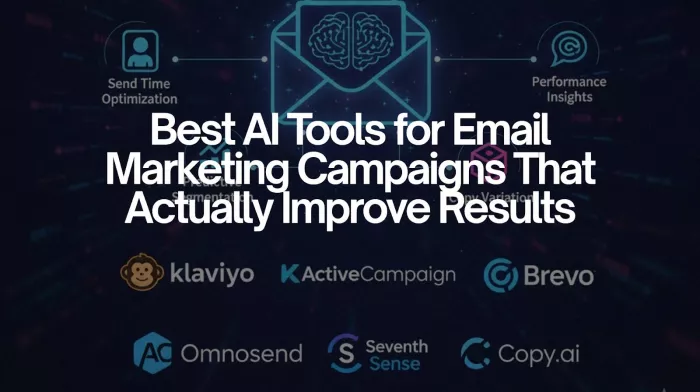
Email marketing still delivers one of the highest ROIs in digital marketing, but most campaigns underperform for predictable reasons. Subject lines get repetitive, lists grow without segmentation, send times are guessed, and optimization happens too slowly to matter.
This is where AI tools for email marketing campaigns are starting to make a real difference. Not by replacing marketers, but by improving decisions that humans consistently get wrong at scale.
This article focuses on real tools, what they are actually good at, and when they make sense to use. No hype. No magic claims. Just practical analysis.
One of the biggest mistakes teams make with AI in email marketing is expecting it to replace human thinking. In reality, AI performs best when it supports decisions, not when it tries to own them entirely.
Understanding this balance helps you choose the right tools and avoid disappointment later. The table below breaks down where AI consistently adds value and where human judgment still plays a critical role.
| Email Marketing Task | Where AI Performs Best | Where Humans Still Matter |
| Subject lines | Generating multiple variations and identifying performance patterns | Defining brand voice, emotional tone, and intent |
| Email copy | Drafting structures, CTAs, and test variants quickly | Final messaging, nuance, and brand alignment |
| Send timing | Analyzing engagement behavior at scale to find optimal delivery times | Deciding urgency, campaign windows, and exceptions |
| Segmentation | Clustering subscribers based on behavior and activity | Choosing which behaviors actually matter |
| Automation flows | Adapting paths dynamically as engagement changes | Designing the journey and business logic |
| Performance analysis | Identifying trends across large datasets | Interpreting why results changed and what to do next |

AI excels at processing patterns that are invisible at scale. Humans excel at context, strategy, and intent. When these roles are confused, results suffer.
Teams that struggle with AI driven email marketing often do one of two things. They either over automate without oversight or avoid automation entirely due to fear of losing control. The most effective teams sit in the middle.
They let AI handle repetition, pattern detection, and optimization while humans focus on clarity, relevance, and direction. This approach leads to better performance and far fewer surprises.
Keeping this balance in mind makes it easier to evaluate the tools that follow. You are not looking for software that replaces you. You are looking for software that helps you make better decisions faster.

Mailchimp is often the first platform businesses use, and its AI features are designed to feel incremental rather than disruptive.
Its AI helps with subject line suggestions, content drafting, predictive send times, and performance insights. The biggest strength here is accessibility. AI features are built directly into the workflow, which lowers friction for non technical users.
Mailchimp works best when the goal is gradual optimization rather than advanced modeling. The AI improves consistency and testing velocity, but deeper predictive features sit behind higher tier plans.
Best for small to mid sized businesses that want AI assistance without changing platforms or workflows.

Klaviyo approaches email marketing from a data first perspective. Its AI is deeply tied to purchase behavior, browsing activity, and customer lifetime value.
This allows Klaviyo to power predictive analytics, product recommendations, and behavior driven flows such as replenishment, win back, and VIP campaigns. The AI does not just help write emails. It helps decide who should receive which message and when.
The tradeoff is complexity and cost. Klaviyo is powerful, but overkill for simple newsletters or content only campaigns.
Best for ecommerce brands that want email to directly drive and measure revenue.
ActiveCampaign is built around automation depth. Its AI supports predictive sending, behavioral triggers, and content suggestions inside complex multi step journeys.
Where ActiveCampaign shines is adaptability. Subscribers move automatically between flows based on engagement, site actions, and CRM data. AI supports timing and prioritization rather than flashy copy generation.
The downside is a steeper learning curve. Teams need time to design and maintain these systems properly.
Best for businesses running long lifecycle campaigns that require personalization at multiple stages.

Brevo focuses on practicality. Its AI tools assist with copy drafting, basic segmentation, and campaign optimization, without pushing users into expensive tiers too quickly.
The AI here is more about productivity than prediction. It helps teams move faster, but it does not offer deep behavioral modeling or advanced send time intelligence compared to higher end platforms.
Still, for budget conscious teams, Brevo offers meaningful value.
Best for small businesses that need usable AI features without enterprise pricing.

Omnisend is built specifically for ecommerce workflows. Its AI supports product recommendations, cart abandonment, and purchase based segmentation.
What makes Omnisend effective is focus. Instead of trying to serve every use case, it optimizes a narrow set of revenue generating scenarios. Setup is fast, and results tend to appear quickly for stores with clean data.
It is less suitable for content publishers or B2B funnels.
Best for small to mid sized online stores that want fast deployment and predictable outcomes.
Seventh Sense is different. It does not write emails. It does not design campaigns. It focuses entirely on send time and frequency optimization.
Its AI models individual subscriber behavior to determine when and how often emails should be sent. This helps improve open rates, deliverability, and list health, especially for large or aging lists.
Because it integrates with existing platforms, it adds cost and complexity. But the performance gains can justify it.
Best for teams already happy with their ESP who want a specialized AI layer for timing.
Rasa.io uses AI to personalize content heavy newsletters. Instead of sending one version to everyone, each subscriber receives a unique mix of articles based on interests and engagement.
This reduces manual curation and increases relevance for information driven emails. However, it is not designed for promotional or ecommerce campaigns.
Best for associations, publishers, and organizations focused on education and content distribution.
AI has not changed the fundamentals of email marketing. The channel still succeeds or fails based on relevance, timing, list quality, and clear intent. What AI changes is how consistently those fundamentals are applied at scale.
The best AI tools for email marketing campaigns do not exist to replace strategy or creativity. They exist to remove friction from decisions that humans struggle to make repeatedly, such as choosing the right send time, identifying which subscribers deserve attention, testing more variations without burnout, and adapting campaigns as behavior changes.
What becomes clear when comparing these tools side by side is that there is no universal winner. Platforms like Klaviyo and Omnisend excel when revenue and ecommerce behavior drive campaigns. Tools like ActiveCampaign shine when journeys are complex and long lived. Mailchimp and Brevo serve teams that value accessibility and steady optimization. Specialists like Seventh Sense prove that sometimes one well solved problem can outperform broad feature sets.
The real mistake is treating AI as a shortcut. When data is weak, lists are unhealthy, or messaging lacks clarity, AI simply accelerates the wrong outcomes. When data is clean and intent is clear, AI becomes a force multiplier.
The most effective teams do not ask which AI tool is best. They ask where their campaigns are breaking down, then choose the tool that fixes that specific problem. That mindset matters more than any feature comparison.
Used with restraint and purpose, AI makes email marketing quieter, smarter, and more consistent. Used blindly, it just sends the wrong message faster.
That distinction is what separates results from noise.

Let’s start with a small truth about storytelling: writing the first s...

WhatsApp is preparing to allow third-party artificial intelligence cha...
BrandCrowd built its name as a go-to logo tool for small business...
There is a specific kind of disappointment that comes from opening a b...

AI companion apps have moved well beyond novelty status. What started...
Let’s start with an uncomfortable truth. Most people want their photos...
Discussion