


Web‑analytics platforms estimate blooket.com in the tens of millions of visits per month in 2025, placing it alongside Kahoot and Quizizz in overall traffic and classroom reach. Most of this usage comes from 10–15 minute review blocks—warm‑ups, exit tickets, and end‑of‑unit checks - where teachers lean on exportable stats like questions attempted, correct vs incorrect, and accuracy rate instead of full‑period gameplay.
Blooket’s join‑by‑code model and simple multiple‑choice format make it easy to automate. Public codes cut setup time but also allow outsiders or off‑task students to join with cheat tools the moment a code leaks beyond the classroom.
Cheat sites and GitHub projects cluster around four core capabilities:
Auto‑answer scripts that read questions and instantly select the correct option.
Flood bots that push dozens of fake players into a lobby in seconds.
Answer‑reveal helpers that highlight the correct choice on screen.
Crash scripts that deliberately destabilize or end live games.
Not all tools disrupt in the same way. A useful way to frame them is by three scores: impact on learning, time lost, and how hard they are to spot.
| Tool type | Learning impact (1–10) | Time lost (1–10) | Detection difficulty (1–10) |
|---|---|---|---|
| Auto‑answer scripts | 8 | 4 | 6 |
| Flood bots | 7 | 9 | 5 |
| Answer‑reveal helpers | 6 | 3 | 7 |
| Crash / disruption | 5 | 8 | 4 |
Auto‑answer and answer‑reveal tools most directly distort accuracy data, while flooders and crash scripts mainly wipe out the limited 10–15 minute review window that Blooket is designed for.
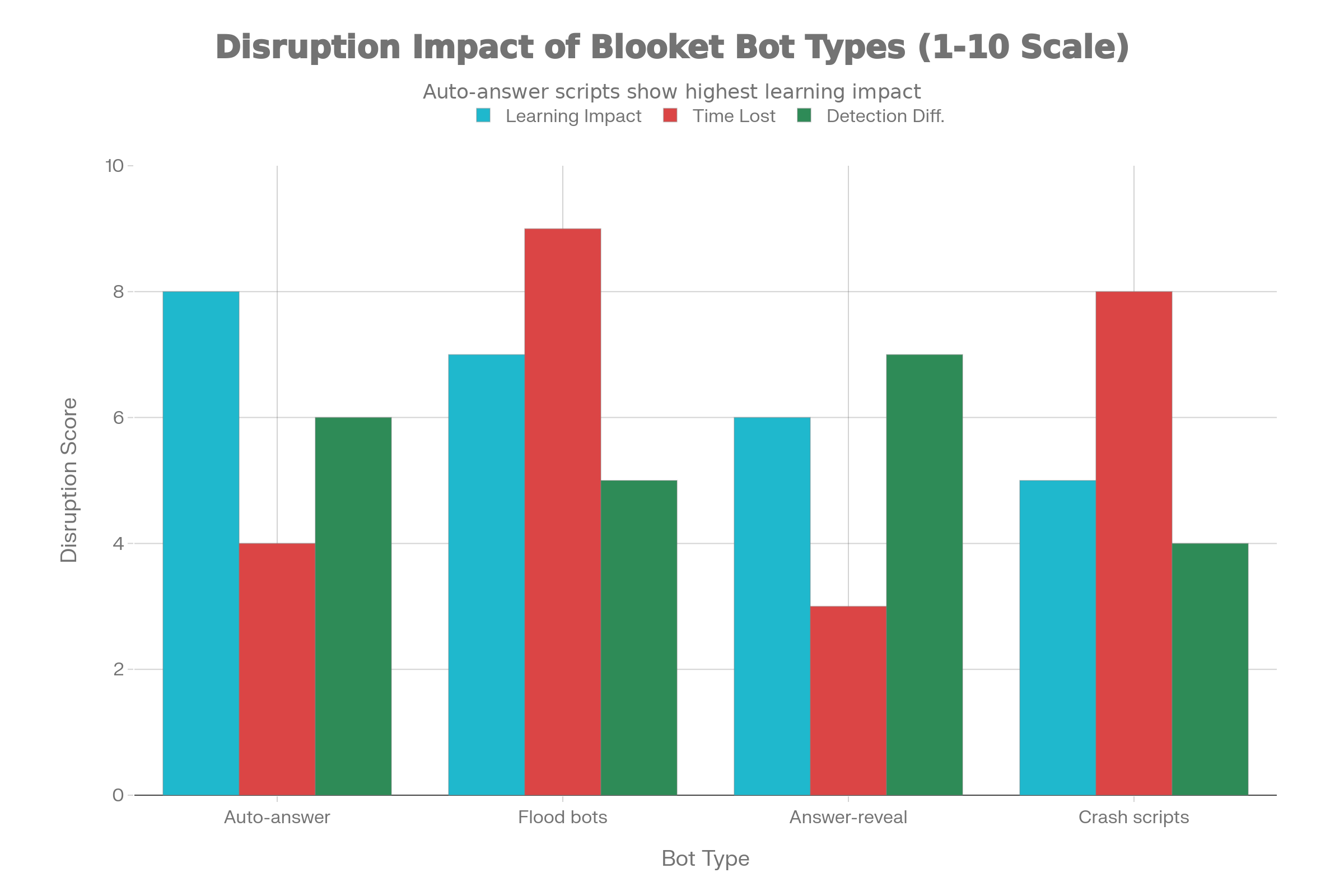
Relative disruption impact of different Blooket-related bot and cheat tools
Teacher reports and aggregated commentary point to a clear directional shift once bots become common: engagement drops, distraction and cheating rise. A reasonable classroom model for a 25‑student session looks like this:
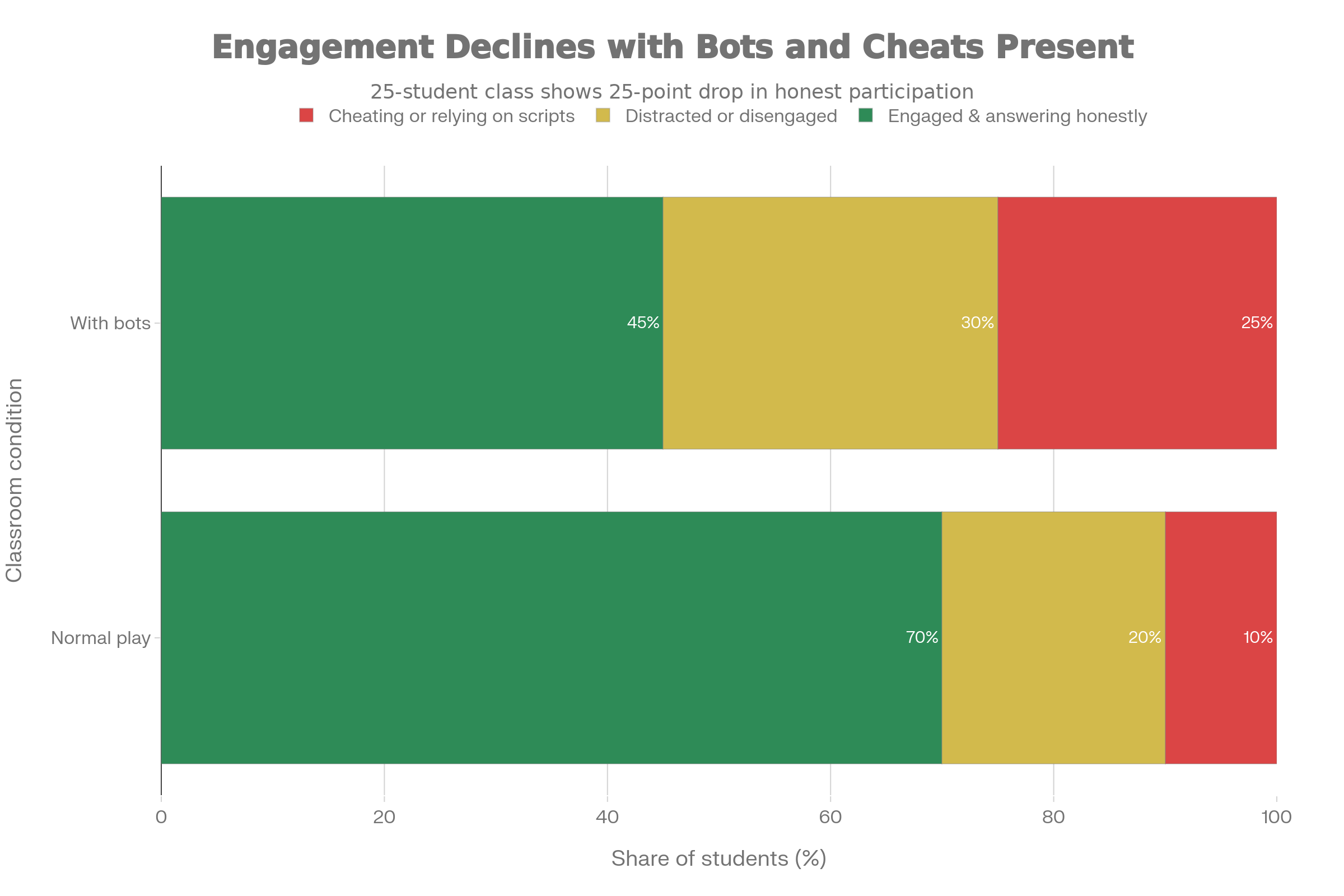
That change shows up as more arguments over “rigged” leaderboards, more students “testing” scripts instead of thinking, and less trust in Blooket as a meaningful check for understanding.
The practices that consistently reduce bot interference are structural rather than technical tricks.
Tighten access: use private or rostered codes and require school logins so abnormal behavior maps to a known account.
Pick accuracy‑first modes: Classic, Fishing Frenzy, and Racing tie progress closely to correct answers, reducing the payoff for chaos‑driven play.
Reward accuracy, not just rank: give credit for hitting accuracy thresholds or improvement, which undercuts the incentive to rely on auto‑answer tools.
Estimated distribution of student behavior in Blooket sessions with and without bots
Treat cheat sites as safety risks: block known domains on school networks and explain, in age‑appropriate language, why copying random scripts is a security issue as well as cheating.
The data points tell a consistent story: Blooket has true scale—tens of millions of visits per month and widespread 10–15 minute classroom use—but open public codes, drama‑heavy modes, and leaderboard‑only rewards create ideal conditions for bots and bad behavior. When teachers pair Blooket with controlled access, accuracy‑driven incentives, and basic network filtering, the platform is far more likely to deliver what it promises: a quick, lively, and reasonably honest snapshot of what students actually understand
Do your emails often get ignored and end up unopened in crowded inboxe...
Homework used to take time. You had to go through books, notes, and di...
There is a very specific kind of confidence that comes from generating...
If AI could understand vibes, we wouldn’t be writing essays as prompts...

Hospitals are beginning to see measurable reductions in waiting times...
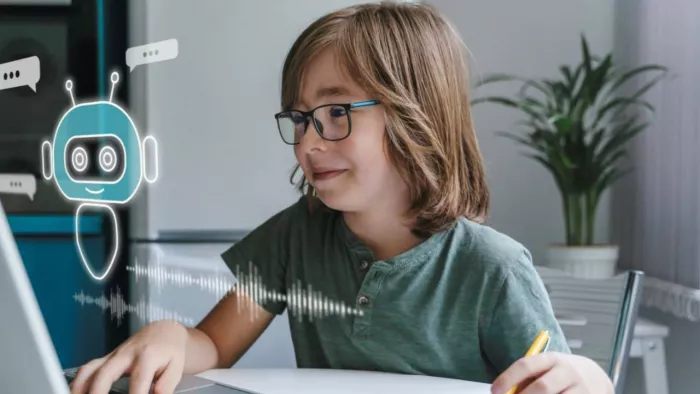
Artificial intelligence has quickly become part of everyday learning....
Discussion