

Cramly AI presents itself as a study assistant built to reduce writing time, generate long essays with citations, and help students overcome writer’s block. On paper, it looks like an efficient shortcut for academic tasks, offering tools for essay drafting, paraphrasing, summarizing, multiple choice support, and even AI detection checks. Its pricing is marketed as student friendly, with monthly, annual, and lifetime options that appear more affordable than many writing platforms.

But platforms designed for students cannot be judged by their feature lists alone. The real measure comes from how reliably they perform under pressure and how they treat users when something goes wrong. That is where the reviews tell a much more complicated story.
This article looks at Cramly through the lens of verified user experiences, not promotional claims, and then compares those impressions with competing tools that may better fit specific needs.
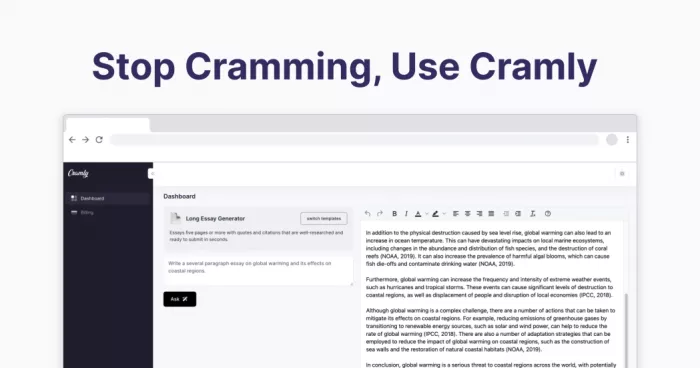
Cramly positions itself as an all in one writing and homework assistant capable of producing 5 page or longer essays, generating organized outlines, offering plagiarism free phrasing, and delivering answers to multiple choice questions. For students who struggle with long assignments or tight deadlines, the appeal is obvious. Reviews from satisfied users often mention that the platform helped them structure their thoughts, save time, or handle repetitive writing tasks more efficiently.
However, the platform’s ambitions create expectations that it does not always meet. The contrast between what Cramly advertises and what users report becomes the center of the reliability discussion.
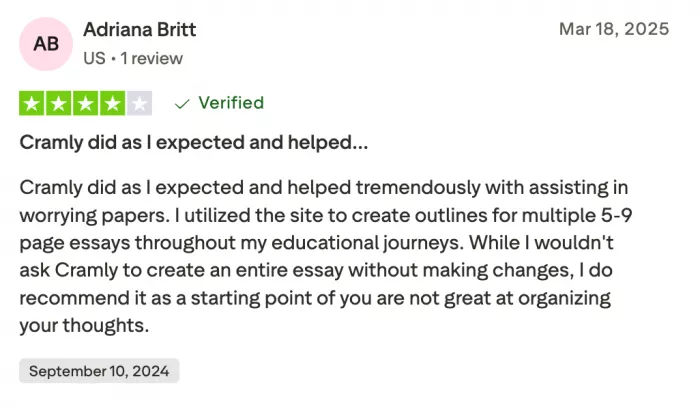
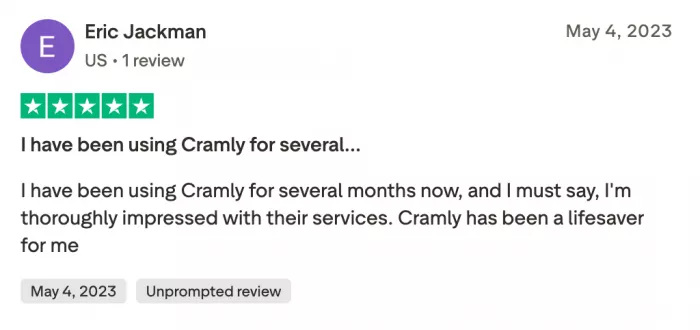
A subset of users describe Cramly as a practical tool that simplifies their workload. These reviews typically highlight concrete benefits rather than vague praise, which makes them more informative.
Several patterns emerge:
● Users who rely on Cramly for essay outlines, basic drafts, or intro level assignments tend to report positive experiences.
● Many appreciate the simple interface, noting that it requires very little setup or learning curve.
● Some users say it helps them understand their topic better, not just produce content.
● A few mention that Cramly is noticeably helpful for humanities writing, where answers depend more on structure than cold accuracy.
These experiences paint Cramly as a writing assistant that performs best when the task is straightforward and the user is comfortable revising and fact checking the results.
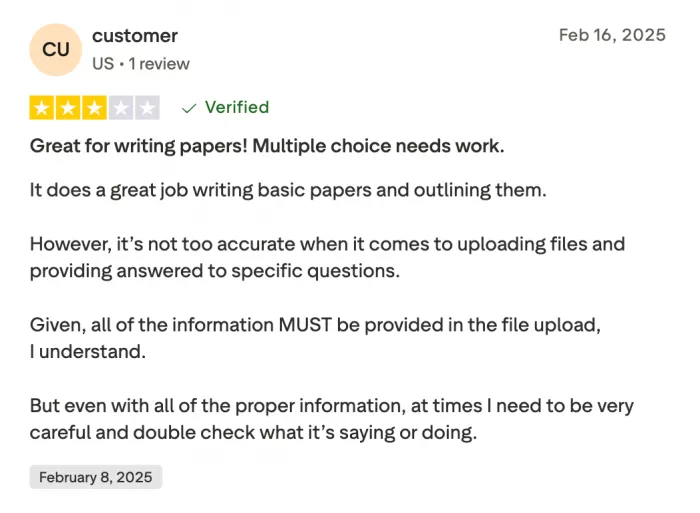
While positive reviews exist, negative feedback appears more consistently and covers a wide range of issues. These complaints offer insight into the platform’s weak points.
The most common problems reported include:
● Billing issues such as unauthorized charges or incomplete refunds.
● Lagging and error loops, especially after longer periods of use.
● Frequent inaccuracies when answering uploaded questions or solving multiple choice prompts.
● Incorrect or incoherent essay outputs, sometimes described as meaningless or jumbled.
● Declining performance where the service worked well at first but worsened over time.
One recurring theme is frustration with customer support. Several users report unresolved disputes, lack of refunds, or responses that did not address the underlying issue. Billing complaints appear more frequently than you would expect for a tool targeting students with limited budgets.
Another notable pattern involves accuracy problems. Users often mention that Cramly struggles when context is complex or when the uploaded material requires deeper interpretation. This makes the tool unreliable for higher level coursework.
Beyond individual complaints, certain structural patterns in the feedback raise broader concerns about reliability.
● A large share of recent reviews are one star, indicating dissatisfaction is not isolated.
● The platform carries a 2.5 to 2.7 TrustScore, which is low compared to similar writing tools.
● Several users report that the platform claimed subscriptions they never made.
● Others say the site became unusable on mobile, which is a problem for students who primarily work on phones.
● Some describe the service as helpful at first but progressively less stable.
These patterns do not automatically imply bad intentions, but they highlight inconsistencies that users should take seriously, especially when refunds and billing come into play.
Students with heavy writing workloads may benefit from Cramly’s outline and draft generation tools, especially if they are comfortable editing and verifying everything the AI produces. Users who only need occasional writing support may also find value in the lifetime plan.
However, students who rely on AI for precise answers, who expect error free workflows, or who worry about billing transparency may find the tool more trouble than it is worth. Those who work primarily on mobile devices are especially likely to encounter performance issues.
Cramly sits in a competitive field where other tools offer more stability, richer features, or better accuracy depending on use case. The following table summarizes how alternatives differ and why someone might choose them instead.
| Tool | Why Someone Would Choose It Over Cramly | Rating (5) |
| Jasper AI | Strong for branding, marketing content, and team collaboration. More stable and consistent for professional writing. | ⭐⭐⭐⭐ |
| Writesonic | Good mix of SEO tools, templates, and speed. Better for long form articles and blogs where structure matters. | ⭐⭐⭐⭐ |
| Copy.ai | Offers unlimited generation on most plans. Ideal for high volume writers and freelancers. | ⭐⭐⭐⭐ |
| HIX AI | Large suite of tools with an AI humanizer, exports, and multilingual support. More reliable for general everyday writing. | ⭐⭐⭐⭐ |
| Grammarly and Quillbot | Better for rewriting, clarity editing, and paraphrasing with fewer stability issues. Free tiers available. | ⭐⭐⭐⭐ |
| ChatGPT | Strong for conceptual clarity, brainstorming, math, coding, and in depth explanations. More flexible and accurate overall. | ⭐⭐⭐⭐⭐ |
None of these tools replicate Cramly’s attempt to produce long academic essays with citations, but they outperform it in consistency, accuracy, and error handling.
Cramly AI is neither a scam nor a miracle solution. It fills a niche for students who need quick drafts, outlines, or writing support, and it can genuinely reduce workload when used carefully. At the same time, user reviews highlight issues that cannot be ignored, including unreliable accuracy, frequent errors, and recurring billing disputes.
The clearest conclusion is this. Cramly works best for light assistance but is not dependable for tasks that require precision or stability. Students expecting flawless essays or perfect answers will likely experience disappointment.
If approached with realistic expectations and paired with manual editing and fact checking, Cramly can serve as a supplementary tool. If reliability is a priority, its alternatives offer more trustworthy performance.
Do your emails often get ignored and end up unopened in crowded inboxe...
Homework used to take time. You had to go through books, notes, and di...
There is a very specific kind of confidence that comes from generating...
If AI could understand vibes, we wouldn’t be writing essays as prompts...

Hospitals are beginning to see measurable reductions in waiting times...

Artificial intelligence has quickly become part of everyday learning....
Discussion