

I didn’t approach this thinking I was doing “content research.” I approached it the way most fans do: with curiosity, excitement, and a vague idea that it shouldn’t be that hard to make an OC that fits. That assumption dissolved quickly.
Dandy’s World has a deceptively simple surface. Big smiles. Rounded shapes. Familiar cartoon language. But the longer I stayed with it, the more I realized that this simplicity is a trap. The world only works because of what’s restrained, not what’s added. Every OC that fails usually fails by doing too much, too loudly, too fast.
This review comes from actually sitting with that tension.
Before starting, I assumed OC creation would be front-loaded with decisions and then taper off. Pick a concept, choose a look, assign stats, done. In reality, it was the opposite. The early steps were easy; the later ones were uncomfortable.
At the beginning, ideas came too quickly. Everything felt usable. Every concept seemed clever enough to try, and that abundance created a false sense of progress. I mistook motion for momentum. It wasn’t until I reached the later stages, when choices had to exclude other choices, that the process slowed to a crawl.
The hardest part wasn’t generating ideas, it was deleting them. I found myself attached to concepts simply because I liked them, not because they belonged. Each time I cut something, it felt like I was losing potential, even when keeping it would have weakened the character. That constant self-editing created a kind of mental friction I hadn’t anticipated.
What surprised me most was how this friction reshaped my relationship with tools. I stopped judging them by how much they offered and started judging them by how well they forced restraint. I realized very early on that Dandy’s World punishes excess, even when that excess is imaginative. And most tools, by design, encourage you to keep adding rather than refining. That mismatch is where many OCs quietly fail.
Visual builders gave me instant gratification. I could see a Toon forming in front of me within minutes, and that felt productive. I experimented with proportions, smiles, gloves, body shapes, color saturation. Everything felt right on a surface level, like I was checking all the boxes that define the Dandy’s World look.
At first, this speed felt empowering. I could iterate quickly, discard versions without consequence, and move on. But over time, I noticed something subtle and uncomfortable: the speed was preventing reflection. Decisions were being made because they were available, not because they were meaningful.
After a while, my choices stopped feeling intentional. The available options began steering me. When I tried to push beyond them, by imagining a posture, expression, or silhouette that didn’t quite fit. the tool pushed back. I wasn’t designing anymore. I was selecting from a finite menu.
The real issue wasn’t repetition. It was constraint disguised as freedom. I could create many characters, but not many distinct ones. That realization explained something I had noticed in the community but never articulated: why so many OCs look perfectly fine on their own, yet blur together when placed side by side. The tools flatten difference, even when they appear flexible.
The turning point came when I tried to explain my OC to someone without showing them the image. I struggled. I could describe what they looked like, the colors, the face, the general vibe, but not who they were or how they would behave under pressure.
That gap was revealing. In Dandy’s World, visual design isn’t just decoration. It’s supposed to hint at behavior, risk, and eventual corruption. A smile isn’t just a smile; it’s a promise that something might go wrong later. If the look doesn’t imply consequences, it’s incomplete, no matter how polished it appears.
I realized that I had been treating visuals as an endpoint instead of an entry point. From that moment on, I stopped asking whether the OC “fit the style” and started asking whether it suggested a story without telling one outright. Did the design imply a flaw? Did it hint at a weakness that could be exploited? Did it feel stable, or barely holding together?
That shift raised the bar significantly. It meant accepting ambiguity and resisting the urge to explain everything. But it also made the character feel alive in a way no amount of visual polish ever had. That’s when I understood that in Dandy’s World, looking right is the minimum requirement, not the goal.
When I brought AI into the process, I wasn’t looking for answers. I was looking for resistance. I wanted something that would push back against my instincts instead of affirming them, and that’s exactly what happened.
Every time I ran an ability or stat spread through an AI prompt, it forced me to slow down and justify myself. Why is this character fast? Why are they both stealthy and durable? Why does their ability solve so many problems at once? These weren’t questions I had ignored deliberately, I just hadn’t asked them yet. AI made avoidance impossible.
What surprised me most was how often I rejected the output. Entire descriptions went unused. Abilities were rewritten or scrapped entirely. But those rejections weren’t wasted effort. Each one sharpened the character. By disagreeing with the AI, I was actually clarifying my own intent.
That’s when it clicked: AI wasn’t contributing creativity. It was exposing laziness. It highlighted where I had defaulted to “cool” instead of “necessary,” and where I had added complexity instead of meaning. Used properly, AI became less like a generator and more like a mirror, one that reflected every corner I tried to cut.
That alone justified its place in the workflow.
Mobile OC maker apps felt playful at first. Swipe, tap, assemble, done. There’s a certain charm in that immediacy, and I understand why these apps are popular, they remove hesitation. You don’t have to commit. You don’t even have to think very hard.
But the longer I used them, the more disposable everything felt. I wasn’t building anything I wanted to return to. I was producing outcomes without attachment. If something didn’t feel right, I didn’t interrogate it, I erased it and started over.
That difference matters more than it seems. Restarting avoids reflection. It trains you to bypass discomfort instead of working through it. Over time, I realized that the apps were conditioning me to treat characters like temporary objects rather than evolving ideas.
In Dandy’s World, characters gain weight through friction. They become interesting because something resists, a limitation, a flaw, a constraint. Mobile apps remove that resistance entirely. For casual play, that’s fine. For meaningful creation, it’s a dead end. Nothing sticks long enough to deepen.
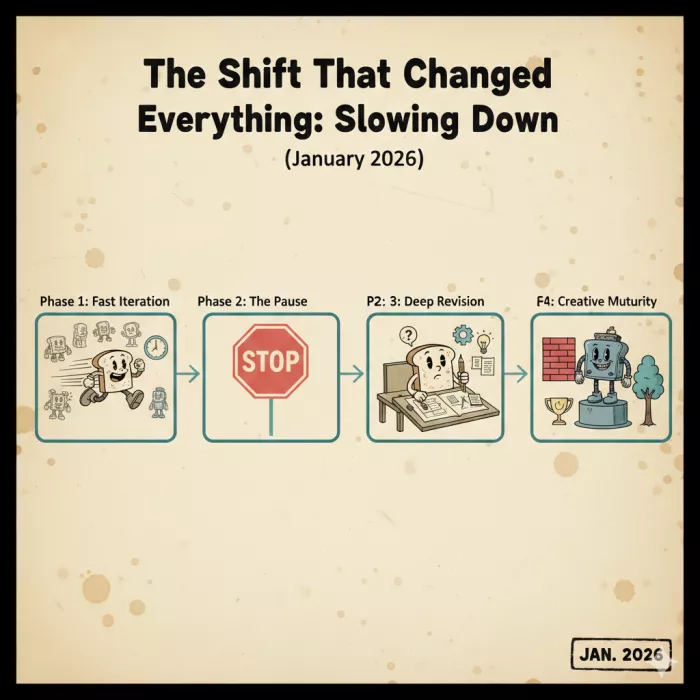
The biggest improvement in my OC didn’t come from a better tool. It came from stopping.
Instead of producing finished answers, I let ideas sit unresolved. I wrote notes instead of committing to final traits. I allowed contradictions to coexist without immediately fixing them. For the first time, the character felt unstable, and that instability was productive.
Slowing down made weaknesses impossible to ignore. It also made strengths less obvious, which paradoxically made them better. The character stopped shouting for attention and started implying things quietly. Details emerged naturally instead of being forced.
This pause also changed how I evaluated my own excitement. If an idea only felt good in the moment, it usually didn’t survive overnight. The ones that stayed interesting after time passed were the ones worth keeping.
That’s when I understood something fundamental: this is where Dandy’s World lives. Not in explanation. Not in excess detail. But in implication, the sense that something is slightly off, and you’re not sure why yet.
Stats were where my design instincts were finally held accountable. I couldn’t hide behind aesthetics anymore. Numbers made the imbalance visible, and once it was visible, I couldn’t ignore it.
Early on, I kept nudging stats upward to make the character “viable.” Faster movement felt safer. Higher stamina felt forgiving. Better stealth felt smart. But taken together, those choices drained the character of tension.
When I finally locked in a stat spread that felt underpowered in one specific area, something shifted. The character suddenly needed others. They had reasons to hesitate, reasons to avoid certain situations, reasons to rely on the environment instead of dominating it.
That vulnerability gave the character stakes. It also gave them identity. They stopped feeling like wish fulfillment and started feeling like participants in a shared system with rules and consequences.
That’s when the design stopped being about what I wanted the character to be and started being about what the world would realistically allow them to survive as.
Designing the Twisted version wasn’t about adding horror, it was about removing safety. That distinction took me longer to understand than I’d like to admit. My first instinct was to escalate: sharper shapes, darker colors, exaggerated expressions. On paper, it all sounded right. In practice, it felt hollow.
My first attempt failed because it tried too hard to scare. It was loud, obvious, and self-conscious. The character looked like it wanted to be frightening, and that intention undermined everything. It felt theatrical rather than inevitable, like a costume instead of a consequence.
When I stepped back, I realized I was asking the wrong question. I wasn’t supposed to ask, “How do I make this scarier?” I was supposed to ask, “What makes this character feel safe right now?” Once I identified that, the smile, the posture, the familiarity, the path forward became clearer.
The second attempt worked because it didn’t escalate; it deteriorated. Familiar elements bent slightly instead of breaking. The smile didn’t stretch, it slackened, as if it no longer had the energy to perform. The posture didn’t contort, it collapsed, as though the character had given up holding itself together.
What made this version unsettling wasn’t what I added, but what I took away: confidence, symmetry, intention. The character looked less aggressive and more exhausted, less monstrous and more wrong. That restraint created unease instead of spectacle.
That’s when I understood why Twisted versions are such a litmus test. They reveal whether you understand the character at a structural level or only at a visual one. Horror in Dandy’s World isn’t about shock, it’s about erosion.
One of the hardest lessons was realizing that feedback isn’t always verbal. Early on, I paid too much attention to comments and not enough attention to silence. I assumed that no reaction meant neutrality. It doesn’t.
When something works, people engage differently. They don’t just say “cool.” They ask questions. They speculate about behavior. They imagine scenarios the character might struggle in. Sometimes they don’t comment at all, they just linger longer, or bring the OC up later in conversation.
When something doesn’t work, it’s ignored. Not rejected, not criticized, just passed over. That kind of silence is efficient and unforgiving. It means the character didn’t create enough friction to hold attention.
That silence taught me more than any critique ever did. It showed me that OCs are read quickly, intuitively, and with very little patience. The community doesn’t owe anyone engagement. Either a character resonates on first contact, or it disappears into the noise.
Once I understood that, I stopped chasing validation and started watching reactions more carefully. Engagement wasn’t about praise, it was about curiosity. If people were curious, the OC was doing something right.
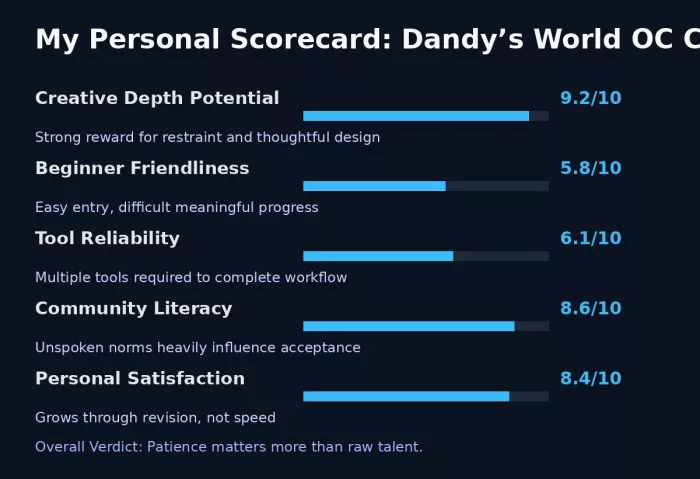
After living inside this process, my scoring system changed completely. I stopped measuring success in terms of polish or uniqueness and started measuring it in terms of sustainability. Could the character hold up if revisited weeks later? Could I imagine them failing? Could I imagine them being ignored by the world instead of centered within it?
From that lens, here’s how I honestly evaluate the experience:
Overall, the experience rewards patience more than talent. Skill helps, but patience decides whether the character survives beyond its first draft. The longer I worked within that reality, the more respect I developed for both the world and the people quietly maintaining its standards.
What stayed with me after all this wasn’t pride, it was respect. Respect for the designers who made Dandy’s World feel cohesive. Respect for the community that quietly enforces standards. Respect for the process itself.
A good OC isn’t impressive because it’s complex. It’s impressive because it knows when to stop.
That’s the lesson no tool teaches, and the one that matters most.
BrandCrowd built its name as a go-to logo tool for small business...

There is a specific kind of disappointment that comes from opening a b...
AI companion apps have moved well beyond novelty status. What started...
Let’s start with an uncomfortable truth. Most people want their photos...

The U.S. Commerce Department is considering a new set of export contro...

Amazon Web Services has introduced Amazon Connect Health, a new health...
Discussion