


Choosing the right software for your business can feel overwhelming. With so many options available, making the wrong choice can lead to wasted time, money, and effort. In 2026, businesses focus on balancing cost, features, and support to select tools that truly add value. This guide explains how modern companies evaluate software and provides a practical example to help you make informed decisions.
Software is no longer just a tool, it's a business investment. Selecting the wrong platform can result in:
● Lost productivity
● Frustrated employees
● Higher operational costs
● Poor integration with existing systems
In 2026, businesses are no longer picking software based solely on price or flashy features. Instead, they assess the total value, considering cost, features, and support together.
Price is important, but businesses now consider the total cost of ownership (TCO), which goes beyond the monthly or annual subscription. TCO includes:
● Subscription or licensing fees – monthly or yearly charges based on users or features
● Implementation costs – setup, data migration, and employee training
● Integration costs – connecting software to existing tools
● Hidden costs – add-ons, pay-per-use features, or overage fees
In 2026, businesses are willing to invest more upfront if the software reduces repetitive tasks, minimizes human error, or improves efficiency, as long-term ROI often outweighs initial expenses.
Additional Cost Factors:
● Scalability pricing: Software that charges per user or transaction may become expensive as teams grow.
● Platform lock-in risk: Switching costs if the vendor’s ecosystem is complex.
● Cloud vs on-premises costs: Cloud SaaS often reduces infrastructure costs but may increase subscription fees.
While features attract initial attention, relevance, usability, and innovation are prioritized over sheer quantity. Key questions in 2026 include:
● Does it solve your problem? The software should address core business needs effectively.
● Can it be customized? Adjustable dashboards, reports, and workflows improve adoption and usability.
● Will it scale? Software should grow with your team and operations without costly upgrades.
● Is it innovative? Features like AI-driven insights, predictive analytics, workflow automation, mobile-first design, and cross-platform integration are highly valued.
● Collaboration support: Multi-user access, version control, and team-based permissions are increasingly critical.
Additional Feature Considerations:
● Interoperability: Compatibility with existing tools, APIs, and data formats.
● Automation and AI: Reducing repetitive tasks, providing suggestions, and predictive analysis.
● Security features: Role-based access, encryption, and compliance with global regulations like GDPR, CCPA, or ISO standards.
A software with fewer but high-impact features often outperforms tools with extensive but poorly implemented options.
Even the best software can fail without reliable support. Businesses now evaluate vendors based on:
● Response time – how quickly support resolves issues
● Expertise – access to specialists for setup, training, or troubleshooting
● Resources – knowledge bases, tutorials, and AI-assisted help
● Reliability – frequent updates and active communities indicate long-term support
Many companies in 2026 prefer predictive support, where AI anticipates potential problems and resolves them before they impact operations.
Different businesses weigh these factors differently:
● Small businesses often prioritize low cost with adequate features and basic support
● Mid-sized companies look for feature-rich tools with reasonable costs and dependable support
● Large enterprises focus on scalable software with excellent support, even if it costs more
A common method is to score each factor and assign weights to make an objective decision.
Example: Choosing a Project Management Tool
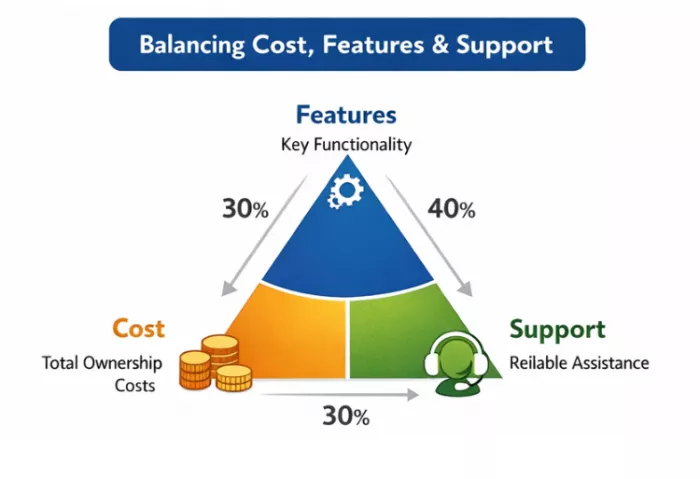
Imagine a mid-sized marketing agency evaluating project management software. They score three options on cost, features, and support, assigning weights of 30% to cost, 40% to features, and 30% to support:
| Software | Cost Score | Features Score | Support Score | Weighted Score |
| TaskPro | 8/10 | 8/10 | 7/10 | 7.5/10 |
| WorkFlowX | 7/10 | 9/10 | 9/10 | 8.7/10 |
| PlanEasy | 9/10 | 6/10 | 5/10 | 5.5/10 |
Even though WorkFlowX costs slightly more than PlanEasy, it scores higher overall because it offers strong features and excellent support, demonstrating how balancing all three factors leads to better business decisions.
Beyond cost, features, and support, businesses are increasingly evaluating:
● AI and automation: Tools that can predict tasks, optimize workflows, and suggest improvements.
● Security and compliance: Adherence to stricter regulations in data privacy, cybersecurity, and industry standards.
● Sustainability and ethics: Vendors’ environmental practices and ethical considerations influence purchasing decisions.
● Mobile-first design: Increasing demand for software accessible via mobile devices and hybrid work setups.
● Integration ecosystem: APIs, plug-ins, and marketplace availability for smoother multi-tool workflows.
● Trial periods and freemium models: Hands-on testing reduces risk before full investment.
● User adoption analytics: Software that tracks engagement helps businesses understand ROI and training needs.
1. Identify your needs first – Know which problems the software must solve
2. Score each factor objectively – Assign weights for cost, features, and support
3. Test before committing – Use free trials or demo versions
4. Check reviews and references – Learn from other businesses’ experiences
5. Consider long-term value over initial cost – Investing more upfront can save time and money later
Q: What is the most important factor when choosing software?
A: It depends on the business size and needs, but most companies balance cost, features, and support together for the best ROI.
Q: How do businesses weigh cost, features, and support?
A: By assigning a weight to each factor based on priorities and scoring software options, businesses can make objective decisions.
Q: Should small businesses prioritize cost over features?
A: Often, yes, but they should ensure basic support and core functionality are included to avoid future issues.
In 2026, selecting software is about finding the right balance between cost, features, and support. Businesses no longer just choose the cheapest or most feature-packed tool. They invest in software that saves time, improves efficiency, scales with growth, and offers reliable support.
By evaluating software objectively, using examples like the TaskPro/WorkFlowX comparison, and considering emerging trends like AI and automation, your business can make smarter decisions that drive success.

Do your emails often get ignored and end up unopened in crowded inboxe...
Homework used to take time. You had to go through books, notes, and di...
There is a very specific kind of confidence that comes from generating...

If AI could understand vibes, we wouldn’t be writing essays as prompts...

Hospitals are beginning to see measurable reductions in waiting times...

Artificial intelligence has quickly become part of everyday learning....
Discussion