


The internet has a strange habit of turning “quick explanations” into endurance events. A video titled “5 Minute Productivity Hack” often runs for half an hour, includes a motivational story, two tangents, and a sponsor segment before finally arriving at the actual tip. By the time the conclusion arrives, the viewer has already forgotten why they clicked the video.

This is not just a minor annoyance. Long-form video has become one of the dominant formats for education, commentary, and professional content. Podcasts often stretch beyond two hours, university lectures can fill an entire afternoon, and conference presentations frequently run longer than the average person’s attention span.
At the same time, people are dealing with an overwhelming volume of information. Every day, massive amounts of digital content are created across platforms, and professionals spend hours searching for the insights that actually matter. Most viewers are not trying to watch everything. They simply want the core ideas buried inside long videos.
That gap between information overload and limited time is where AI summarization tools have found their audience. Instead of sitting through an hour-long lecture or podcast, users can quickly scan a structured summary and decide whether the video deserves their attention.
Summarize.tech is a web-based AI tool designed to summarize YouTube videos into concise text. The idea is straightforward: paste a YouTube link into the site, press submit, and receive a structured breakdown of the video’s key points within seconds.
The platform is operated by Summarize, LLC and uses GPT-style language models to generate summaries that read like human-written notes rather than random fragments. Unlike many AI tools that come with dashboards and complicated workflows, Summarize.tech focuses on a single task.
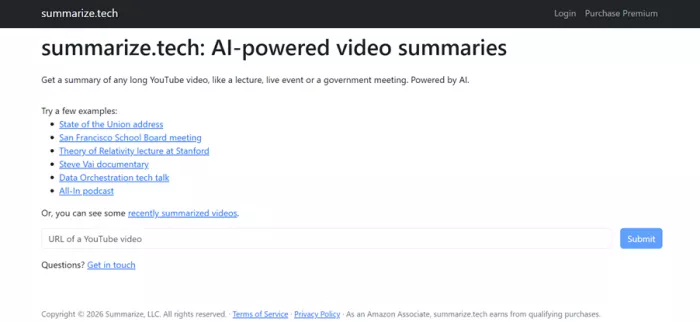
That simplicity is one of its strengths. Instead of navigating multiple menus, users interact with a single input box. Paste a video link, wait a few seconds, and the AI produces a summary with timestamps that correspond to sections of the video.
The website also includes a feed of recently summarized videos. Browsing through it reveals how people actually use the tool, from academic lectures and political speeches to tech podcasts and startup interviews.
| Attribute | Details |
| Tool | Summarize.tech |
| Category | AI video summarizer |
| Main Function | Summarize YouTube videos into structured text |
| Input | YouTube URL |
| Output | AI-generated text summary with timestamps |
| AI Engine | GPT / ChatGPT (OpenAI) |
| Operator | Summarize, LLC |
| Best For | Students, researchers, professionals, content creators |
| Free Tier | Yes (daily usage limits) |
| Premium | $10/month (unlimited daily, up to 200 videos/month) |
| Website | summarize.tech |
Despite the minimal interface, the technology behind Summarize.tech follows a fairly sophisticated pipeline. The first stage involves transcript extraction. When a user submits a YouTube link, the platform retrieves the video’s transcript from captions or subtitles.
This transcript forms the raw data that the AI analyzes. The tool does not actually watch the visual elements of the video. Instead, it processes the spoken text captured in captions. If the transcript is accurate, the AI has a reliable source to summarize.
The second stage involves natural language processing. The AI scans the transcript to identify patterns such as recurring topics, key arguments, and structural transitions in the discussion. This process is similar to how someone might outline a lecture while taking notes.
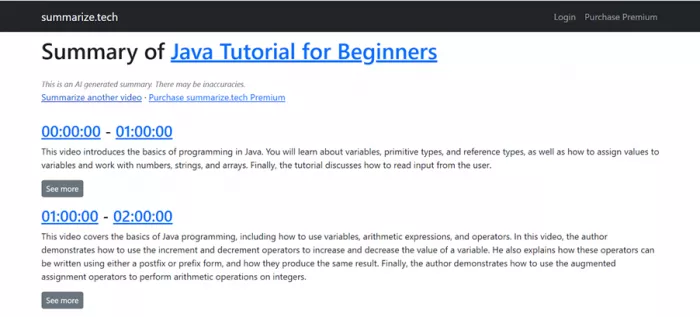
Finally, a large language model generates the condensed summary. The result is organized into timestamped sections that correspond to moments in the video. This structure allows users to skim the summary and jump directly to relevant parts of the original video if needed.
Opening Summarize.tech is refreshingly simple. The homepage presents a single text field where users can paste a YouTube link. There are no complicated menus or setup processes.
After submitting a link, the summarization process begins automatically. For most videos between 30 and 60 minutes, the tool generates a summary within roughly 10 to 30 seconds. The output typically includes short sections linked to timestamps in the original video.
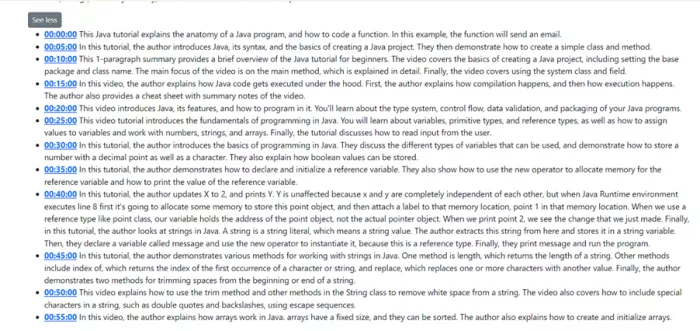
Clicking a timestamp allows users to jump directly to that point in the video. This makes the summary useful not only as a standalone overview but also as a navigation tool.
In general, the tool performs best with structured content such as lectures, presentations, and educational videos. In these cases, the summaries often capture the main arguments and supporting points clearly.
Some types of content are almost perfectly suited for AI summarization. Structured lectures, for example, often follow a logical sequence that is easy for AI models to analyze.
Conference talks and keynote presentations also translate well into summaries. These talks usually follow predictable structures with introductions, main arguments, and conclusions.
Podcast interviews are another interesting category. While not always perfect, summaries can capture the key topics of discussion and help listeners decide whether the full episode is worth watching.
Content types where the tool works especially well include:
AI summarization is useful, but it is not flawless. Some types of content are difficult to summarize accurately.
Short videos under five minutes usually gain little benefit from summarization. Reading a summary often takes almost as long as watching the original clip.
Entertainment videos are also challenging. Comedy sketches, music videos, and visual demonstrations rely heavily on visuals and timing. When these elements are converted into text summaries, much of the original value disappears.
Transcript quality also plays a major role. Videos with poor audio quality or inaccurate captions can produce flawed summaries. Since the AI relies on text transcripts, errors in captions often lead to inaccurate results.
The audience for AI video summarizers has expanded rapidly in recent years. Students represent one of the largest user groups.
University lectures, recorded seminars, and long educational videos can take hours to review. Summaries allow students to quickly identify the most important points before exams or research assignments.
Researchers and journalists also use summarization tools to scan large volumes of video content. Instead of watching every talk or interview, they can skim summaries to determine which videos deserve deeper attention.
Content creators use these tools in different ways. Many analyze competitor videos or industry talks to extract insights that inspire new content ideas.
Common user groups include:
Summarize.tech is part of a growing category of AI productivity tools designed to reduce the time required to process information. Instead of replacing content entirely, these tools help users filter large volumes of material.
Several platforms now compete in the AI summarization space, each offering slightly different approaches.
| Tool | Core Approach | Key Differentiator | Pricing |
| Summarize.tech | Paste YouTube URL, get structured summary | Simplicity, timestamped output | Free / $10 per month |
| Eightify | Chrome extension summarizing YouTube videos | Works directly inside YouTube interface | Free / $4.99 per month |
| NoteGPT | AI video summarizer with notes and mind maps | Batch summaries for multiple videos | Freemium |
| Glasp | AI highlight and summarization tool | Works across web, PDF, and YouTube | Free extension |
| YouTube AI tools | Built-in summarization features | Native platform integration | Premium features only |
The growth of these tools reflects a broader shift in how people consume information. Instead of committing to every piece of content, users increasingly rely on summaries to decide what deserves deeper attention.
AI summarization tools raise an interesting question about how people learn. If someone reads a summary instead of watching a full lecture, have they actually learned the material?
Summaries are extremely good at delivering information quickly. However, deeper learning often requires exposure to explanations, examples, and reasoning processes that may not appear in condensed text.
A more realistic approach is to treat summaries as filters. By skimming a summary first, users can decide whether a video is worth watching in full.
In many cases, this approach actually improves efficiency. Instead of spending hours on irrelevant content, viewers can focus their time on videos that truly matter.
AI summarization tools still have several limitations. One of the most common issues is the loss of nuance.
Complex arguments often rely on subtle conditions and relationships between ideas. When these ideas are compressed into short summaries, some of that nuance may disappear.
Another challenge is emphasis. AI models sometimes treat frequently mentioned topics as more important than they actually are, while overlooking brief but critical insights.
Finally, summaries simplify complex discussions. This simplification makes content easier to scan but sometimes reduces accuracy.
The internet produces more information than anyone can realistically consume. Every minute, massive amounts of video content appear online, and most people simply do not have the time to watch everything.
Tools like Summarize.tech attempt to solve this problem by compressing long videos into quick insights. They are not replacing long-form content or eliminating the need for deeper learning.
Instead, they are changing how people filter information. In a world where attention is limited and content is endless, the ability to quickly identify important ideas may become one of the most valuable digital skills.
1. What is Summarize.tech used for?
Summarize.tech is an AI tool that converts long YouTube videos into short text summaries, helping users quickly understand the main ideas of the video.
2. Is Summarize.tech free to use?
Yes, the platform offers a free tier with daily usage limits. A premium plan is also available for around $10 per month with higher limits.
3. How accurate are the summaries generated by Summarize.tech?
Accuracy depends largely on the quality of the video transcript. Educational and structured videos typically produce more accurate summaries than informal or conversational content.
4. Can Summarize.tech summarize any YouTube video?
The tool works best with videos that have clear transcripts. Videos without captions or with poor audio quality may produce weaker summaries.
5. Who benefits most from using Summarize.tech?
Students, researchers, content creators, and professionals who need to quickly review long videos often benefit the most from AI summarization tools.
6. Does Summarize.tech watch the video itself?
No. The system analyzes the video’s transcript rather than the visual content, which means the summary is based entirely on spoken text from captions.

Do your emails often get ignored and end up unopened in crowded inboxe...
Homework used to take time. You had to go through books, notes, and di...
There is a very specific kind of confidence that comes from generating...
If AI could understand vibes, we wouldn’t be writing essays as prompts...

Hospitals are beginning to see measurable reductions in waiting times...

Artificial intelligence has quickly become part of everyday learning....
Discussion