


Valant.io presents itself as a purpose-built, cloud-based EHR and practice management platform specifically for behavioral and mental health providers, rather than a generic medical software repackaged for this niche. It targets clinicians and practice leaders who want to streamline care delivery and operations while staying aligned with behavioral health–specific workflows and regulations.

After spending time going through the site, Valant clearly positions itself as a specialized, B2B SaaS EHR for behavioral health organizations of different sizes, from solo prescribers to multi-site groups and intensive outpatient programs. Its core promise is to combine clinical documentation, scheduling, billing, and outcome tracking in one platform so practices can “provide quality care” and “keep business running smoothly.”
The language throughout the site is tailored to mental and behavioral health, with references to IOP/PHP, measurement-based care, treatment plan templates, and evidence-based note types rather than generic hospital terminology. This makes it most relevant to U.S.-based outpatient, intensive outpatient, and partial hospitalization providers rather than broad medical practices or hospitals.
Behavioral health workflows differ substantially from general medical practice. Documentation is narrative-heavy, billing often involves nuanced coding, and long-term treatment planning is common. Many clinicians report friction when using broad EHR systems that are optimized for physical care rather than mental health.
Valant positions itself as a solution to this gap by designing its platform around behavioral workflows first, rather than retrofitting generic medical software.
At a high level, Valant combines four major functions into one system:
1. Clinical documentation (EHR)
2. Scheduling and practice operations
3. Billing and revenue management
4. Patient engagement and telehealth
The value proposition is consolidation: reducing the need for separate tools and minimizing context-switching during daily operations.
Valant’s EHR is structured to support behavioral health documentation rather than episodic medical visits.
● Customizable clinical note templates tailored to therapy, psychiatry, and medication management
● Integrated intake forms, assessments, and treatment plans
● Notes are accessible directly from the appointment view, reducing workflow friction
Practical observation: Clinicians who manage long-term patient relationships may benefit from having historical notes, assessments, and plans tightly connected. However, the depth of functionality can introduce a learning curve, especially for providers transitioning from simpler systems.
| Aspect | Valant Approach | Practical Impact |
| Note structure | Behavioral-specific templates | Reduces customization effort |
| Historical data | Longitudinal patient records | Helpful for ongoing care |
| Assessment tools | Integrated | Fewer external forms |
| Learning curve | Moderate to high | Training required |
Scheduling in Valant functions as more than a calendar. Each appointment acts as a launch point for related actions.
Capabilities include:
● Appointment-linked clinical notes and billing
● Management of prospective patients and waitlists
● Centralized view of provider availability across a practice
Potential trade-off: This integrated approach is powerful for mid-sized or growing clinics, but solo practitioners may find the system more complex than necessary for basic scheduling needs.
Billing is often cited as one of the most operationally demanding areas for behavioral health practices. Valant attempts to reduce administrative load through automation.
Billing features include:
● Automated claim creation and submission
● ERA processing and payment posting
● Dashboards for tracking billing status and outstanding balances
Balanced perspective: Automation can significantly reduce manual errors, but practices with unique billing arrangements or frequent exceptions may still require hands-on oversight. Some users note that mastering the billing tools takes time.
Valant includes built-in telehealth and patient portal capabilities, reflecting the shift toward remote and hybrid care.
Patient-facing tools typically include:
● Secure video sessions
● Online appointment management
● Digital intake and bill payment
Consideration: While integrated telehealth reduces reliance on third-party video tools, practices that already use specialized telehealth platforms may find Valant’s built-in option sufficient—but not necessarily superior.
Valant offers API access to support integrations with external systems such as analytics tools, data warehouses, or specialized third-party services.
This is particularly relevant for:
● Larger organizations
● Multi-location practices
● Groups with custom reporting or data needs
Smaller practices may never need this level of extensibility.
Valant does not publicly list pricing. Instead, costs are typically provided through direct consultation.
Implications of this model:
● Pricing can be tailored to practice size and complexity
● Budget forecasting is harder without upfront numbers
● Comparison shopping requires direct sales engagement
Onboarding and training are commonly part of the implementation process, which can be valuable—but also extends time to full productivity.
| Factor | Impact |
| Custom quotes | Flexible but opaque |
| Upfront visibility | Low |
| Budget predictability | Moderate |
| Best for | Established practices. |
Trust signals are present but subtle. Company identity, longevity, and behavioral health specialization are confirmed across LinkedIn and software directories, and third-party sites report solid aggregate ratings for the platform. On the site itself, unlimited access to a “live, local support team” with behavioral health expertise is highlighted as a differentiator, suggesting an ongoing service-oriented relationship rather than a purely self-serve tool.
That said, users should set expectations carefully:
● Treat the blog as vendor-aligned education: it offers real guidance, but it does so from the perspective of an EHR provider.
● Plan to ask detailed questions about pricing, integrations, data migration, and implementation support directly, since these are not outlined exhaustively on the surface pages.
● Use external directories and independent reviews to cross-check the on-site narrative, especially around usability at scale and support responsiveness over time.
● Behavioral‑health fit: Users repeatedly highlight that Valant “is behavioral health specific,” and that it feels designed for psychotherapy, psychiatry, group work, and outcome tracking rather than generic medicine.
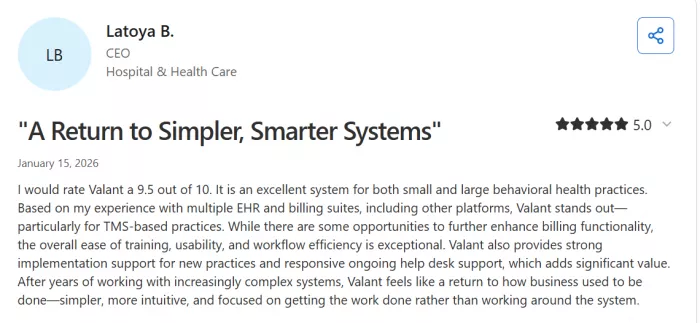
● Documentation speed: Several reviewers mention that templates and narrative‑style notes let them complete documentation quickly, sometimes describing charting as “very intuitive” and “saves me time in documentation.”
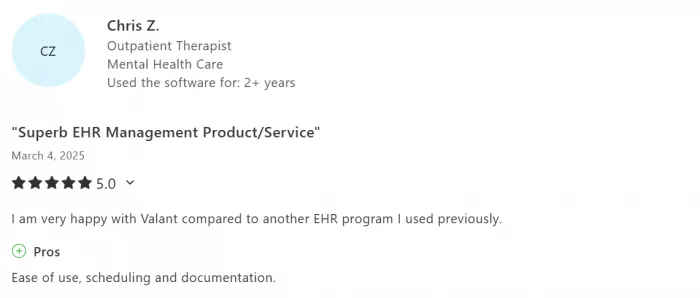
● All‑in‑one workflows: Clinicians and admin staff appreciate being able to chart, bill, and manage patient records in one place, with one reviewer calling the ability to “chart and bill at ease” a major advantage.

● Support and onboarding (when it goes well): Some practices report smooth implementation and “fantastic” IT support during setup, along with helpful training videos and resources that make the transition easier.
● Billing complexity and accounting frustrations: A vocal minority of users describe the billing system as confusing or overly rigid, with one accountant calling it “beyond stupid,” especially when it comes to handling more complex billing scenarios.
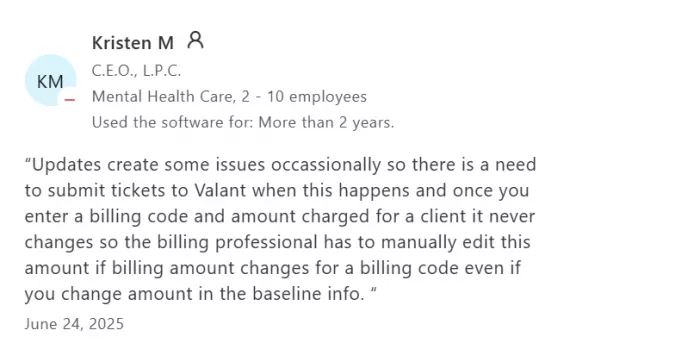
● Customer service inconsistency: While some users love support, others report slow responses, difficulty getting issues escalated, and frustration with accounting‑related communication, particularly when support leans heavily on email instead of quick phone resolution.

● Interface and workflow quirks: A subset of reviewers say parts of the interface feel dated or clunky, and that some clinical forms lack logical flow or miss specific elements like straightforward discharge notes or phone‑call documentation.
● Contract and licensing rigidity: A few reviewers mention that they could not easily decrease licensed users mid‑contract, leading to months of paying for inactive providers.
Valant tends to make the most sense for:
● Medium to large behavioral health practices
● Clinics with in-house billing operations
● Organizations planning to scale or add providers
It may be less ideal for:
● Solo practitioners seeking minimal setup
● Practices prioritizing low cost over integrated depth
| EHR | Best for | Pricing style | Standout strength |
| Valant | Mid–large BH groups, IOP/PHP | Custom quotes | BH‑specific workflows, outcomes, complex ops |
| TherapyNotes | Solo–mid therapy/psych groups | Transparent per user | Solid all‑in‑one, easy to learn |
| SimplePractice | Solo & small private practices | Public plan tiers | Very user‑friendly, strong client portal |
| Ensora (TheraNest) | Solo–group BH practices | Flat/simple pricing | Flexible forms, treatment planning |
| Sessions Health | Solo–small groups | Transparent tiers | Clean, simple, lightweight |
If you are a behavioral or mental health provider especially running an outpatient clinic, group practice, or IOP/PHP program, Valant.io is best understood as a specialized, long-standing EHR and practice management platform built around your specific workflows rather than general medicine. The site gives you a strong sense of its behavioral focus, feature set, and editorial stance, but leaves crucial operational details like pricing, integrations, and quantified impact for direct conversations and external research.
In day-to-day terms, the site is most useful for three things: understanding how a behavioral health specific EHR might structure your clinical and administrative processes, exploring educational content on practice management and regulation, and shortlisting Valant as one of several vendors to compare more deeply using demos and third-party reviews. Treated that way as a specialized, informative starting point rather than a complete decision hub, it can play a meaningful role in helping you shape your EHR strategy for behavioral health.

Do your emails often get ignored and end up unopened in crowded inboxe...
Homework used to take time. You had to go through books, notes, and di...

There is a very specific kind of confidence that comes from generating...

If AI could understand vibes, we wouldn’t be writing essays as prompts...

Hospitals are beginning to see measurable reductions in waiting times...

Artificial intelligence has quickly become part of everyday learning....
Discussion