

The AI landscape in 2025 and 2026 is evolving quickly. Users are no longer satisfied with tools that simply answer questions. The expectation has shifted toward assistants that can plan steps, call tools, and execute meaningful workflows in the background.

Modern AI platforms increasingly behave like junior digital operators. They browse the web, draft emails, schedule meetings, and manage multi step tasks with minimal prompting. This shift has quietly raised the bar for what counts as a capable AI assistant.
Against this backdrop sits Leeco AI, a specialized job hunting agent that still attracts steady interest among job seekers but rarely appears in broader AI discussions. That contrast raises a fair question. Is Leeco still quietly effective, or has the category widened faster than its design?
| Evaluation Lens | Leeco AI Approach | Modern AI Assistant Approach |
| Product philosophy | Single purpose career automation | Multi purpose digital assistant |
| Core user promise | Hands off job discovery and apply | Flexible task execution across domains |
| Integration style | Deep within job platforms and WhatsApp | Wide across productivity and business tools |
| Reasoning model | Structured pipeline logic | Open ended LLM reasoning |
| User effort required | Low after setup | Moderate depending on workflow |
Leeco AI is intentionally narrow but highly streamlined. It focuses on reducing job search friction rather than becoming a universal AI workspace.
Modern assistants are intentionally broad. They trade simplicity for flexibility and are designed to expand into multiple workflows over time.
Leeco AI positions itself as an AI career agent designed to put job hunting on autopilot. Its core promise is straightforward. It scans job platforms, filters roles based on your preferences, and alerts you on WhatsApp when something worth applying to appears.
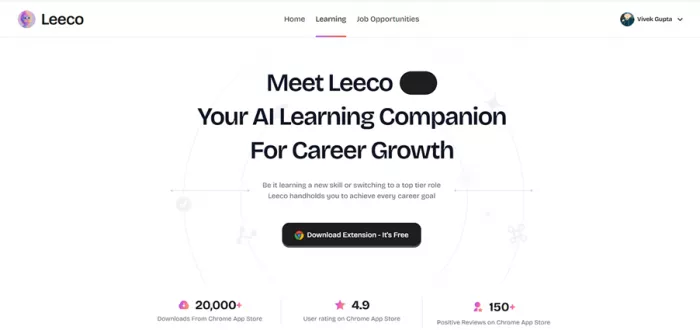
Once a match is found, the platform generates an optimized resume version tailored to the role and asks for one tap approval before submitting the application. For users applying at scale, this removes a large amount of repetitive searching and form filling.
The intended audience is very specific. Active job seekers who want coverage and speed without manually checking multiple portals. It is not designed to be a conversational AI or a flexible productivity assistant.
The broader AI market has moved decisively toward agent style systems. Leading platforms now focus on assistants that can reason through problems, plan multi step workflows, and interact dynamically with external tools.
Modern assistants commonly support web browsing, API calls, document analysis, and persistent memory. Many allow users to build custom workflows that connect calendars, email systems, and databases into automated loops.
This shift has changed user expectations. People increasingly want AI that completes tasks end to end rather than tools that operate within one fixed lane. Leeco remains efficient in its domain, but the surrounding category has clearly widened.
Leeco performs best where the workflow is clearly defined and repetitive. Within the job search pipeline, it automates multiple steps that job seekers typically handle manually.
Because these steps are tightly integrated, the experience can feel smooth for users applying to many roles each week.
General AI assistants take a platform first approach. They are designed to operate across many domains and often include tool ecosystems that allow deep customization.
These systems typically support long context reasoning, cross app automation, and live data retrieval. Users can extend them into writing, research, scheduling, coding, and business workflows.
The trade off is clear. Leeco optimizes depth in one pipeline. Modern assistants optimize breadth across many workflows.
| Capability Area | How Leeco AI Handles It | How Modern Assistants Handle It |
| Job discovery automation | Continuous background scanning | Usually manual or partial |
| Resume tailoring | Role aware optimization | User prompted generation |
| Referral support | Built in workflow | Typically manual research |
| Cross domain tasks | Not a core focus | Core strength |
| Tool extensibility | Fixed pipeline | User expandable |
| Workflow adaptability | Job search focused | Multi scenario capable |
Leeco delivers strong job velocity. Modern assistants deliver wider task flexibility.
In practical use, Leeco’s automation can feel refreshingly hands off. The system continuously scans job platforms and only interrupts the user when a relevant opportunity appears. For high volume applicants, this can reduce daily search fatigue.
The limitation appears when expectations expand. The platform is configuration driven rather than conversational, and it does not extend naturally into adjacent workflows such as interview prep or research.
There are also early trust signals worth monitoring. Some users have reported subscription friction in related Leeco offerings, so reviewing billing terms carefully is advisable before committing.
Based on the current checkout flow, Leeco uses a low entry trial followed by an auto renewing annual plan.

This structure is important for users to understand. The entry price looks minimal, but the long term commitment is annual and significantly higher.
From a value perspective, the model rewards heavy job seekers who actively use the automation. Casual users may find the yearly billing harder to justify if usage drops.
| Value Lens | Leeco AI Positioning | Modern Assistant Positioning |
| Entry cost | Very low trial barrier | Usually free tier or monthly |
| Renewal model | Annual auto billing | Monthly or usage based |
| Pricing clarity | Visible at checkout | Typically on pricing page |
| Best value scenario | High volume job hunters | Multi task users |
| Cost flexibility | Lower | Higher |
Important note: Users should pay close attention to the yearly renewal terms before starting the ₹1 trial.
Leeco continues to serve a meaningful niche. Users applying to large numbers of roles may benefit from the continuous scanning and one tap apply flow. If your main bottleneck is application volume, the automation can save measurable time.
It also suits users who prefer minimal interface complexity. There is no need to craft prompts or configure tool chains. Once preferences are set, the system runs largely in the background.
Another strong fit is for candidates managing dozens of parallel applications. The built in tracking dashboard reduces the need for manual spreadsheets.
Outside the job search lane, the capability gap becomes more visible. Modern assistants handle research, writing, scheduling, and cross platform automation in ways that single purpose tools cannot easily match.
They integrate directly with calendars, email systems, and databases, allowing workflows to evolve over time. This adaptability is where most innovation in the AI assistant space is currently happening.

If user needs extend beyond job applications, general AI assistants offer significantly more flexibility.
Leeco AI is not trying to be everything, and that is both its strength and its constraint. Within the job hunting workflow, it removes real friction and can meaningfully speed up application volume.
However, the broader AI assistant market has moved toward flexible, tool driven systems that operate across many domains. Measured against that wider standard, Leeco feels tightly specialized rather than future expansive.
If your only goal is to streamline job applications and you understand the yearly billing model, Leeco can still deliver solid value. For users seeking a flexible AI partner that grows with their workflow, modern assistants currently offer a broader runway.
BrandCrowd built its name as a go-to logo tool for small business...
There is a specific kind of disappointment that comes from opening a b...

AI companion apps have moved well beyond novelty status. What started...
Let’s start with an uncomfortable truth. Most people want their photos...

The U.S. Commerce Department is considering a new set of export contro...

Amazon Web Services has introduced Amazon Connect Health, a new health...
Discussion