

Every writer has had that moment. You open a blank document, stare at it for five minutes, and suddenly feel like becoming a farmer instead. So naturally, the logical solution is to let AI suffer instead.
This experiment was simple and slightly unfair. NovelAI would write an entire story from scratch using just one prompt. No edits, no guiding paragraphs, no “let me fix this one sentence” cheating. Just raw AI output from start to finish.
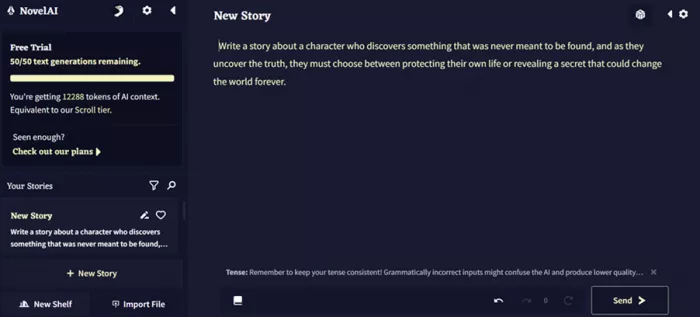
The prompt used was:
"Write a story about a character who discovers something that was never meant to be found, and as they uncover the truth, they must choose between protecting their own life or revealing a secret that could change the world forever."
The goal here was not to check if AI can write sentences. That part is easy. The real question was whether it can hold a story together without collapsing halfway like a badly written Netflix series.
Before the story even begins, NovelAI introduces you to its first feature: unexpected suspense.
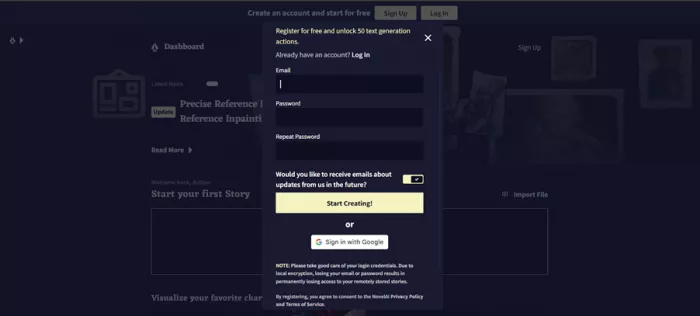
You get two login options:
Simple enough. But then comes the verification step, and things get… interesting.
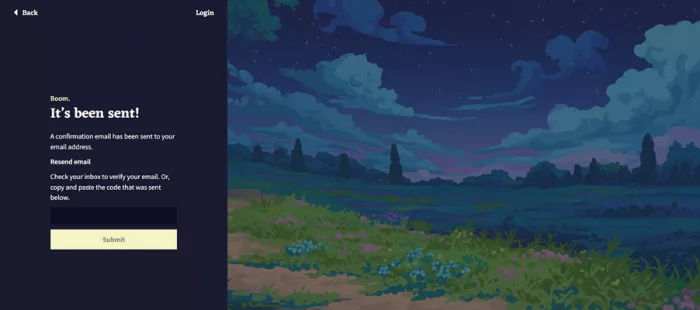
You are told to:
Naturally, you wait for the code. Nothing arrives. You refresh. Still nothing. At this point, you start questioning your life choices.
Clicking “verify email” leads to a blank screen, which is not exactly reassuring. The actual trick is something you discover only after mild frustration: you need to log in again after verification, and only then does it work.
It’s not broken, but it definitely feels like the platform wants to test your patience before letting you create worlds.
To keep things honest, this was treated like an actual experiment, not a “wow AI is cool” demo.
| Parameter | Setup |
| Genre | Literary sci-fi |
| Prompt | Single prompt only |
| Editing | None allowed |
| Tool | NovelAI |
| Goal | Full story generation |
| Evaluation | Coherence, creativity, consistency |
The idea was to remove all safety nets. No memory tuning, no lorebook entries, no adjustments. If NovelAI performs well, it does so on its own. If it fails, it fails publicly.
This matters because most AI demos are quietly assisted. This one wasn’t.
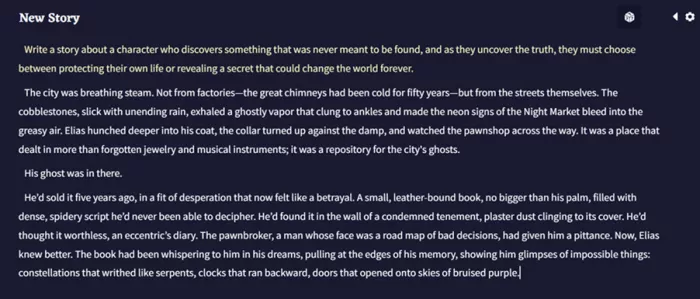
The story started strong. Surprisingly strong.
Instead of jumping straight into action, it leaned into atmosphere. The writing style felt poetic and reflective, almost like something you would expect from literary fiction rather than mainstream storytelling.
That’s both a strength and a limitation.
For readers who enjoy:
this works really well.
For readers expecting:
it might feel a bit heavy.
The important part is this: the output felt intentional, not random. It didn’t read like stitched-together sentences. It read like a story trying to say something.
As the story progressed, things remained mostly stable, which is already a win in AI storytelling.
But then small cracks started appearing.
The AI began introducing elements that didn’t fully connect to the original premise. Not completely wrong, just slightly unnecessary. It’s like the story decided to take a scenic route without telling you.
The tone also shifted slightly. The early sections were controlled and atmospheric, while the middle leaned more toward dramatic expansion.
This is where you realize something important. The AI is not “thinking” about the story. It is continuing it based on patterns. And sometimes, those patterns get a little adventurous.
Characters are where most AI tools struggle, and NovelAI is no exception.
| Element | Early Stage | Mid Stage | Late Stage |
| Character Voice | Clear and defined | Slight variation | Less distinct |
| Motivation | Strong | Loosening | Less focused |
| Dialogue | Natural | Repetitive patterns | Generic tone |
The protagonist begins with a clear identity and purpose. Decisions feel logical and grounded.
As the story continues, that clarity fades slightly. The character doesn’t become inconsistent, but it starts feeling more generic.
It’s like the character slowly forgets who they were supposed to be.
Now comes the most revealing part.
The ending.
Instead of building toward a powerful conclusion, the story suddenly accelerates. It wraps things up quickly, almost like the AI remembered it had another task to do.
The emotional weight built earlier doesn’t fully pay off. The resolution is technically there, but it lacks depth.
This highlights a key limitation:
AI is excellent at continuing stories. Finishing them properly is still a work in progress.
To test another feature, image generation was used with the following prompt:
"A cinematic anime-style illustration of a lone girl standing on a rooftop at sunset..."
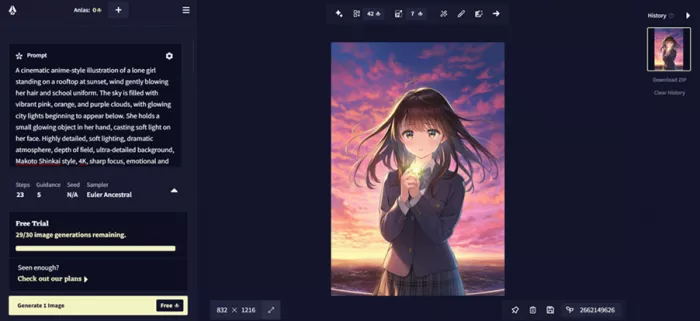
The result was impressive.
The output felt detailed and intentional, not generic. It captured the mood exactly as described.

In practical terms, the image generation side is reliable and performs well without much tweaking.
This is where things get slightly more serious.
NovelAI uses a combination of:
| Plan | Price | Key Benefits |
| Tablet | $10/month | Basic access, pay-as-you-go images |
| Opus | $25/month | Unlimited image generation*, higher usage limits |
Key differences:
This means the subscription is not just about access. It directly affects how much you can generate without additional cost.
| Anlas Pack | Price | Value |
| 2,000 Anlas | $4.79 | ~417 Anlas/USD |
| 5,000 Anlas | $8.19 | ~610 Anlas/USD |
| 10,000 Anlas | $13.99 | ~714 Anlas/USD |
The larger packs provide better value, which is expected. But heavy image generation can still consume tokens quickly if you are not on the Opus plan.
At first glance, pricing looks reasonable. But actual usage tells a different story.
If you:
Anlas consumption adds up quickly.
For casual users, Tablet works fine. For regular creators, Opus makes more sense due to unlimited generation benefits.
In short, the pricing is flexible, but not always predictable.
NovelAI is not here to replace writers. It is here to assist them, even if it occasionally forgets what it was doing.
What it does well:
Where it struggles:
The most honest conclusion is this:
AI can start a story beautifully. It can carry it fairly well. But finishing it with meaning still feels like a human responsibility.
Is NovelAI good for storytelling?
Yes, especially for literary and creative writing styles.
Can it write a full story?
Yes, but the ending quality may not match the beginning.
Is image generation worth it?
Yes, the output is accurate and visually strong.
Is it beginner-friendly?
Not entirely. Even login can be confusing initially.
Is it worth the price?
For creative users and storytellers, yes. For casual users, it depends on usage.
Do your emails often get ignored and end up unopened in crowded inboxe...
Homework used to take time. You had to go through books, notes, and di...
There is a very specific kind of confidence that comes from generating...
If AI could understand vibes, we wouldn’t be writing essays as prompts...

Hospitals are beginning to see measurable reductions in waiting times...
Artificial intelligence has quickly become part of everyday learning....
Discussion