

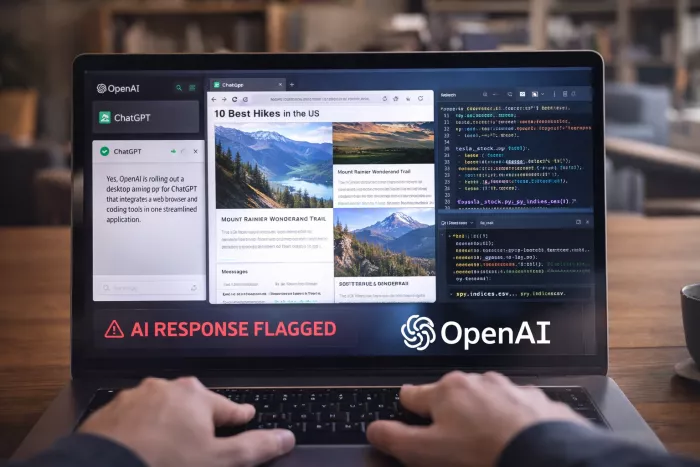
OpenAI is preparing a major shift in how its products are delivered, with plans to launch a unified desktop application that combines ChatGPT, its AI-powered browser, and the Codex coding assistant into a single workspace. The move aims to simplify what has become a fragmented product ecosystem and reposition OpenAI as a full-scale productivity platform rather than just a chat interface.
The proposed “superapp” reflects a broader strategy to reduce friction for users who currently switch between multiple tools for conversations, browsing, and development tasks. By consolidating these capabilities into one desktop environment, OpenAI is signaling a push toward deeper integration and more advanced, task-oriented AI usage.
At a time when competition from Microsoft and Google is intensifying, the company appears to be shifting from standalone features to a cohesive system designed for real work.
The planned desktop application will merge three core components of OpenAI’s current lineup into one interface.
This includes ChatGPT for conversational interaction, an AI-powered browser designed to assist with web navigation and research, and Codex, which focuses on generating and analyzing code. Instead of operating these tools independently, the new app will bring them together inside a single, unified environment.
The goal is straightforward. Reduce the need to jump between tabs, apps, and workflows. Users will be able to chat, search, and build within the same space, turning what are currently separate actions into a continuous experience.
This consolidation also addresses a growing issue within OpenAI’s ecosystem. As new products have been introduced, overlap between tools has increased, creating inefficiencies both for users and internally across teams.
The initiative is being led by Fidji Simo, OpenAI’s Chief Executive of Applications, who is overseeing the development and positioning of the superapp.
Internal discussions suggest that OpenAI sees its expanding product lineup as both an opportunity and a risk. While tools like Codex and the AI browser have gained traction, managing them as separate entities has created complexity in both development and user experience.
The new strategy centers on consolidation. Rather than spreading resources across multiple partially overlapping products, OpenAI intends to double down on what is working and deliver it through a single flagship application.
This approach also aligns with broader efforts to streamline execution, reduce duplication, and improve product coherence.
The superapp is not just about combining features. It represents a shift in how OpenAI wants its technology to be used.
Instead of functioning primarily as a conversational assistant, the new desktop app is being positioned as an “agentic” workspace. This means the AI is expected to handle more complex, multi-step tasks such as writing code, analyzing datasets, and assisting with ongoing projects.
The emphasis is on productivity rather than interaction. Engineering teams, developers, and business users are expected to be the primary audience, although the platform will likely remain accessible to general users.
By integrating browsing, coding, and conversation into one system, OpenAI is aiming to create a workflow where tasks can move seamlessly from idea to execution without leaving the application.

OpenAI already offers desktop versions of ChatGPT for macOS and Windows, but these are largely extensions of the chat interface rather than fully integrated work environments.
Current apps include features such as voice interaction, global shortcuts, and companion windows, but they do not provide a native coding environment or deeply integrated browsing capabilities.
Recent changes suggest that these existing apps are stepping stones toward the larger vision. For example, the company has begun phasing out certain standalone features, such as voice mode in the Mac app, in favor of building more unified experiences across platforms.
The upcoming superapp is expected to go further by combining multiple product layers into one cohesive system rather than adding incremental features to existing clients.
The timing of this move is not accidental. OpenAI is operating in an increasingly competitive landscape where Microsoft’s Copilot ecosystem and Google’s Gemini integrations are pushing toward similar all-in-one productivity environments.
A unified desktop application allows OpenAI to compete more directly at the system level rather than through isolated tools. It also opens the door for stronger enterprise offerings, where bundled capabilities can be packaged into cohesive solutions for teams and organizations.
Internally, consolidation also reduces the complexity of maintaining multiple overlapping products. By focusing on a single platform, OpenAI can streamline development and improve overall product quality.
Despite the growing clarity around the concept, several key details have not yet been publicly confirmed.
There is no official launch timeline, with reports only indicating that the company is preparing for a rollout. It is also unclear whether macOS and Windows versions will be released simultaneously or if one platform will take priority.
Pricing has not been specified, though it is likely to align with existing subscription tiers such as Plus, Team, and Enterprise rather than introducing an entirely new structure.
Another open question is the depth of the app’s “agentic” capabilities. While early descriptions suggest advanced task execution, it is not yet clear how deeply the system will integrate with local files, operating systems, or third-party applications.
OpenAI’s planned superapp marks a clear transition from standalone tools to an integrated ecosystem.
Over the past year, the company has expanded its offerings beyond ChatGPT, introducing new capabilities that extend into browsing and development. The challenge now is not innovation, but organization.
By bringing these tools together into a single desktop experience, OpenAI is attempting to redefine how users interact with AI on a daily basis. The focus is moving away from isolated prompts and toward continuous workflows.
If successful, the superapp could position OpenAI as more than just an AI provider. It could become a central layer in how work gets done on modern computers.
The introduction of a unified desktop app suggests that the next phase of AI development will be less about adding features and more about connecting them.
For users, this could mean fewer tools to manage and a more streamlined experience. For OpenAI, it represents a strategic effort to strengthen its position in a rapidly evolving market.
As AI continues to move closer to the core of everyday workflows, the question is no longer whether these tools will integrate. It is how quickly that integration will reshape the way people work.
Do your emails often get ignored and end up unopened in crowded inboxe...
Homework used to take time. You had to go through books, notes, and di...
There is a very specific kind of confidence that comes from generating...
If AI could understand vibes, we wouldn’t be writing essays as prompts...

Hospitals are beginning to see measurable reductions in waiting times...
Artificial intelligence has quickly become part of everyday learning....
Discussion