

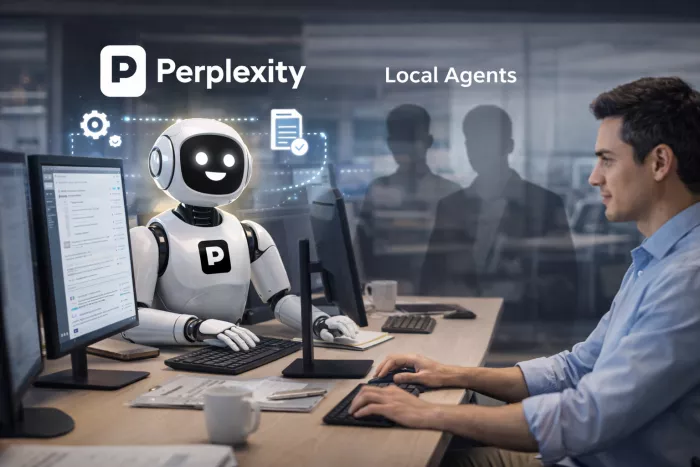
Perplexity has officially launched Computer, a cloud based “digital employee” designed to execute multi step work from a single high level instruction. Announced on February 25, 2026, the platform signals the company’s push beyond conversational AI toward fully autonomous workflow systems.
The product arrives at a moment when enterprises are weighing the benefits of cloud managed agents against local autonomous stacks such as OpenClaw. Perplexity’s pitch is clear: deliver powerful automation while reducing the operational and security burden that comes with self hosted AI agents.
Computer is positioned as a general purpose AI operator rather than a traditional assistant. Users describe the desired outcome, for example building a dashboard from a sales CSV, auditing hundreds of documents, or shipping a marketing site. The system then converts the request into a structured graph of tasks and subtasks.
From there, specialized sub agents are created for each node and run in parallel. These agents can browse the web, write and refactor multi file codebases, execute tests, generate assets, and return a deployment ready bundle at predefined approval checkpoints. The emphasis is on end to end execution rather than step by step prompting.
The platform is also designed to be resilient. If a sub agent encounters issues such as deprecated APIs, authentication failures, or missing dependencies, Computer can launch helper agents to troubleshoot and repair that portion of the workflow without stopping the broader project.
A notable design choice is Perplexity’s multi model orchestration approach. Instead of relying on a single foundation model, Computer routes work across 19 different AI systems depending on the task.
Claude Opus serves as the central coordinator, directing subtasks to models such as Gemini for API related work, lighter models for rapid classification, and specialized vision models for UI or chart generation. This conductor style architecture reflects an industry wide shift toward model routing to optimize performance and cost.
Computer is offered through a paid subscription with usage based credits and runs entirely in Perplexity’s cloud. Users do not need local GPUs, container setups, or custom infrastructure, lowering the barrier for teams that want autonomous workflows without building an agent stack internally.
OpenClaw represents the opposite philosophy. The open source autonomous agent is designed to run locally on user controlled machines, enabling deep system level automation. It can connect directly to email accounts, calendars, local files, terminals, and installed applications with persistent memory that remains on the device.
Developers using OpenClaw decide which large language models to integrate via their own API keys and define the level of operating system access the agent receives. This flexibility provides full data ownership and infrastructure control but increases the burden of secure configuration.
Industry analyses have noted that local agents can effectively perform any action available to the user account they operate under. Without careful sandboxing and monitoring, that power introduces risks such as prompt injection, excessive file access, or compromised plugins.

Coverage from multiple industry observers frames the Perplexity Computer versus OpenClaw decision as a classic convenience versus control trade off.
Perplexity Computer is designed as a turnkey service. Workflows run inside isolated cloud sandboxes, connectors provide scoped access to data sources, and sensitive operations require explicit user approval. Credentials are session bound rather than stored indefinitely, which the company presents as a built in safety measure.
OpenClaw prioritizes autonomy and sovereignty. Everything runs on infrastructure owned by the user or organization. While this eliminates vendor cloud exposure, it also means teams must handle security hardening, permission boundaries, and plugin governance themselves.
Analysts say this split mirrors a broader pattern in the emerging agent market, with managed digital employees targeting teams that want speed and guardrails, and self hosted AI coworkers appealing to organizations willing to invest in deeper control.
Perplexity is explicitly positioning Computer as a safer alternative to local autonomous agents. The system executes tasks inside cloud sandboxes, limits raw shell and file access by default, and requires human approval for sensitive steps such as deployments or credential usage.
The architecture is intended to reduce failure modes often associated with local agents, including prompt injection attacks reaching system tools or cross plugin contamination. However, observers caution that a managed environment does not eliminate risk entirely.
Because all execution occurs within Perplexity’s infrastructure, enterprises in regulated sectors will still need to evaluate data residency, compliance obligations, and governance policies before adopting the platform at scale.
OpenClaw flips the risk model. By keeping operations on user owned systems, it avoids vendor cloud exposure but inherits the full impact of any misconfigured permissions. If an agent is manipulated into harmful behavior, it operates with direct system level authority.
Early commentary suggests the two approaches are likely to coexist rather than directly replace one another.
Perplexity Computer currently appears strongest as a cloud hosted project engine for research heavy workflows, analytics pipelines, and full stack build and deployment tasks. It is particularly attractive for startups, agencies, and product teams that want complex automation without maintaining their own agent infrastructure.
OpenClaw remains better suited for deep internal automation scenarios. Organizations with mature DevOps practices may prefer its local control for managing email systems, repositories, scripts, and sensitive file operations that cannot leave their environment.
Many analysts expect hybrid deployments to emerge, with local agents handling internal operations while cloud based digital workers manage external facing or compute intensive projects.
The launch of Perplexity Computer reinforces a broader shift in artificial intelligence. Systems are rapidly evolving from tools that answer questions into agents that can own and execute multi day workflows.
The next competitive battleground is likely to center on orchestration quality, safety architecture, and integration depth with enterprise tools. In that context, Perplexity is positioning Computer as one of the most ambitious attempts yet to make autonomous digital workers accessible to mainstream teams.
OpenClaw, meanwhile, continues to represent the power user path, where organizations build and operate their own AI agents. Together, the two models illustrate an agent ecosystem that is expanding into multiple tiers of autonomy, safety, and control rather than converging on a single approach.
BrandCrowd built its name as a go-to logo tool for small business...
There is a specific kind of disappointment that comes from opening a b...

AI companion apps have moved well beyond novelty status. What started...
Let’s start with an uncomfortable truth. Most people want their photos...
The U.S. Commerce Department is considering a new set of export contro...
Amazon Web Services has introduced Amazon Connect Health, a new health...
Discussion