

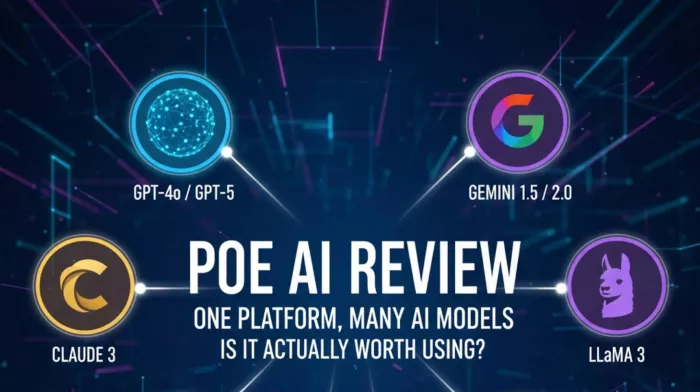
Most AI platforms today ask you to commit. One model, one interface, one way of working. Poe AI takes the opposite approach. Instead of asking you to choose, it puts multiple leading AI models under one roof and lets you move between them freely.
At first glance, that sounds ideal. Why manage separate accounts for GPT, Claude, Gemini, or image models when one platform can handle them all. But convenience alone does not automatically make a tool valuable, especially when daily limits, pricing tiers, and performance differences come into play.
This review looks at Poe AI as it actually functions in real workflows. Not as a product pitch, not as a feature dump, but as a practical platform you would use day after day. The goal is simple. Help you decide whether Poe is genuinely useful or just interesting.
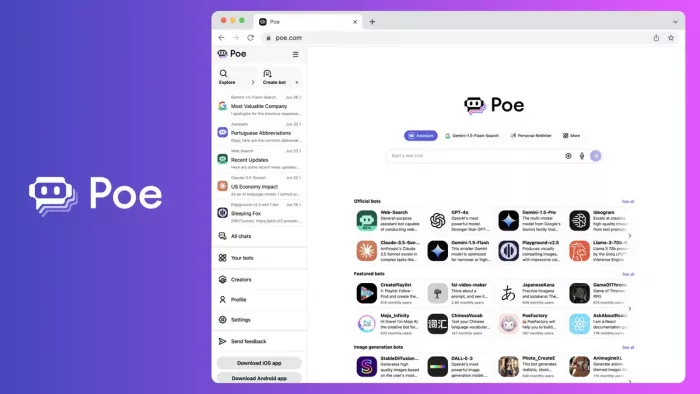
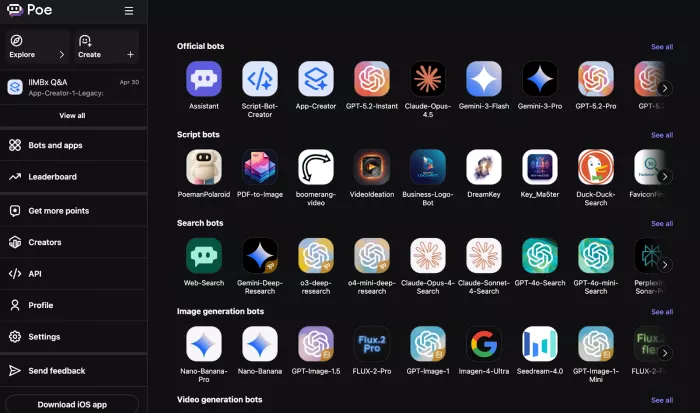
Poe AI is best understood as an AI aggregation platform, not a single AI model. It does not train its own foundational model. Instead, it routes your prompts to third party models like GPT 4, Claude 3, Gemini, LLaMA, and various image generators through one interface.
This distinction matters. Poe does not aim to replace tools like ChatGPT or Claude. It aims to sit above them and offer breadth rather than depth.
If you expect deep coding tools, persistent memory, or advanced file handling, Poe is not designed to win that battle. If you want to compare responses, experiment quickly, or switch models without friction, that is where Poe starts to make sense.
The defining feature of Poe AI is its ability to let you run the same prompt across different models with minimal effort. This is more powerful than it sounds.
When you ask a question once and see how GPT, Claude, and Gemini respond differently, patterns become obvious. You notice shifts in tone, reasoning depth, creativity, and even caution. For writers, researchers, and learners, this comparison alone can surface better insights than sticking to one model.
This is where Poe feels genuinely useful. It turns AI from a single voice into a panel of perspectives.
The interface supports multi bot chats, allowing responses to appear side by side. It removes the friction of copying prompts between platforms and logging into multiple accounts. Over time, that convenience compounds.
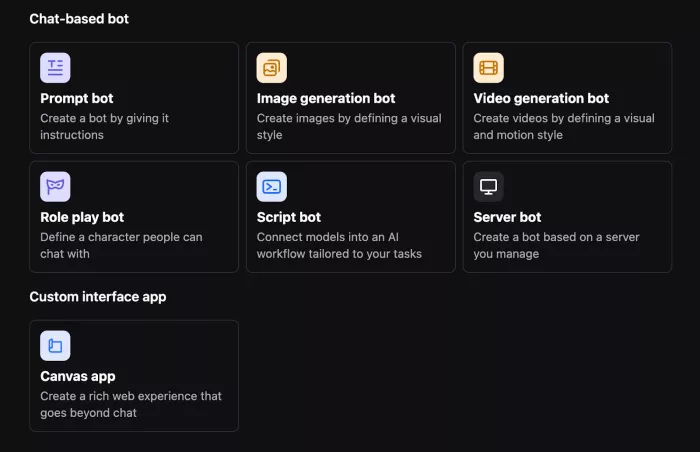
One of Poe’s most underrated features is custom bot creation. These bots are not complex agents. They are more like instruction layers that sit on top of an existing model.
You can create a bot that always responds as a study tutor, a marketing editor, or a code reviewer by defining how it should behave before the prompt is sent to the model. For many users, this replaces repetitive prompt engineering.
For beginners, this feels empowering. You do not need to understand APIs or scripting. You simply describe what the bot should do.
More advanced users can go further using server bots and webhooks, but that is optional. The real value lies in how accessible customization feels without being overwhelming.
Poe is not limited to text. It integrates image generation models such as DALL E 3, Stable Diffusion, and others depending on availability and plan level. This allows users to move from idea to text to visuals without leaving the platform.
For casual creators, this is convenient. For professionals, it is a mixed experience. The image tools are capable, but they lack the fine tuning and workflow control found in dedicated platforms.
Still, for experimentation and rapid iteration, having text and image generation in one place makes sense.
Poe AI shines most when used for exploration, not execution.
Its strongest qualities include:
● Unified access to multiple major AI models
● Fast comparison of outputs for the same prompt
● Low friction experimentation across text and images
● Beginner friendly customization through prompt bots
● Cross platform access across web and mobile
For students, writers, and curious professionals, this flexibility can speed up learning and idea validation significantly.

The biggest criticism of Poe AI is not about concept. It is about limits.
Even on paid plans, Poe enforces daily message caps, especially for premium models. Heavy users often hit these limits faster than expected, which breaks flow and forces prioritization.
Another issue is feature depth. Poe lacks advanced tooling found in dedicated platforms. There is no true code interpreter environment. File uploads and long context workflows are more constrained. Memory across conversations is limited.
Support and reliability are also common complaints. Some users report lost message credits, bugs, and slow or unresponsive customer support. These issues do not affect everyone, but they matter if you rely on the platform heavily.
Poe’s pricing sits in a familiar range. Around 20 dollars per month for premium access, similar to ChatGPT Plus or Claude Pro.
The difference is how that value is distributed.
Instead of paying for one model with deep features, you are paying for access to many models with shared limits. For some users, this feels efficient. For others, it feels restrictive.
If you mainly use one AI heavily every day, Poe can feel less economical. If you use several models lightly or for comparison, it can feel like a smart consolidation.
Compared to ChatGPT, Poe loses on depth but wins on variety.
Compared to Claude, Poe offers flexibility but less polish for long reasoning tasks.
Compared to Perplexity, Poe lacks citation focused research but offers broader creative freedom.
Poe does not try to outperform these tools individually. It tries to sit between them.
This positioning is both its strength and its limitation.
Poe AI tends to work best for people who value comparison and exploration over deep specialization. Learners often benefit from seeing how different AI models explain the same concept, especially when reasoning styles or levels of detail vary. Writers and creators also find value in testing how tone, structure, or creativity changes when the same prompt is routed through multiple models. For product teams and content researchers, Poe can be useful for quickly validating ideas, brainstorming angles, or stress-testing assumptions without committing to a single AI perspective. It also appeals to users who simply enjoy experimenting with AI and prefer flexibility rather than locking themselves into one tool or workflow.
That same flexibility is also where Poe becomes less suitable for certain users. People who rely heavily on one model every day may find the usage limits restrictive, even on paid plans. Developers who need advanced coding environments, persistent memory, or deep tooling will likely feel constrained by Poe’s lighter feature set. Users who are sensitive to daily message caps may experience workflow interruptions, and those looking for long-term automation or deeply personalized AI behavior may find dedicated platforms better suited to their needs.
Poe AI is not trying to be the best AI tool. It is trying to be the most flexible one.
Its value lies in breadth, not mastery. When used for exploration, comparison, and quick experimentation, Poe feels genuinely useful. When pushed into heavy production work, its limits become more visible.
If you enjoy seeing how different models think, if you like testing ideas from multiple angles, and if you value convenience over specialization, Poe AI is worth trying, especially through the free tier first.
If your work depends on one AI model doing deep, focused tasks every day, a dedicated platform will likely serve you better.
Poe is best viewed not as a replacement, but as a hub. And like any hub, its usefulness depends on how many paths you want access to at once.
Let’s start with a small truth about storytelling: writing the first s...

WhatsApp is preparing to allow third-party artificial intelligence cha...
BrandCrowd built its name as a go-to logo tool for small business...
There is a specific kind of disappointment that comes from opening a b...
AI companion apps have moved well beyond novelty status. What started...
Let’s start with an uncomfortable truth. Most people want their photos...
Discussion