

Alibaba has confirmed that Lin Junyang, the technical leader behind its Qwen artificial intelligence models, has left the company. The announcement came through an internal staff letter from Alibaba CEO Eddie Wu, who said the company will create a new task force and allocate more resources to keep its AI development moving forward.
The leadership change comes at a time when Alibaba is investing heavily in large AI models as it competes with global technology companies building advanced generative AI systems.
In a staff message dated March 5, Eddie Wu informed employees that the head of the Qwen AI division had stepped down. Wu emphasized that the departure would not slow the company’s AI ambitions and said Alibaba will strengthen its focus on foundation models.
According to reports from Reuters and regional business outlets, Wu framed the move as part of an acceleration of Alibaba’s AI strategy. The company plans to direct more technical and financial resources into developing its AI models and infrastructure.
Alibaba has also created a new internal task force to oversee the continuation of its model roadmap.
Lin Junyang, also known as Justin Lin, served as the central technical leader behind Qwen, Alibaba’s flagship AI model family.
He played a key role in designing and scaling the model architecture that powers Alibaba’s generative AI platform, which includes tools for chatbots, coding assistance, and enterprise AI applications.
Lin announced his departure publicly on March 3 through a short message posted on X. In the post he wrote, “Bye my beloved Qwen. Farewell to my cherished Qwen,” without providing additional details about the reason for his decision.
His announcement came only days after Alibaba released new smaller models in the Qwen 3.5 series.
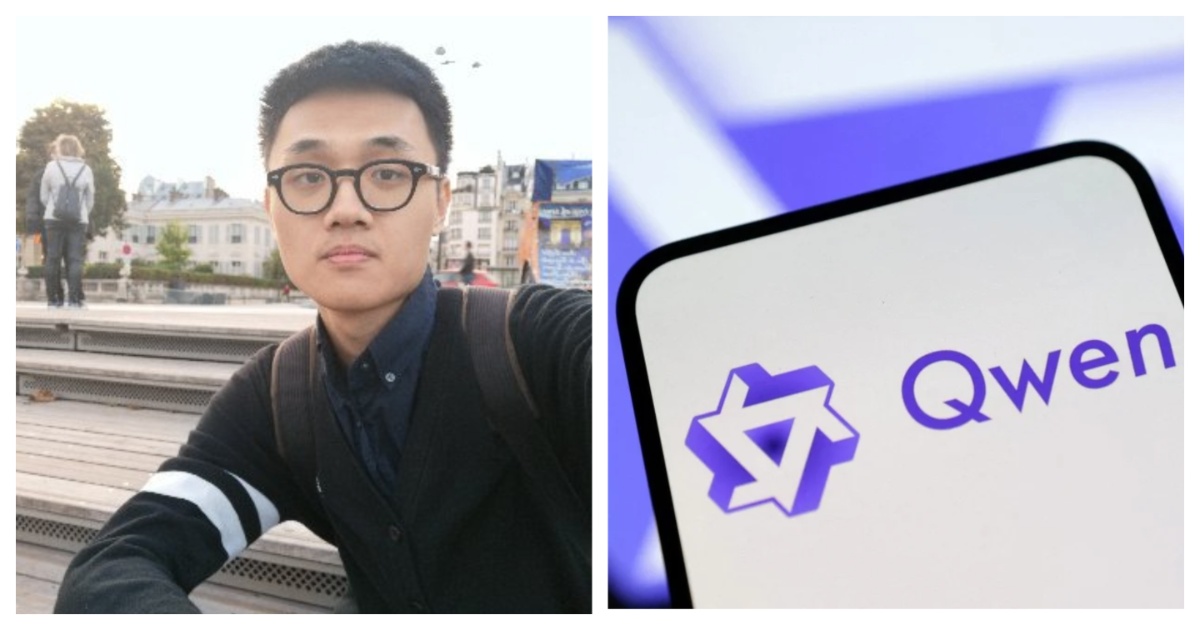
Lin was widely viewed as the technical architect of the Qwen ecosystem, and his departure has drawn attention across the AI developer community.
Developers who collaborated with the team described the move as a major transition for the project, with some calling it the end of an era for Qwen’s leadership.
During Lin’s time leading development, Qwen expanded rapidly across multiple products and platforms. The company’s AI assistant and related applications have seen significant user growth.
Reports indicate that the Qwen mobile app grew from roughly 31 million monthly active users in January to more than 203 million in February 2026. That surge placed it among the most widely used AI applications globally.
In terms of usage scale, it now trails only two major AI services: ChatGPT and ByteDance’s Doubao.
Lin’s exit is not the only leadership shift inside Alibaba’s AI group this year.
Industry reports indicate that Yu Bowen, who led post-training work on Qwen models, has also stepped down. Earlier in January, coding specialist Hui Binyuan left the team as well.
These departures have coincided with a broader restructuring of Alibaba’s AI division.
According to Chinese technology media reports, the company has appointed a new technical leader from outside the original Qwen team. The move appears to be part of a centralized effort to reorganize Alibaba’s AI operations and consolidate its generative AI products under the Qwen brand.
The news of Lin’s resignation also had a visible impact on financial markets.
Alibaba’s Hong Kong listed shares reportedly dropped by about 5 percent following the reports, reflecting investor uncertainty about leadership continuity in the company’s AI strategy.
Technology investors are closely watching the AI race among major global companies, where leadership stability and technical expertise are seen as critical advantages.
Alibaba has positioned Qwen as a central pillar of its future growth strategy, particularly as AI becomes integrated into cloud services, enterprise software, and consumer applications.
Alibaba’s Qwen models are part of China’s broader effort to compete with large language models developed by U.S. technology companies.
The global AI race currently includes companies such as OpenAI, Google, Anthropic, and Meta, all of which are investing heavily in foundation models capable of handling complex reasoning, coding, and multimodal tasks.
Chinese companies including Alibaba, Baidu, ByteDance, and Tencent have launched their own model families in response.
Lin himself previously attracted attention for publicly warning about the widening technology gap between leading U.S. AI systems and those developed in China.
Those comments highlighted the intense pressure Chinese technology firms face to accelerate research and development in artificial intelligence.
Despite the leadership change, Alibaba has made clear that its AI strategy remains a top priority.
The company’s cloud computing division continues to integrate Qwen models into enterprise tools, developer platforms, and consumer products.
Analysts expect Alibaba to continue expanding the Qwen model family, improving performance, and building partnerships with businesses that want to deploy generative AI services.
The newly formed internal task force will likely focus on maintaining the model development pipeline while the company reshapes the leadership structure of its AI teams.
For Alibaba, the challenge will be maintaining the rapid growth and innovation of Qwen while navigating leadership transitions in one of its most important technology initiatives.

BrandCrowd built its name as a go-to logo tool for small business...

There is a specific kind of disappointment that comes from opening a b...

AI companion apps have moved well beyond novelty status. What started...
Let’s start with an uncomfortable truth. Most people want their photos...

The U.S. Commerce Department is considering a new set of export contro...

Amazon Web Services has introduced Amazon Connect Health, a new health...
Discussion