

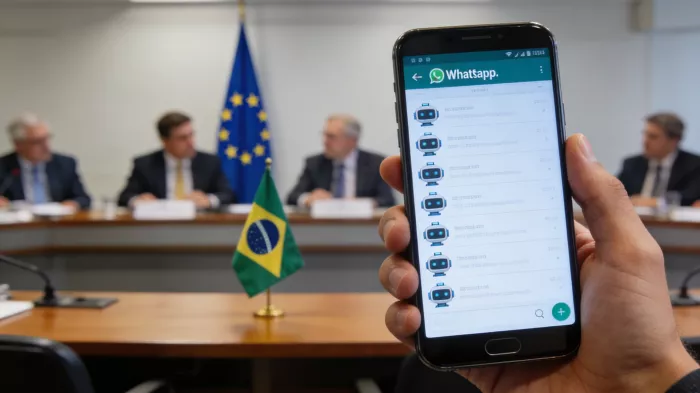
WhatsApp is preparing to allow third-party artificial intelligence chatbots on its messaging platform in Brazil, reversing a previous policy that restricted access to competing AI systems. The change follows pressure from Brazil’s antitrust authority and comes just a day after Meta confirmed a similar concession for European regulators.
Beginning March 11, 2026, rival AI companies will be able to offer chatbot services through the WhatsApp Business API, though access will come at a price. Meta will charge $0.0625 for each non-template message sent by these AI bots in Brazil, a fee structure that could significantly shape how developers deploy AI assistants inside the messaging app.
The decision marks the latest chapter in a growing regulatory confrontation between global technology companies and governments concerned about the competitive impact of dominant digital platforms.
The shift in policy stems from a legal battle in Brazil involving CADE, the country’s administrative council for economic defense.
In October 2025, Meta introduced a rule preventing third-party general AI chatbots from operating through the WhatsApp Business API. The company said the change was necessary because high-volume AI traffic could place strain on WhatsApp’s infrastructure.
The policy still allowed certain business-specific bots such as customer support systems, but it effectively blocked consumer AI assistants from other companies.
Regulators quickly raised concerns that the rule could give Meta’s own AI systems an unfair advantage.
On January 12, 2026, CADE launched an investigation into whether the policy violated competition laws. The regulator ordered Meta to suspend enforcement of the restriction while the case was under review.
A few days later, Meta introduced a 90-day grace period for companies already running AI bots. Brazil was temporarily excluded from the wind-down while regulators continued examining the case.
The dispute culminated in early March when CADE rejected Meta’s appeal and ruled that the ban could harm competition in the Brazilian messaging market.
CADE rapporteur Carlos Jacques argued that the policy risked creating “significant competitive harm” and was not proportionate given WhatsApp’s dominant position in Brazil’s messaging ecosystem.
Following the ruling, Meta confirmed it would open access to the WhatsApp Business API for competing AI services in Brazil.
Companies such as OpenAI, Microsoft, Perplexity, and other AI developers will now be able to integrate chatbot assistants into WhatsApp conversations.
The company said the change applies in situations where regulators require access to the platform. Meta also introduced a pricing structure to compensate for infrastructure costs associated with running high-volume AI conversations.
Under the new model, businesses deploying AI bots through the API will pay $0.0625 per non-template message in Brazil.
Template messages, which are predefined automated responses typically used for notifications or confirmations, will cost less and may sometimes be free depending on the use case.
The Brazilian policy change did not occur in isolation.
Just one day earlier, Meta announced that it would also allow third-party AI chatbots on WhatsApp across parts of Europe. That decision came amid scrutiny from European regulators examining whether Meta’s platform policies disadvantage competing AI services.
In Europe, the rollout will function as a 12-month access program, allowing AI companies to operate chatbots through the WhatsApp Business API.
Pricing in the region will vary depending on the country but will range between €0.0490 and €0.1323 per non-template message.
European regulators are still evaluating how this change affects ongoing antitrust investigations, including whether Meta’s earlier restrictions violated competition rules.
While regulators forced Meta to allow rival AI bots, the company still controls the infrastructure and pricing.
Developers say the new fee structure could significantly affect how AI assistants are deployed inside messaging platforms.
At $0.0625 per message, an extended AI conversation involving dozens of exchanges could cost several dollars per user session. Some developers estimate that an average interaction could range from $3 to $6 depending on the number of messages generated.
For companies offering free AI assistants, these costs could quickly become unsustainable.
As a result, some AI startups are reconsidering whether to integrate with WhatsApp immediately or waiting to see how pricing evolves.
Premium services or enterprise AI tools may be more likely to absorb the costs.

The dispute highlights a broader regulatory trend targeting self-preferencing by dominant platforms.
Messaging platforms like WhatsApp hold enormous influence because they act as communication infrastructure used by billions of people. When those platforms restrict access to certain services, it can effectively shape which technologies reach consumers.
Regulators in Europe and Brazil have increasingly argued that companies cannot use control over essential digital platforms to exclude competitors.
The WhatsApp case mirrors similar debates surrounding app stores, search engines, and online marketplaces.
Authorities are particularly focused on ensuring that AI companies can compete fairly as generative AI becomes a core technology across the digital economy.
For AI developers, the decision could unlock access to one of the largest communication platforms in the world.
WhatsApp has more than 2.5 billion users globally, making it one of the most widely used messaging services on the planet.
If companies integrate their AI assistants into WhatsApp chats, they could reach millions of users who already rely on the platform for daily communication.
This could allow users to interact with tools such as ChatGPT-style assistants directly inside a messaging conversation rather than through separate apps.
Industry observers expect several major AI companies to begin experimenting with WhatsApp integrations once the policy takes effect.
For users in Brazil and parts of Europe, the policy change could soon introduce a new category of messaging experiences.
Instead of chatting only with friends, businesses, or Meta’s built-in AI assistant, users may be able to interact with third-party AI systems through WhatsApp conversations.
These assistants could help with tasks such as:
The integration could also allow businesses to deploy more advanced AI support systems for customer interactions.
However, the timeline for widespread adoption remains uncertain as developers evaluate the economic implications of the new pricing model.
The events in Brazil and Europe suggest that regulators are increasingly willing to intervene when digital platforms attempt to limit access to emerging technologies.
Messaging apps are becoming critical gateways for AI services, much like search engines and app stores became gateways for earlier generations of digital tools.
As AI assistants evolve into everyday digital companions, control over where they can operate may become a major battleground between technology companies and regulators.
For now, WhatsApp’s decision to open its platform to rival AI chatbots marks an important step in that broader debate.
The next question is whether other regions, including major markets like India and Southeast Asia, will push for similar policies in the months ahead.

Let’s start with a small truth about storytelling: writing the first s...

BrandCrowd built its name as a go-to logo tool for small business...
There is a specific kind of disappointment that comes from opening a b...
AI companion apps have moved well beyond novelty status. What started...
Let’s start with an uncomfortable truth. Most people want their photos...
The U.S. Commerce Department is considering a new set of export contro...
Discussion