

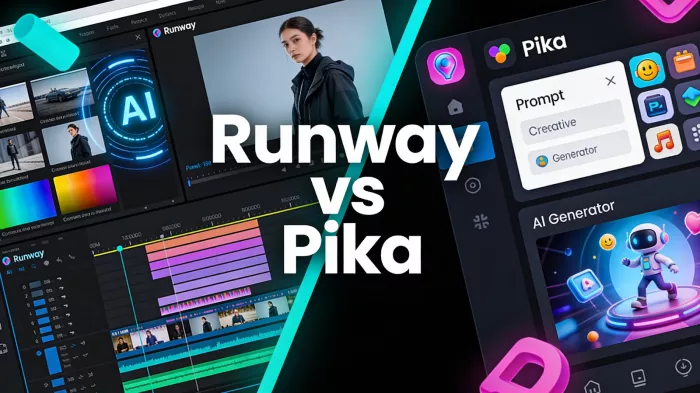
Most people meet Runway and Pika through short clips on social media. A cinematic scene appears out of nowhere, generated from a simple prompt, and suddenly it feels like filmmaking has been reduced to typing.
Then you try it yourself.
The first few generations feel exciting. The next few feel inconsistent. And by the time you try to create something usable end-to-end, the differences between tools become very obvious.
Runway and Pika sit in the same category on paper. Both generate video from text or images. Both promise cinematic outputs. Both are pushing the boundaries of generative video.
But they behave very differently once you move beyond experimentation and try to build something repeatable.
This is not a feature comparison. This is about how each tool actually performs when you try to use it like a creator, not a demo.
The runway is built like a creative production system.
Pika is built like a generative video engine focused on fast visual output.
That difference shapes everything.
Runway feels closer to editing software enhanced with AI. It gives you tools to refine, extend, and control outputs. Pika feels more like a generator that prioritizes quick, visually striking clips with less friction.
So the real question is simple. Are you trying to create a video, or generate one?
| If your goal is… | What actually matters |
| Cinematic storytelling | Consistency, control, scene continuity |
| Social media clips | Speed, visual appeal, variation |
| Experimental visuals | Prompt responsiveness, style diversity |
| Brand content | Predictability, editing capability |
| Short-form loops | Fast generation, minimal setup |
The category itself is still evolving. These tools are not replacing traditional editing yet. They are redefining early-stage creation.
Official website: https://runwayml.com/
Runway is best understood as a creative suite powered by generative AI. It is not just about generating clips. It is about shaping them.
The platform offers tools like Gen-2 and Gen-3 video generation, image-to-video, video extension, inpainting, motion control, and editing workflows that allow creators to refine outputs over time. This makes it particularly useful for creators who want consistency across shots.
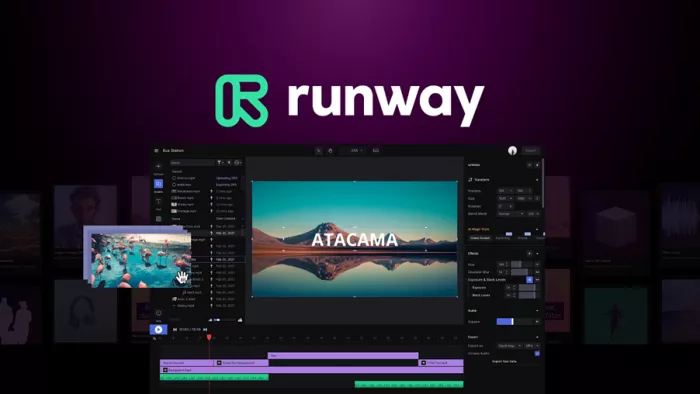
In practice, Runway behaves more like a production environment. You generate a clip, then adjust it, extend it, or modify elements to fit a larger sequence. This ability to iterate gives it a major advantage when building structured content.
Where it stands out is control. You are not just generating random clips. You are shaping them into something usable.
Its limitation is speed and simplicity. Compared to Pika, it requires more effort to get results. It is not built for instant gratification. It is built for refinement.
| Factor | Detail |
| Category | AI video generation and editing suite |
| Core strength | Control and editing capabilities |
| Inputs | Text, image, video |
| Key features | Gen-3 video, inpainting, motion control, video editing |
| Pricing | Credit-based system |
| Best use case | Cinematic content, structured video creation |
| Limitation | Requires more effort and learning |
| Specific pros | Specific cons |
| Advanced editing tools allow creators to refine and extend generated clips into usable sequences | Steeper learning curve compared to simpler generators |
| Better consistency across scenes when building longer content | Slower workflow when quick outputs are needed |
| Supports image-to-video and video editing in one ecosystem | Credit usage can increase quickly during experimentation |
| Stronger control over motion and composition | Not ideal for rapid content generation |
Official positioning: Pika AI (PixVerse)
Pika takes a very different approach. It focuses on making video generation fast, accessible, and visually engaging without requiring deep control.
The platform is designed for quick results. You input a prompt, generate clips, and iterate rapidly. It is particularly strong for short-form content, social media visuals, and experimental clips where speed matters more than precision.

In practice, Pika feels more responsive. It produces outputs quickly and encourages experimentation. This makes it appealing for creators who want ideas fast rather than perfect sequences.
Where it shines is simplicity. You can generate multiple variations quickly and pick what works.
Its limitation is control. Maintaining consistency across clips or building longer narratives is harder compared to Runway.
| Factor | Detail |
| Category | AI video generation tool |
| Core strength | Speed and ease of use |
| Inputs | Text, image |
| Key features | Fast generation, stylized outputs |
| Pricing | Credit-based |
| Best use case | Social media, quick visuals, experimentation |
| Limitation | Limited control for long-form content |
| Specific pros | Specific cons |
| Extremely fast generation makes it ideal for rapid content creation | Limited control over scene continuity |
| Easy to use with minimal setup required | Harder to build structured narratives |
| Produces visually engaging clips quickly | Outputs can feel inconsistent across iterations |
| Great for experimentation and idea generation | Less suitable for professional editing workflows |
| Factor | Runway | Pika |
| Workflow style | Controlled creation | Fast generation |
| Output consistency | Higher | Variable |
| Speed | Moderate | High |
| Editing capability | Strong | Limited |
| Best use case | Structured videos | Short-form content |
Runway helps you build.
Pika helps you generate.
That is the difference.
The difference becomes more visible when you move beyond single clips.
Runway becomes stronger as projects grow. Its editing and control features allow creators to maintain consistency across multiple scenes.
Pika becomes less predictable at scale. While it remains fast, maintaining uniform style and narrative becomes difficult.
| Factor | Runway | Pika |
| Batch creation | Moderate | High |
| Consistency | High | Medium |
| Iteration control | High | Low |
| Best scaling use | Structured content | Quick content production |
| Tool | Pricing model | What it means |
| Runway | Credit-based | Paying for control and editing |
| Pika | Credit-based | Paying for speed and experimentation |
Both tools use credits, but how you use them changes the cost.
Runway consumes credits through refinement.
Pika consumes credits through volume.
| Category | Runway | Pika |
| Speed | 7.5/10 | 9/10 |
| Quality | 8.5/10 | 8/10 |
| Ease of use | 7/10 | 9/10 |
| Scalability | 8.5/10 | 7.5/10 |
| Creativity | 8/10 | 8.5/10 |
| Overall | 8.3/10 | 8.2/10 |
Runway is built for creators who want control, structure, and the ability to refine outputs into something consistent.
Pika is built for creators who want speed, experimentation, and visually engaging results without friction.
Neither replaces the other.
They serve different stages of creation.
Use Runway when the goal is building something intentional.
Use Pika when the goal is generating ideas quickly.

Every meeting produces information that matters. Decisions get made, a...

AI note takers are tools designed to automatically capture what happen...

South Korean President Lee Jae-myung has called for a deeper strategic...

Amazon-owned Ring is taking a major step beyond its roots in home secu...

AI avatar video tools are easy to get excited about.Type a script, pic...

Healthcare professionals are under constant pressure. Between patient...
Discussion