


A Structural, Behavioral, and Risk-Based Analysis of How the Platform Really Operates
Dating platforms succeed or fail not by what they claim, but by how their systems behave under real user conditions. This article examines SearchingForSingles.org through its design choices, monetization mechanics, behavioral signals, and trust architecture, not marketing promises.

At first glance, SearchingForSingles.org presents itself as a conventional online dating website. However, platform intent becomes clear only when you examine what actions are rewarded and what outcomes are ignored.
The site does not optimize for:
Instead, the system is optimized for:
There is no visible success funnel leading users from chat → call → meet → relationship.
That omission is not neutral, it signals that successful exits are not a core business metric.
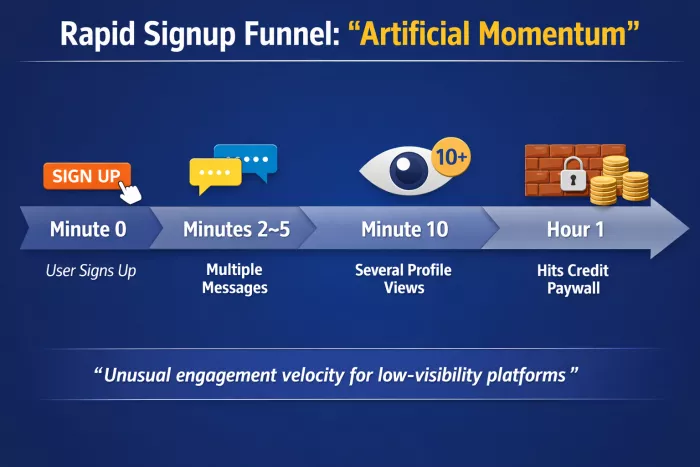
Most users report an unusually fast engagement surge immediately after registration. This includes:
From a statistical standpoint, this is implausible on a low-visibility dating platform without a massive active user base.
In organic dating environments:
Here, engagement is predictable and consistent, suggesting system-assisted activity rather than organic discovery. This design creates perceived value before any payment, making users more likely to convert once credits are required.
A deeper look at conversation flow reveals repeated anomalies:
These patterns align with engagement scripting, not human curiosity.
Importantly, conversations often:
This behavior is consistent across many user reports and suggests conversation continuity is monetized, not relationship depth.
SearchingForSingles.org profiles often show:
While none of these prove falsity individually, combined they reduce authenticity confidence.
Real user profiles typically show:
Here, profile uniformity suggests template-driven creation, whether automated or moderated. The result is a dating environment where users are interacting with representations, not people.
The platform uses a pay-per-interaction model, where:
This model is not inherently illegal, but it is structurally incompatible with real dating success.
Why?
Because:
This creates a perverse incentive: the platform profits most when users stay emotionally engaged but practically stalled.
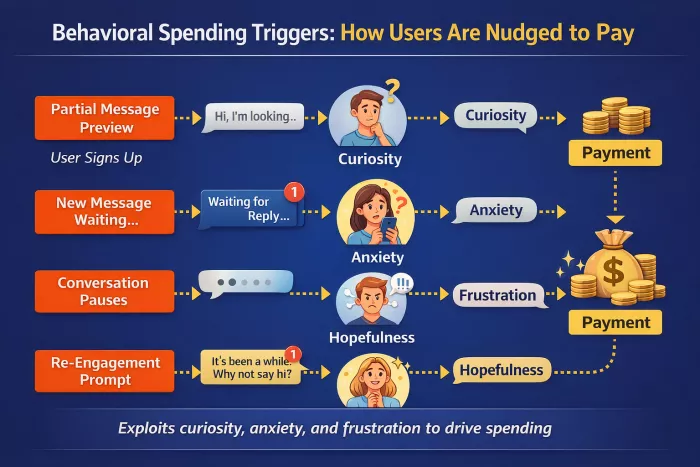
The site employs well-documented behavioral monetization techniques:
These triggers are borrowed from freemium gaming psychology, not relationship design. They exploit:
This is why many users report spending more than planned without measurable outcomes.
One of the strongest red flags is how rarely conversations:
In legitimate dating platforms, users naturally attempt to shift channels.
Here, conversations often deflect or delay off-platform movement, because doing so breaks the monetization loop.
This is not coincidence; it is structural.
SearchingForSingles.org provides minimal clarity regarding:
This lack of transparency matters because:
Opaque ownership is not just a trust issue, it is a risk amplifier.
Although the site uses HTTPS, deeper privacy questions remain unanswered:
Given that engagement itself is monetized, conversation data is likely a core asset, yet disclosure remains vague.
The majority of external content referencing SearchingForSingles.org falls into:
“Is it legit?”
“Safe or scam?”
“Fake profiles?”
“Worth the money?”
This discovery pattern indicates skeptic-driven traffic, not community advocacy.
Successful dating platforms generate:
This one generates cautionary analysis.
Mainstream dating platforms such as Tinder, Bumble, and Hinge monetize:
But they still benefit when users succeed and leave.
SearchingForSingles.org benefits when users stay emotionally invested but unresolved.
That is the core difference.
This platform is particularly risky for:
The combination of emotional reinforcement + financial friction creates high regret probability.
Repeated sentiments include:
“I thought it would turn real”
“I kept paying because it felt close”
“Nothing ever progressed”
“It felt designed to keep me spending”
These are not isolated complaints, they are systemic outcomes.
| Dimension | Assessment |
| Profile authenticity | Low confidence |
| Financial predictability | Poor |
| Exit success probability | Extremely low |
| Emotional manipulation risk | High |
| Transparency | Weak |
| Consumer protection | Limited |
SearchingForSingles.org is not a scam in the legal sense, but it is misaligned with genuine dating goals.
It functions best as:
It functions poorly as:
Conclusion
If your goal is real human connection, this platform works against you.
If your goal is paid interaction without expectations, it will deliver exactly that.

Let’s start with a small truth about storytelling: writing the first s...

WhatsApp is preparing to allow third-party artificial intelligence cha...

BrandCrowd built its name as a go-to logo tool for small business...

There is a specific kind of disappointment that comes from opening a b...

AI companion apps have moved well beyond novelty status. What started...
Let’s start with an uncomfortable truth. Most people want their photos...
Discussion