

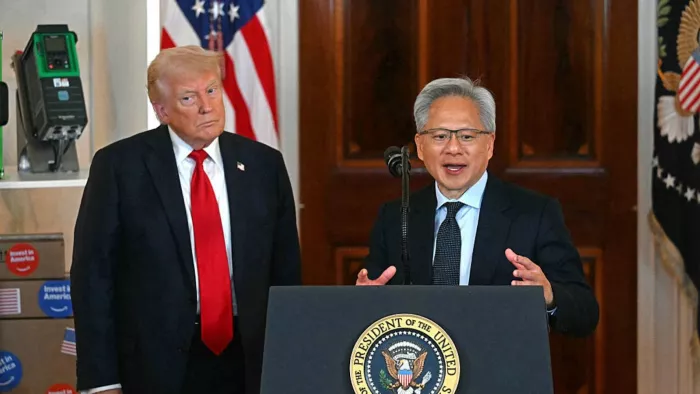
President Donald Trump’s plan to let Nvidia ship its most advanced artificial intelligence chips to China has ignited a fierce fight in Washington, where a powerful House committee has moved to seize new authority over AI exports in the name of national security. At the heart of the clash is Nvidia’s H200 processor, a flagship AI chip that could be worth tens of billions of dollars in sales to China but which lawmakers warn could supercharge Beijing’s military and cyber capabilities.
Trump has cleared the way for Nvidia to sell its H200 AI chips to Chinese customers, under a deal that would give the U.S. government a 25% cut of the revenue from those sales. The H200, part of Nvidia’s high‑end Hopper line, is significantly more powerful than earlier export‑compliant chips such as the H20 that Washington had previously allowed Nvidia to sell into China.
● The Commerce Department has issued a new rule framework requiring exporters to prove there is “adequate supply” of H200 chips for U.S. users before any units ship to China.
● Exports to “countries of concern” such as China, Russia, Iran and North Korea still need licenses, but the H200 decision effectively opens a path for Beijing to access cutting‑edge AI compute under strict conditions.
Trump has pitched the move as a hard‑nosed business deal that keeps American firms on top while extracting value for U.S. taxpayers. “We’re allowing them to sell, but the United States is getting 25 percent of the dollar value,” he told supporters, framing the arrangement as proof that “America will get paid when our technology powers the world.”
In response, the House Foreign Affairs Committee has advanced new legislation, dubbed the AI Overwatch Act, that would give Congress a direct veto over licenses to export the most advanced AI chips.
● The bill, introduced by committee chair Rep. Brian Mast of Florida, would require both the House Foreign Affairs Committee and the Senate Banking Committee to approve any Commerce Department license for sophisticated AI chips within 30 days.
● Lawmakers could block a proposed export via a joint resolution, effectively placing AI chips under a review process similar to arms sales.
Mast has cast the stakes in stark security terms. “Entities like Nvidia are seeking to sell millions of advanced AI chips, which are at the forefront of modern warfare, to Chinese military‑linked firms such as Alibaba and Tencent,” he said, calling these exports “a direct threat to American national security.”
Rep. John Moolenaar, the Republican chair of the House Select Committee on China, has backed the bill as “an essential move to safeguard America’s technological superiority and prevent our adversaries from turning Silicon Valley’s innovation into weapons aimed back at us.”
The fight over the H200 has crystallized a broader debate in Washington: whether restricting AI chip exports actually protects U.S. security or instead pushes China to build rival technologies faster.
● Critics of Trump’s decision say Nvidia’s H200 could turbocharge China’s AI research, from autonomous weapons to advanced cyber operations and intelligence analysis.
● Supporters argue that maintaining U.S. dominance in AI hardware, even through controlled exports, is critical for shaping global standards and keeping American firms years ahead of Chinese rivals.
Sen. Mark Warner, the Democratic vice‑chair of the Senate Intelligence Committee, blasted the move as “an ad‑hoc, transactional approach to the most important strategic technology of our time” and warned that “there is still no coherent strategy to ensure China cannot turn our chips into tools of repression or war.” “American companies must remain the undisputed leaders in AI, because this competition will be decided by whose ecosystem the world ultimately trusts and adopts,” he said.
Former senior Asia adviser Matt Pottinger went further in testimony, saying the administration is “heading in the wrong direction on AI” and warning that selling H200s to China “will supercharge Beijing’s military modernization, enhancing capabilities in everything from nuclear weapons to cyber warfare.”
The AI Overwatch Act has alarmed parts of the tech industry, which fear Congress could gain a de facto veto over commercial deals at the heart of the global AI race.
● David Sacks, Trump’s White House adviser on AI and crypto and a prominent Silicon Valley investor, has criticized the bill publicly, arguing that it would undermine presidential authority and hamper U.S. firms competing with Chinese and European rivals.
● Industry executives warn privately that if Washington overreaches, Chinese cloud giants and startups will accelerate their shift toward domestic chips from firms like Huawei, permanently reducing the leverage that U.S. regulators currently hold.
Tech lobbyists are already pressing lawmakers to narrow the bill’s scope, focusing on truly “military‑grade” AI systems while preserving room for commercial cloud and consumer AI products. One senior chip industry executive, speaking on background, said the current draft “risks turning every export license into a political football,” adding that “investors need predictable rules, not case‑by‑case Twitter campaigns.”
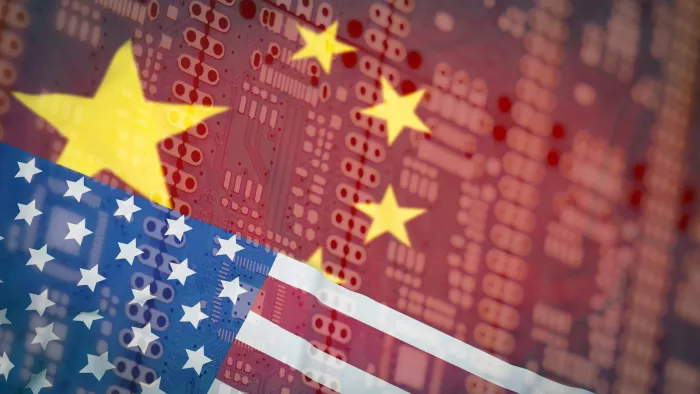
The current showdown builds on more than a year of back‑and‑forth over AI chips between Washington and Beijing.
● The Biden administration first imposed sweeping curbs in 2022 and 2023, blocking Nvidia’s most powerful GPUs from China to prevent their use in surveillance and military AI.
● In 2025, Trump expanded some restrictions but later eased them, allowing Nvidia to sell a specially designed H20 chip to China under a deal that gave Washington a 15% share of H20 sales.
Even as Trump relaxes some rules, Chinese authorities have signaled they will not allow unfettered inflows of Nvidia hardware.
● Chinese customs officials have reportedly been instructed to block H200 imports and warn tech companies against buying them unless absolutely necessary.
● Regulators have encouraged large Chinese firms to prioritize domestic chips, part of Beijing’s broader “self‑reliance” push in semiconductors.
A Beijing‑based tech policy analyst noted that “China’s AI sector is still deeply dependent on Nvidia’s ecosystem, but every new U.S. export fight strengthens the argument for pouring resources into homegrown chips.”
The AI Overwatch Act still faces an uncertain path on Capitol Hill, with its fate tied to a broader struggle over how much control Congress should have over advanced technology exports.
● The House Foreign Affairs Committee approved the measure with strong bipartisan support, 42–2, but it must still clear the full House and then the Senate, where competing proposals already exist to tighten or delay any easing of AI chip curbs to China.
● A separate bipartisan Senate bill introduced in late 2025 would bar the administration from loosening restrictions on Nvidia and AMD AI chip sales to China for at least 2.5 years.
If enacted, the Overwatch Act would also codify a two‑year ban on exports of Nvidia’s next‑generation Blackwell AI chips to China, locking into law limits that are currently imposed only by regulation. One senior Democrat on the House panel warned that “if Congress doesn’t step in now, we could wake up in a few years to find that the most powerful AI systems on Earth are training in data centers controlled by the Chinese Communist Party.”
For Nvidia, the stakes could hardly be higher. The company has previously estimated that China represents a potential $50 billion annual market for its AI chips, a figure that makes Beijing both its biggest long‑term opportunity and its most politically fraught customer. As Washington debates how far to go in constraining those sales, the outcome will help define not just one company’s future, but the balance of power in the global AI race.

Do your emails often get ignored and end up unopened in crowded inboxe...
Homework used to take time. You had to go through books, notes, and di...

There is a very specific kind of confidence that comes from generating...

If AI could understand vibes, we wouldn’t be writing essays as prompts...

Hospitals are beginning to see measurable reductions in waiting times...

Artificial intelligence has quickly become part of everyday learning....
Discussion