

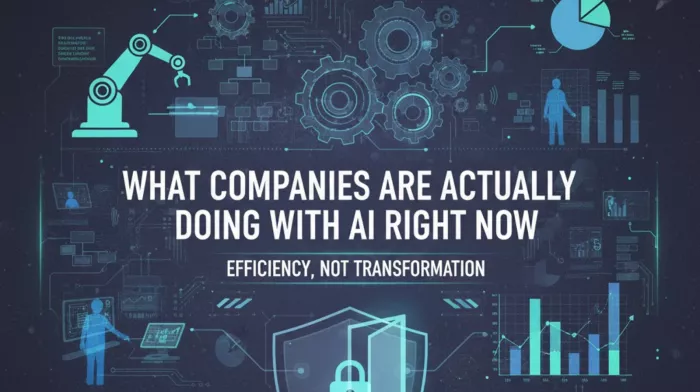
For the past three years, executives have talked about artificial intelligence as if it were a force already reshaping everything. Earnings calls, keynote speeches, and internal memos repeat the same promise: AI will change how work gets done. Yet when you look inside most organizations, the reality is quieter, slower, and far more incremental than the hype suggests.
Companies are using AI. They are investing heavily in it. But in most cases, they are not reinventing themselves around it. Instead, they are fitting AI into existing systems, cautiously and often invisibly.
Across industries, the dominant pattern is not bold reinvention but operational cleanup. AI is being applied where processes are already being automated or simplified.
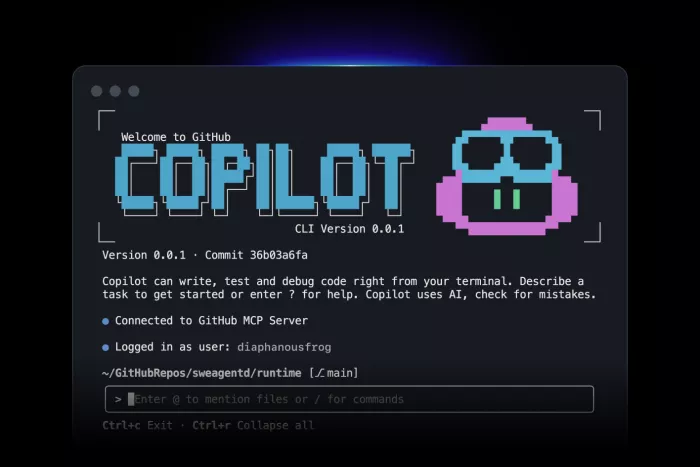
Many firms start by licensing tools such as copilots for writing, coding, or document review. These tools summarize emails, draft reports, generate code snippets, or extract information from PDFs and slide decks. The benefit is real, but modest. Work moves a little faster. Employees spend less time on repetitive tasks. Very little about the organization fundamentally changes.
Executives describe these gains as time savings rather than revenue drivers. The language matters. Most companies are not pointing to AI as a new growth engine yet. They describe it as a way to reduce friction in work that already existed.

When companies talk privately, they tend to describe AI as something happening in the background. It shows up in workflow tools, customer support routing, fraud detection, and internal analytics.
In manufacturing and logistics, AI helps forecast demand and manage inventory. In finance, it flags anomalies and accelerates reporting. In customer service, it triages requests before a human ever sees them.
These systems are not flashy. Customers rarely notice them. Employees often do not realize when an AI system is involved. That invisibility is intentional. Most organizations want AI to assist without introducing new risk or confusion.
A growing number of vendors describe their products as agents. In practice, many of these tools are still chatbots with better prompts.
True autonomy is rare. Allowing software to make decisions over days or weeks without human approval raises legal, operational, and cultural concerns. Even companies experimenting with advanced systems usually insist on human oversight at key decision points.
This caution is not just technical. It is organizational. Leaders worry about errors, accountability, and trust. A system that hallucinates a response is inconvenient. A system that executes the wrong action can be costly.
As a result, most deployments stop short of full autonomy. AI recommends. Humans approve.
The hesitation around autonomous systems comes down to trust. Companies know AI systems can be wrong. They also know mistakes scale quickly.
This is why customer facing chatbots were slow to appear, even though the technology existed for years. Only recently have major brands allowed AI to interact directly with customers at scale. Even now, those interactions are tightly constrained.
Businesses are far more comfortable letting AI summarize a document than letting it negotiate a contract or approve a refund. The risk profile is different, and most organizations remain conservative.

Public studies often show disappointing results from AI pilots. Many projects fail to deliver clear financial impact. That has not slowed spending.
Executives appear willing to wait. They frame AI investment as inevitable infrastructure rather than a short term bet. The return they emphasize is often indirect. Faster decision making. Lower future hiring needs. Greater flexibility.
Some companies measure success through cost avoidance rather than profit. If AI allows a team to grow without adding headcount, leaders consider that a win even if revenue stays flat.

AI is part of the hiring conversation, whether companies admit it or not. Many firms openly say they are keeping headcount flat while investing in automation. Others are less explicit but follow the same pattern.
This does not mean AI is the sole reason for layoffs or slower hiring. Economic uncertainty plays a role. Still, AI has become a convenient explanation for doing more with fewer people.
Analysts note that revenue per employee has stagnated or declined at many large companies. That trend suggests AI has not yet delivered broad productivity gains, even as it changes how work is allocated.
One lesson companies learned from the cloud era is to avoid dependence on a single provider. That mindset now shapes AI strategy.
Most large organizations describe themselves as model agnostic. They experiment with tools from multiple vendors and avoid committing fully to one ecosystem. This approach reduces risk but also slows progress. Integrating many systems is harder than standardizing on one.
The result is experimentation without consolidation. Pilots multiply. Enterprise wide transformation lags.
Technology alone does not appear to be the differentiator. Culture is.
Companies that move fastest tend to have leadership that actively uses AI and encourages experimentation. They give employees tools and freedom rather than rigid rules. Learning is rewarded. Curiosity is modeled from the top.
This is rare. In most organizations, AI adoption is driven by IT teams rather than executives. Without visible leadership buy in, tools sit unused or are applied narrowly.
Many people report that AI feels more impressive in personal use than in professional settings. At home, there are no restrictions. Users can experiment freely. At work, policies and compliance slow everything down.
This difference shapes perception. Consumers experience AI as creative and flexible. Employees experience it as limited and controlled. The gap is cultural as much as technical.
AI in 2025 is neither a revolution nor a failure. It is a gradual shift. Most companies are using it to smooth existing processes, not to replace them. Autonomy remains limited. Trust is still being built.
The organizations that succeed with AI are not the ones chasing headlines. They are the ones quietly changing how people work, step by step, without pretending the future has already arrived.
The real test will not be whether companies adopt AI. That is already happening. The question is whether they can move beyond safe efficiency gains and decide what they are willing to let machines actually do.

Let’s start with a small truth about storytelling: writing the first s...

WhatsApp is preparing to allow third-party artificial intelligence cha...
BrandCrowd built its name as a go-to logo tool for small business...

There is a specific kind of disappointment that comes from opening a b...

AI companion apps have moved well beyond novelty status. What started...
Let’s start with an uncomfortable truth. Most people want their photos...
Discussion