

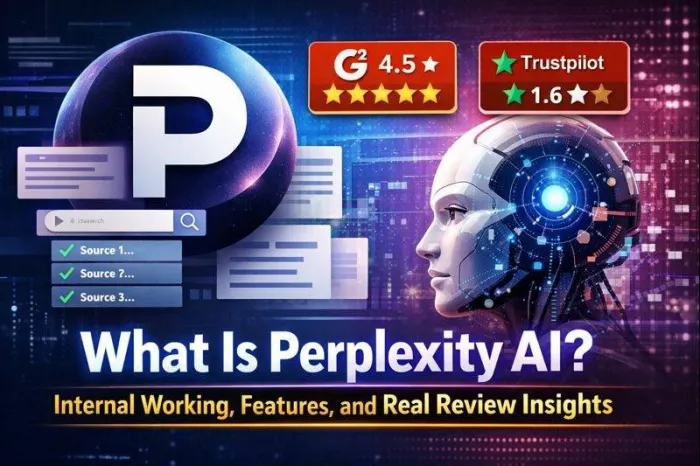
Perplexity AI is positioned as an “answer engine” (sometimes also described as a research assistant) that responds to a query with a natural-language answer plus citations to sources it used. (Perplexity AI)
● Goal: return a synthesized answer with verifiable references, rather than only a ranked list of links.
● Operationally: Perplexity says it searches the web in real time, then summarizes what it found.
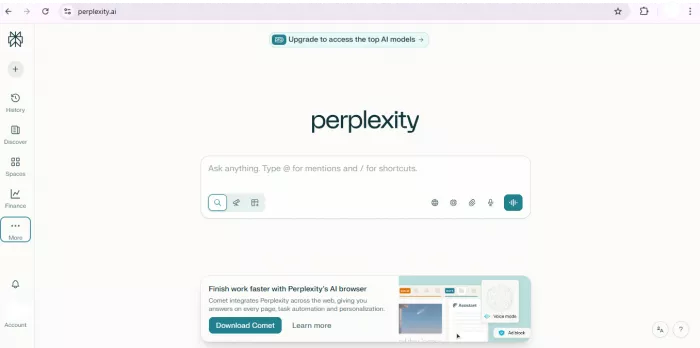
Traditional web search (e.g., Google Search) is optimized to:
● retrieve and rank documents/pages,
● present them as links + snippets, and
● let the user do the synthesis.
Perplexity instead emphasizes:
● retrieving documents/snippets,
● compressing them into an answer,
● attaching citations to the supporting sources. (Search Engine Land)
A chatbot can answer from its model memory (training data) without necessarily showing where facts came from. Perplexity describes itself as retrieval-first: it uses web search and then generates an answer grounded in what it retrieved.
Perplexity’s public technical writing about its search infrastructure (especially the Perplexity Search API) gives a useful “inside” view of the key moving parts:
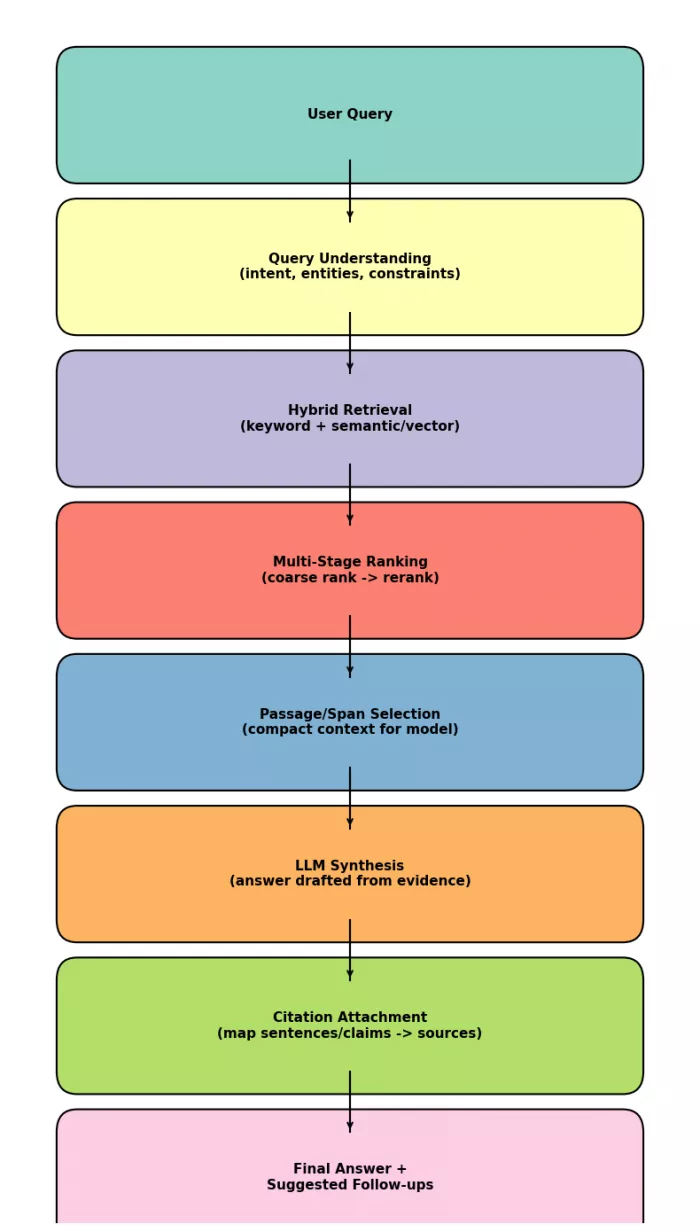
1. Query understanding:
○ The system analyzes the user query and intent (e.g., entities, constraints, desired freshness). Perplexity’s help center attributes this to “cutting-edge language models.”
2. Hybrid retrieval:
○ Perplexity describes an architecture with hybrid retrieval mechanisms (typically meaning a combination of lexical/keyword retrieval and semantic/vector retrieval), backed by large-scale indexing.
3. Fine-grained context selection:
○ A notable technical design point: it emphasizes not only document-level retrieval, but also treating sections/spans of documents as first-class units for “context engineering” (choosing the tightest, most relevant passages).
4. Multi-stage ranking:
○ Retrieved candidates are refined through multi-stage ranking pipelines.
○ Practically, this often looks like: fast initial retrieval → reranking with heavier models/signals → pick top passages for the final answer.
5. Citations:
○ The citations you see are tied to the retrieved sources/passages that were fed into the generation step (not simply “added later”). Perplexity’s product framing repeatedly emphasizes “answers with sources.”
● Retrieval systems (indexing + search + ranking) decide what evidence is likely relevant and trustworthy enough to include.
● Large language models (LLMs) turn the selected evidence into a coherent answer (summarize, reconcile conflicts, explain). Perplexity’s help center explicitly describes LLMs as part of query understanding and answer construction.
● Perplexity’s developer docs also separate “Search” use cases (retrieve + synthesize) from heavier reasoning tasks—suggesting different model modes depending on the job.
At a high level, grounding is achieved by:
● retrieving sources,
● selecting the most relevant passages,
● providing those passages to the LLM as context,
● generating an answer that is expected to stay consistent with that context,
What it is: a trace from the answer back to the retrieved documents/passages.
How it’s enabled: the retrieval layer supplies URLs (and often snippets/spans) that are inserted into the LLM prompt/context; the UI then displays the corresponding sources as citations. This design is consistent with Perplexity’s retrieval-first description and its emphasis on span-level “context engineering.”
What it is not: a guarantee that every sentence is perfectly supported; it’s a provenance signal that still requires checking (see limitations).
Perplexity behaves like a conversational system: follow-ups are typically handled by:
● carrying forward the prior turn’s topic constraints (entities, timeframe),
● running a new retrieval with the refined query,
● synthesizing again with new citations.
This is implied by its “answer engine” conversational workflow and retrieval-first approach.
Perplexity’s help documentation states it searches the internet in real time for answers.
Separately, Perplexity’s Search API article frames “staleness vs latency” as a core systems problem and describes building infrastructure to keep results usable for systems “hoping to be accurate and trustworthy.”
Perplexity’s developer documentation describes Search-type models as tuned for retrieval + synthesis, and notes they are not ideal for exhaustive multi-step analyses. (Perplexity)
Also, Perplexity’s help center names specific frontier models it may use for understanding and answering (as a product statement).
There are two different “performance” questions people often mix:
Perplexity published benchmark results for its Search API using an open-sourced evaluation framework and a set of benchmarks it lists (e.g., SimpleQA, FRAMES, BrowseComp, HLE). It reports:
● median latency (p50) around 358 ms (requests from AWS us-east-1), and
● comparative benchmark scores versus other search APIs in their test setup.
This is useful, but note it is vendor-published evaluation (good transparency, but still not fully independent).
| Platform | Rating |
| G2 | ~4.5 / 5 stars based on 135 reviews |
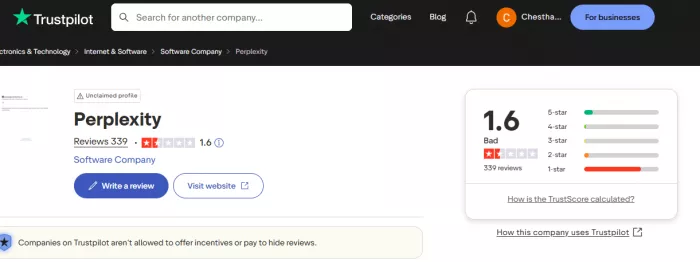
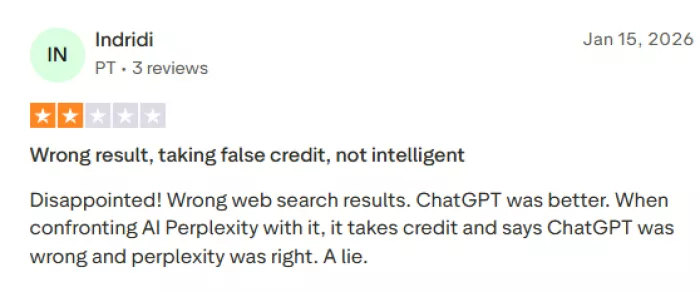
| Trustpilot | ~1.6 / 5 stars based on 339 reviews |
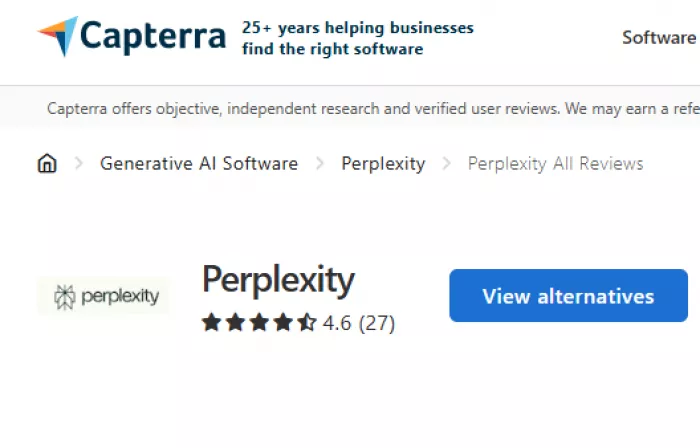
| Capterra | ~4.6 / 5 stars based on 27 reviews |
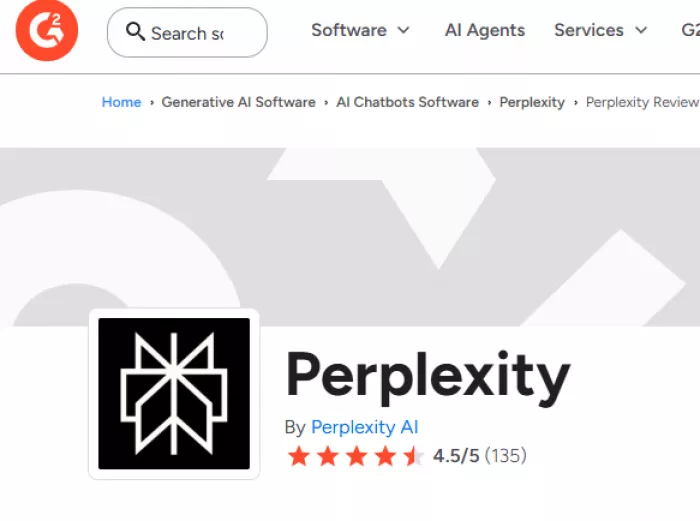
1. Strong Research Support & Source Attribution:
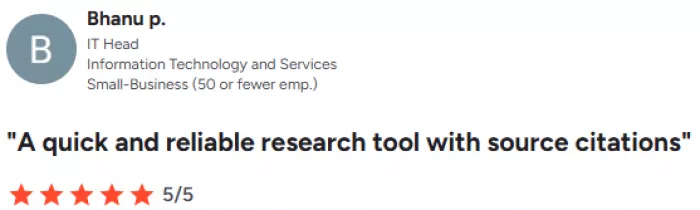
● Many verified reviewers appreciate Perplexity’s ability to produce answers with citations, aiding research and fact-checking.
● Users specifically value its utility in academic tasks (coding help, project work).
2. Easy to Use:
● Several comments highlight a clean, intuitive interface that makes it approachable even for complex queries.
3. Productive for Research Workflows:
● Some users say the tool runs in the background and helps gather information efficiently for longer research work.
1. Performance & Responsiveness Issues
● Users report very slow answers or responses that fail to meet expectations.
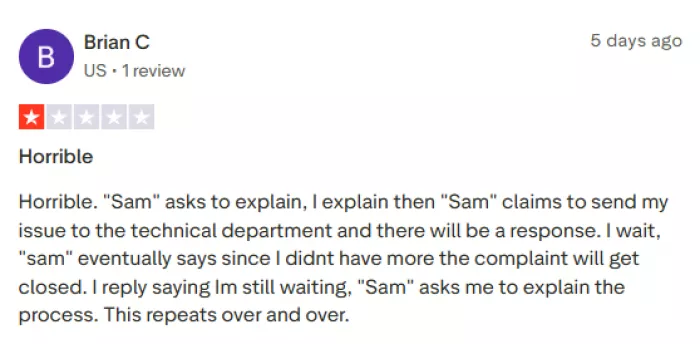
2. Poor Customer Support
● Frequent complaints about delayed or unhelpful responses from support staff.
3. Subscription / Billing Problems
● Several reviews allege issues with unauthorized charges or difficulty canceling paid plans.
4. Inconsistent Output Quality
● Some reviewers claim the model drifts off in answers or remains incorrect despite corrections.
● Fact-finding with verification: when you want an answer and quick access to sources for checking.
● Rapid multi-source summaries: “What’s the consensus across sources?” style questions.
● Decision support with evidence: comparing options where citations let you inspect assumptions.
● Open-ended creative writing (citations don’t help much; retrieval may distract).
● Tasks requiring guaranteed correctness (medical dosing, legal advice, safety-critical steps): citations help auditing, but the model can still mis-synthesize.
● Very broad “exhaustive research” unless you can iterate: Perplexity’s own model docs caution that retrieval+synthesis modes aren’t ideal for exhaustive multi-step research by default.
| Dimension | Perplexity AI | Google Search (classic) | ChatGPT-style assistant (no browsing) |
| Primary output | Synthesized answer + citations | Ranked links + snippets | Generated text from model memory |
| Default grounding | Retrieval-first + cited sources (as positioned) | Grounded in documents (you read them) | Not grounded unless you provide sources/tools |
| Strength | Fast “answer with sources” workflow | Comprehensive index; best for navigating many results | Reasoning, drafting, transformation, brainstorming |
| Weakness | Can still misattribute/overgeneralize from sources | User must do synthesis; AI summaries vary by feature set | Can be outdated; may hallucinate without sources |
| Freshness | Claims real-time web search | Strong freshness for indexed web | Depends on training cutoff unless browsing/tools |
| Transparency | Citations expose provenance | Full transparency via links, but no synthesis guarantee | Often opaque unless it cites provided sources |
| Best use cases | Research summaries, quick fact checks, source-backed explanations | Deep dives, shopping, local results, broad exploration | Writing, planning, tutoring, coding, structured reasoning |
Perplexity AI is a retrieval-first answer engine that combines web search with an LLM to produce summarized answers with citations. Unlike Google Search (links) or ChatGPT-style tools (often no sources), it follows a pipeline like query understanding → hybrid retrieval → ranking → passage selection → LLM synthesis → citation attachment.
Public feedback is split: it scores high on G2 (~4.5/5) and Capterra (~4.6/5) for research and citation-backed summaries, but much lower on Trustpilot (~1.6/5) due to complaints about billing/support and inconsistent output. Overall, it works best for fast fact-finding and source-based summaries, but can still fail when sources are weak or when accuracy must be guaranteed.

Do your emails often get ignored and end up unopened in crowded inboxe...
Homework used to take time. You had to go through books, notes, and di...
There is a very specific kind of confidence that comes from generating...

If AI could understand vibes, we wouldn’t be writing essays as prompts...

Hospitals are beginning to see measurable reductions in waiting times...

Artificial intelligence has quickly become part of everyday learning....
Discussion