

Yoodli AI sits in a category that still feels unsettled. It is not productivity software in the traditional sense, not sales tech in the narrow CRM-driven way, and not quite edtech either. It describes itself as an AI roleplay and communication coach, a private space to practice speaking without judgment. That framing has drawn in job seekers, public speakers, sales teams, educators, and coaches. It has also surfaced deeper questions about privacy, consent, and how much of communication can reasonably be evaluated by software.
The mixed reaction around Yoodli is not accidental. It reflects the tension inherent in tools that listen closely, analyze human behavior, and turn subjective skills into metrics.
Most people do not lack information about how to speak better. They lack repetition and feedback. Public speaking advice is everywhere, but practice opportunities are limited, inconsistent, and often uncomfortable. Feedback usually arrives late and is shaped by social dynamics rather than honesty.
Yoodli attempts to address that gap by creating a repeatable practice loop. Users speak. The system listens. Feedback arrives immediately. Over time, patterns emerge.
This is why Yoodli often gets compared to Grammarly for speech. The analogy works only partially. Grammarly edits text artifacts. Yoodli evaluates behavior, timing, tone, and habits. That difference makes the experience feel far more personal and, for some users, more intrusive.
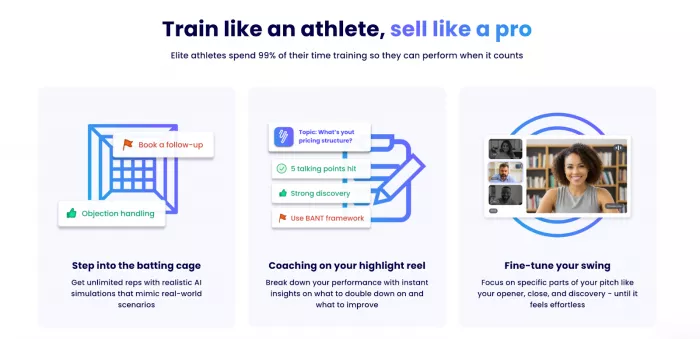
A typical Yoodli session starts with a scenario. Users choose an interview, pitch, presentation, or conversation roleplay. They can define the goal and, in many cases, the persona of the AI conversation partner, such as a skeptical buyer, an interview panel, or a group presentation setting.
The AI asks questions and responds dynamically. As the user speaks, Yoodli tracks delivery signals like pace, filler words, pauses, clarity, and verbal structure. Depending on the setup, feedback appears during the session or afterward.
Post-session, users see analytics that summarize how they spoke rather than what they said. Over time, these analytics show trends rather than one-off mistakes, which is where the tool becomes more useful than a single coaching session.
For organizations, Yoodli extends this model into structured programs. Teams can upload talk tracks, rubrics, and methodologies. Roleplays can be assigned, completed, and reviewed asynchronously, with dashboards that show patterns across groups rather than anecdotes from managers.
Across G2 reviews and practitioner feedback, several themes appear repeatedly. These are not marketing claims so much as recurring user observations.
• Practice feels realistic enough to matter
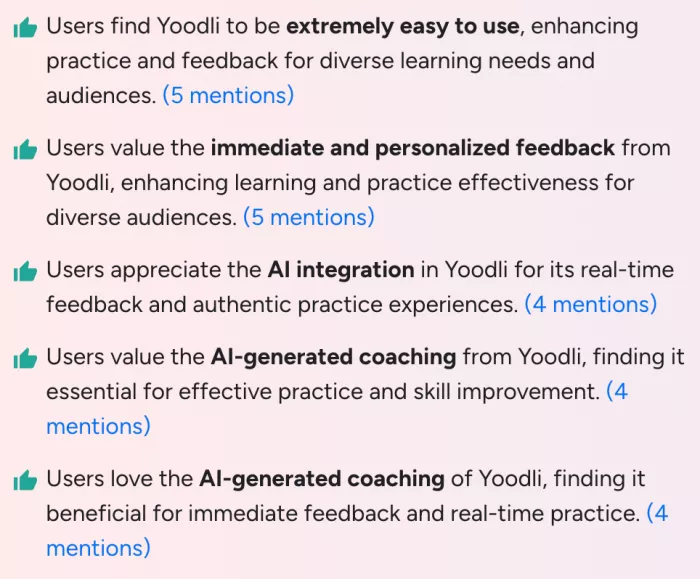
Users often say the AI follow-up questions feel close to real conversations, especially in interviews and pitch certification contexts. This realism makes practice transferable rather than performative.
• Feedback highlights habits people miss
Filler words, uneven pacing, rushed closings, and overlong explanations are hard to self-diagnose. Users value having these surfaced consistently without social discomfort.
• Time savings for coaches and managers
Program managers and enablement leaders note that Yoodli reduces the need to sit through every practice session. They can focus on trends and targeted coaching instead.
• Low barrier to practice
Reviewers repeatedly describe the interface as approachable after a short adjustment period. This matters because tools that feel heavy or complex tend to reduce practice frequency.
• Encourages repetition rather than perfection
Because feedback is private and repeatable, users feel more comfortable practicing often, which is where improvement actually happens.
The criticism around Yoodli is not primarily about whether it works. It is about what kind of coaching it provides and what it does not.
• Delivery over strategy
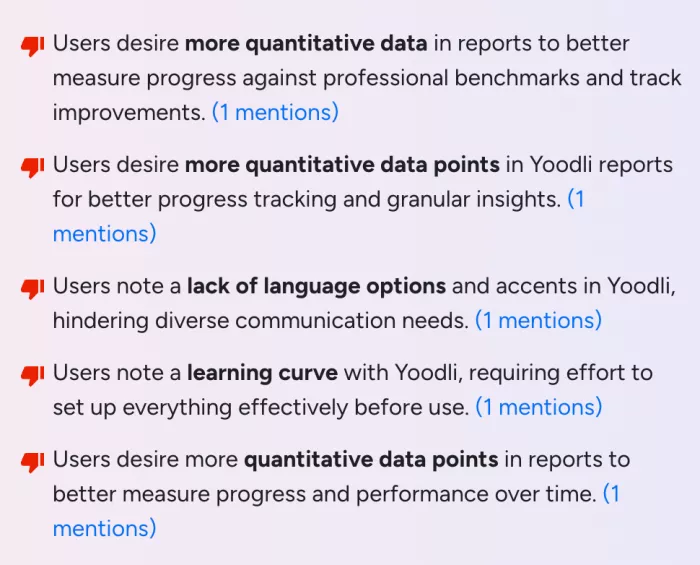
Yoodli excels at how something is said. It does not deeply evaluate whether an argument is strategically sound, persuasive in context, or aligned with deal dynamics. Sales professionals sometimes expect more strategic judgment than the system currently offers.
• Occasional latency in live roleplays
Some users notice short pauses while the AI processes responses. This rarely breaks usability but can disrupt immersion during fast-paced practice.
• Metrics stop short of deep insight
While analytics are clear, some reviewers want richer longitudinal reporting or benchmarking against expert speakers beyond pacing comparisons.
• Adjustment period for real-time feedback
Seeing feedback while speaking can feel distracting at first. Users generally adapt, but the initial experience can feel unnatural.

Long before Yoodli positioned itself as enterprise-grade software, it was discussed in communities like Toastmasters. Those early Reddit threads still shape perception.
The concern was not whether Yoodli worked. It was about what happened to recorded speeches, how content could be reused, and whether users retained control. Some readers of the terms of service felt uncomfortable with how broadly content usage was defined at the time.
Yoodli responded publicly, acknowledging the concern, explaining deletion controls, and stating that terms would be updated. That transparency mattered, but it did not eliminate the underlying tension.
Any tool that records and analyzes speech will trigger privacy anxiety. Yoodli’s challenge is not unique, but it is unavoidable given the nature of the product.
Today, Yoodli emphasizes SOC 2 Type 2 certification and GDPR compliance. Enterprise plans include SSO, SCIM, configurable data retention, and integrations with LMS, CMS, and HR systems.
For organizations, the distinction between coaching and monitoring is critical. Used thoughtfully, Yoodli supports skill development without constant human oversight. Used poorly, it risks feeling like surveillance disguised as training.
That risk is not embedded in the software itself. It depends on how leadership frames and deploys it.
Yoodli’s pricing is not fragmented. It is tiered by intent and usage, with a clear progression from exploration to enterprise deployment.
| Plan | Cost | Intended use | Key limits |
| Starter | Free | Exploration and casual practice | Up to 5 roleplays total |
| Pro | $8 per month, billed annually | High-stakes preparation | Up to 10 roleplays per week |
| Advanced | $20 per month, billed annually | Ongoing improvement | Unlimited roleplays, data excluded from AI training |
| Team & Enterprise | Custom | Organizational training | Dashboards, SSO, integrations, SOC 2 |
The Advanced tier is notable because it explicitly excludes user data from AI training, which directly addresses earlier privacy concerns for sensitive use cases.
Yoodli occupies a middle ground. It is more interactive than static speech analysis tools and less specialized than sales-only roleplay platforms.
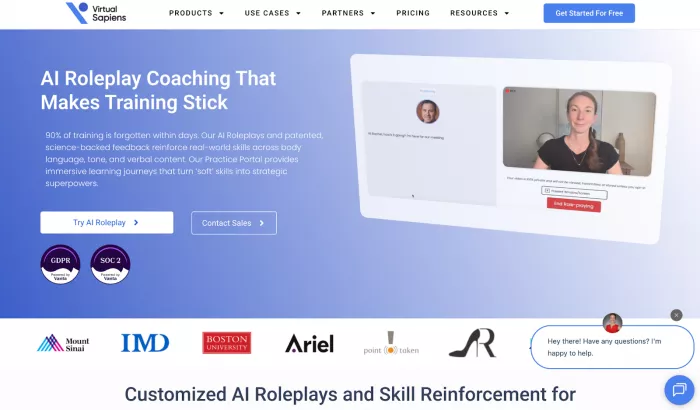
Tools like Virtual Sapiens focus heavily on executive presence and non-verbal cues. Sales roleplay platforms go deeper into CRM-driven simulations and deal mechanics. Yoodli stays horizontal, applying across interviews, presentations, leadership communication, and sales onboarding.
This breadth is why it works well as a general communication coach and why specialists sometimes find it insufficient for narrow objectives.
| Dimension | Where Yoodli works well | Where it falls short |
| Practice realism | Dynamic, conversational roleplays | Not identical to live pressure |
| Feedback quality | Strong on pacing and habits | Limited strategic evaluation |
| Accessibility | Easy to start and repeat | Initial adjustment required |
| Privacy controls | Clear deletion and enterprise safeguards | Trust depends on usage context |
| Scalability | Effective for cohorts and programs | Not deeply verticalized |
Yoodli AI is not a shortcut to confidence. It is a repetition engine.
It works best for people who believe communication improves through practice, reflection, and pattern recognition. It helps surface habits that human feedback often misses or softens. It lowers the friction of practicing out loud, which is where real improvement happens.
At the same time, the discomfort some users feel is valid. A tool that listens closely deserves scrutiny. Yoodli’s emphasis on privacy controls and enterprise compliance helps, but trust ultimately depends on how the tool is framed and used.
Yoodli is not a replacement for human coaching, nor does it claim to be. It is infrastructure for practice.
For users who want more reps, clearer feedback, and a private space to improve how they speak, it can be valuable. For those uncomfortable with AI-mediated evaluation, no amount of certification will make it feel right.
That tension is not a flaw. It is the reality of building software that listens.
Let’s start with a small truth about storytelling: writing the first s...

WhatsApp is preparing to allow third-party artificial intelligence cha...
BrandCrowd built its name as a go-to logo tool for small business...
There is a specific kind of disappointment that comes from opening a b...

AI companion apps have moved well beyond novelty status. What started...
Let’s start with an uncomfortable truth. Most people want their photos...
Discussion