
AI writing tools are now widely used across marketing, SEO, and content creation because teams need to produce more content without increasing time or headcount.
GravityWrite AI and Copy.ai are often compared because both promise faster content generation. On the surface, they seem similar. In practice, the difference becomes clear when you look at how they perform in real workflows.
This comparison focuses on actual use cases, not feature lists, so the decision becomes clearer based on how content is created and used.
| Category | GravityWrite AI | Copy.ai |
| Pricing | Free plan, paid starts ~$8–$15/month, Pro ~$49/month | Free plan available, Pro ~$36/month |
| Best Use Case | Quick blog drafts, basic content, budget workflows | Marketing automation, sales copy, structured workflows |
| Ease of Use | Very easy, template-driven | Easy but more system-oriented |
| AI Capabilities | Template-based generation | Workflow automation, prompt chaining |
| Ratings | ~4.5–4.7 (varies) | G2: 4.7, Capterra: ~4.6 |
This table sets the baseline. GravityWrite is positioned for simplicity and affordability, while Copy.ai is built more around structured marketing workflows.
GravityWrite is designed for quick blog generation using structured templates. Users can input a topic and generate full drafts with headings, introductions, and sections. It works well for informational content and basic SEO articles, especially when speed matters more than depth.

Copy.ai approaches blog writing differently. It relies more on workflows and prompt chaining rather than fixed templates. This gives more flexibility but requires more input structuring. The output tends to be more controlled, but not always faster.
In terms of SEO, neither tool replaces dedicated SEO platforms, but Copy.ai has slightly better alignment with structured content creation when combined with workflows.
Quick comparison:
GravityWrite: Faster draft generation, but content may feel generic in long-form
Copy.ai: More control and structure, but requires more setup
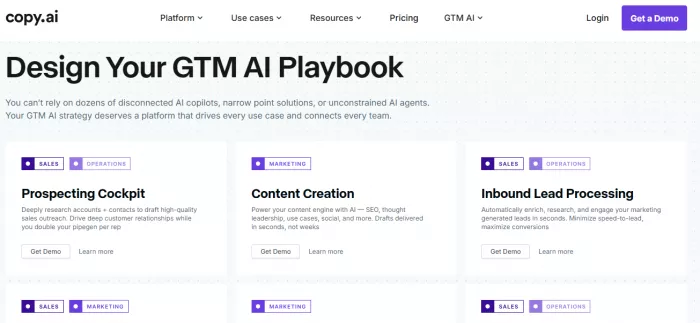
This is where Copy.ai has a clear advantage. It is designed for marketing workflows, including email sequences, ad copy variations, and landing page messaging. The tool allows users to build repeatable systems for generating high-conversion content.
GravityWrite also supports marketing copy through templates, but it is more static. It works well for one-off outputs like social posts or ad headlines, but lacks depth in campaign-level workflows.
Copy.ai performs better when content needs to be iterative and optimized across multiple variations.
Quick comparison:
GravityWrite: Good for quick ad copy and social content, limited depth
Copy.ai: Strong for campaigns, sequences, and conversion-focused writing
GravityWrite is optimized for speed. Its template-based approach allows users to generate content in a few clicks. For users producing large volumes of basic content, it is efficient and predictable.
Copy.ai is slightly slower in raw generation because it emphasizes structured workflows. However, once workflows are set up, it becomes more scalable for repeated tasks like email campaigns or product descriptions.
The difference is simple. GravityWrite is faster for immediate output. Copy.ai is more scalable for repeated processes.
Quick comparison:
GravityWrite: Faster for one-click content generation
Copy.ai: Better for repeatable, system-driven content production
GravityWrite is easier to start with. The interface is simple, and most features are template-driven. Users can generate content without understanding prompt engineering or workflow setup.
Copy.ai requires more initial effort. Users need to understand how workflows function and how to structure inputs effectively. Once learned, it offers more flexibility.
This creates a clear difference in user type. GravityWrite is beginner-friendly. Copy.ai is better suited for users who want control and are willing to invest time.
Quick comparison:
GravityWrite: Minimal learning curve, immediate usability
Copy.ai: Moderate learning curve, higher long-term flexibility
| Feature | GravityWrite AI | Copy.ai |
| Long-Form Writing | Moderate, template-driven | Flexible but workflow-dependent |
| Templates | 80+ templates | Fewer templates, more customizable |
| Automation Workflows | Limited | Strong workflow automation |
| SEO Support | Basic | Moderate (better with structured prompts) |
| Integrations | Minimal | Better integration ecosystem |
This table reinforces the pattern. GravityWrite simplifies content creation. Copy.ai builds systems around it.
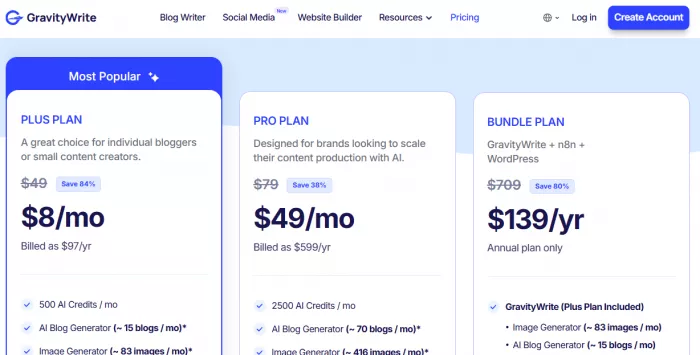
GravityWrite:
Free plan available
Plus: ~$8–$15/month (limited credits)
Pro: ~$49/month
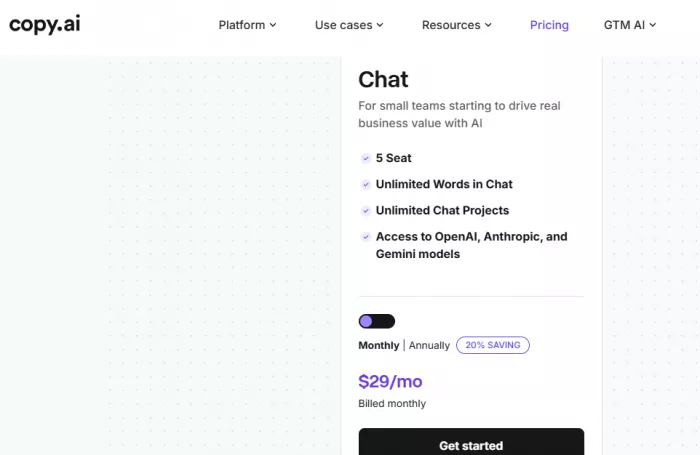
Copy.ai:
Free plan available
Pro: ~$29/month
GravityWrite is more affordable at the entry level. It allows users to start at a lower cost, but usage limits can push users toward higher plans.
Copy.ai sits in the mid-range. It is more expensive than entry-level GravityWrite plans but offers more structured capabilities for marketing workflows.
The decision depends on usage. If the goal is occasional content generation, GravityWrite is more cost-effective. If the goal is building repeatable content systems, Copy.ai justifies its pricing.
| If your goal is | Best choice | Why |
| Affordable content writing | GravityWrite AI | Lower entry cost with essential features |
| Quick blog generation | GravityWrite AI | Faster template-based output |
| Beginner-friendly tool | GravityWrite AI | Simple interface and setup |
| Marketing automation workflows | Copy.ai | Workflow-driven content creation |
| Email and ad campaigns | Copy.ai | Better for structured marketing outputs |
| Scalable content systems | Copy.ai | Designed for repeatable processes |
Copy.ai is the stronger tool overall because it supports structured workflows, automation, and scalable marketing systems. It is better suited for teams and businesses that rely on content as a core function.
GravityWrite AI is the smarter choice for affordability and speed. It works well for individuals and small teams that need quick output without complexity.
If the goal is fast and low-cost content generation, GravityWrite is sufficient. If the goal is building repeatable, high-impact content systems, Copy.ai is the better investment.

Marketing teams often need images before a product is ready for a phot...
Creating a logo that will grab customers' attention is one of the main...

Enterprise software has a well-known failure mode. The demo goes great...

Most people who produce video at any real scale hit the same wall even...

A cinematic AI video needs more than realistic skin, dramatic lighting...

Have you noticed how difficult it is not to watch spoilers of a sporti...

Discussion