


A quirky nickname is masking a serious shift in artificial intelligence.
Across China, an open-source AI agent called OpenClaw has sparked what users are calling a “lobster frenzy,” drawing crowds, spawning local clones, and quietly aligning with Beijing’s long-term AI strategy. But behind the viral excitement lies a more consequential development: the rapid normalization of AI systems that do more than respond—they act.
The software at the center of the phenomenon, OpenClaw, is not a typical chatbot. Built by an Austrian developer and released in 2025, it is designed as an agentic AI assistant capable of executing tasks autonomously.
Users can instruct it to send emails, organize files, manage social media accounts, or even carry out trading actions with minimal supervision. The system plugs into different underlying AI models and operates more like a digital assistant than a conversational tool.
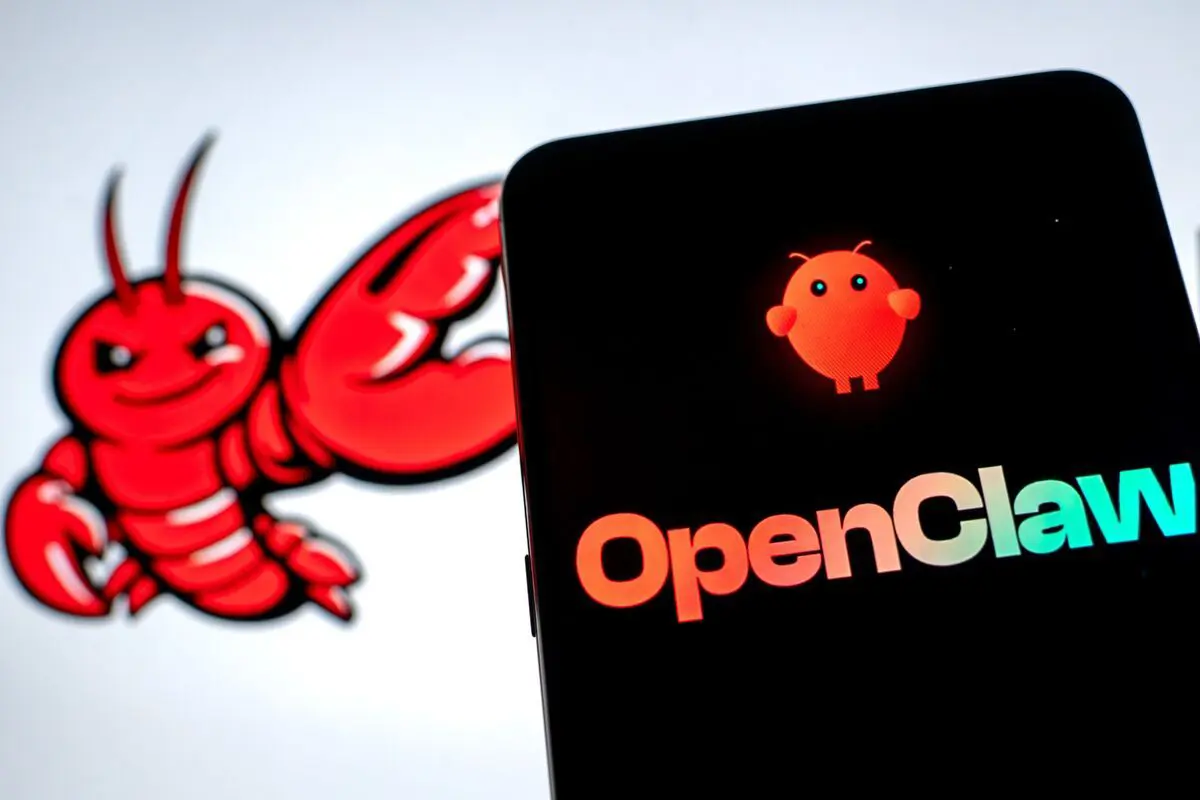
Its red claw logo quickly earned it the nickname “little lobster” among Chinese users, and interacting with it has been described as “raising a lobster.” The phrase has since become shorthand for experimenting with agentic AI.
The trend has moved beyond online curiosity. Reports indicate that people have gathered at offices of major Chinese tech companies seeking help installing or customizing their own “lobsters,” while local events have attracted hundreds of developers and enthusiasts.
What began as a tool has become a movement.
The surge in popularity is tied directly to what OpenClaw represents technically.
Unlike ChatGPT-style systems that wait for prompts, OpenClaw is designed to initiate and execute workflows. It can call tools, interact with files, and complete multi-step tasks without continuous human input.
This marks a shift from passive AI to active systems.
In Chinese media and policy discussions, this transition is often framed as the evolution from “chatbots” to “AI agents.” The distinction is critical. Chatbots assist. Agents operate.
That capability aligns closely with China’s broader vision of AI as a productivity engine embedded across industries, rather than a standalone digital assistant.
What makes the “lobster” phenomenon particularly notable is how quickly grassroots adoption has intersected with institutional backing.
Developers, students, and small business owners have reportedly begun integrating OpenClaw into daily workflows, using it to automate social media management, scheduling, and experimental income streams. The usage is not theoretical. It is practical and widespread.
At the same time, Chinese technology firms have moved rapidly to localize the tool.
Variants such as DuClaw, QClaw, and ArkClaw have emerged, often hosted on domestic cloud infrastructure and connected to Chinese large language models from companies like Baidu, Alibaba, and ByteDance. These localized versions adapt the open-source framework to fit China’s ecosystem and regulatory environment.
Local governments have also begun offering subsidies and incentives to companies adopting agentic AI systems, effectively turning a viral trend into a policy-aligned initiative.
The result is a rare convergence: consumer enthusiasm, developer experimentation, and state encouragement all moving in the same direction.
The rapid spread of OpenClaw is not just a cultural moment. It reflects several deeper strategic priorities.
First, it highlights China’s focus on agentic AI as a productivity multiplier. With economic growth slowing and demographic pressures increasing, policymakers see AI agents as a way to maintain output without relying on labor-intensive expansion.
Second, it aligns with the government’s “AI Plus” initiative, which targets widespread integration of AI across industries. Official goals include AI adoption in 70 percent of key sectors by 2027 and up to 90 percent by 2030. Agent-based systems are seen as essential to achieving that scale.
Third, it demonstrates a deployment-first approach. While China is often viewed as trailing the United States in frontier AI model development, its ability to drive rapid real-world adoption may provide a different kind of advantage. Large-scale usage generates data, and data improves systems.
In this sense, the lobster craze is not accidental. It is a live experiment in scaling AI across everyday workflows.
The same features driving OpenClaw’s adoption are also raising concerns.
Because the tool is open-source and foreign-developed, it introduces questions about data flow and compliance with China’s strict localization requirements. Sensitive information processed by the system could potentially move خارج domestic control, a scenario that regulators are keen to avoid.
Security risks have also emerged.
Reports indicate that malicious actors have used OpenClaw’s marketplace to distribute malware disguised as productivity tools. In response, China’s cybersecurity authorities have issued warnings and begun auditing the ecosystem for vulnerabilities.
There is also a broader social concern.
As agentic systems become more capable, they may begin to replace certain categories of work, particularly in administrative and service roles. At a time of high youth unemployment, this introduces a tension between technological advancement and job stability.
These risks underscore a familiar challenge for Beijing: balancing rapid innovation with strict oversight.
Beyond China, the OpenClaw phenomenon carries wider implications.
It demonstrates how quickly an open-source AI tool can spread across borders and become embedded in a different technological and political ecosystem. Once adopted at scale, such tools are difficult to contain or fully control.
It also highlights a divergence in approach.
While Western markets increasingly emphasize regulation and risk mitigation, China appears willing to tolerate higher levels of experimentation in pursuit of faster deployment. This difference could shape the competitive landscape of AI in the coming years.
At the same time, China’s response to OpenClaw—developing domestic alternatives and tightening oversight—suggests that control remains a central priority.
The future of the “lobster” craze will depend on how these competing forces evolve.
On one side is momentum. Developers and users are actively exploring what agentic AI can do, and early use cases are already demonstrating tangible productivity gains.
On the other side is regulation. As concerns around data security, misuse, and economic impact grow, authorities are likely to impose stricter controls on how such systems are deployed.
The key question is whether China can maintain its rapid pace of adoption while tightening oversight without slowing innovation.
OpenClaw’s rise in China is not just a viral tech story.
It is a glimpse into the next phase of artificial intelligence, where systems move from responding to acting—and where the race is no longer just about building smarter models, but about deploying them at scale.
For Beijing, the lobster moment is both an opportunity and a test.
How far it allows agentic AI to operate freely may determine how quickly it can turn ambition into advantage—and how much control it is willing to trade in the process.

Marketing teams often need images before a product is ready for a phot...

Creating a logo that will grab customers' attention is one of the main...

Enterprise software has a well-known failure mode. The demo goes great...

Most people who produce video at any real scale hit the same wall even...

A cinematic AI video needs more than realistic skin, dramatic lighting...

Have you noticed how difficult it is not to watch spoilers of a sporti...
Discussion