

Maybe the replies started landing a little slower. Maybe the phone now travels from room to room, screen turned down. Maybe nothing concrete has happened at all, and the only real change is a quiet question that will not settle. That is usually the moment someone first types Cheaterbuster AI into a search bar.
If that is roughly where you are, the honest goal is not drama. It is clarity. You want to know whether a tool like this will actually tell you something real, or whether it will take your money, raise your blood pressure, and leave you exactly where you started.
So this review stays practical. It looks at how accurate Cheaterbuster AI tends to be, what it costs once the recurring billing is accounted for, what real customers complain about, the privacy questions that come with pointing facial recognition at another person, and the realistic expectations worth holding before paying. It also covers the gentler alternatives, and the situations where the tool helps versus the ones where it quietly makes things worse.
| The short version: Cheaterbuster AI can sometimes surface a public dating profile, but a result from it is a lead to check, never a verdict to act on. |
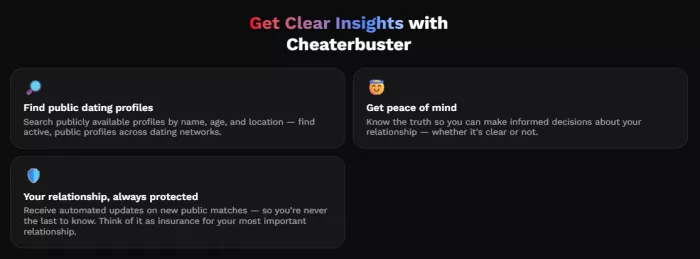
Cheaterbuster started life years ago as a simple Tinder lookup (it was originally launched as Swipebuster) and has since rebuilt itself around AI and photo matching. On its current site it presents a dating profile search, a face based photo search it calls FaceTrace, and ongoing monitoring that re-runs your search over time.
A few things it is not, which matter before any money changes hands. It is not a chatbot or a relationship counsellor, and it gives no advice. It is not connected to your partner's accounts, and it cannot read private messages. Most importantly, it is not proof. It is a search engine that tries to match the name, age, city, and photo you provide against publicly visible profiles, and its output is only ever as good as those inputs.
It is searched most often by people checking dating app activity, Tinder in particular. The company describes itself as a public records search engine that aggregates publicly available information, and says it does not hack accounts or track devices. How it reaches Tinder profiles specifically is not spelled out in public detail, so it is fair to treat the underlying data sources as a partial unknown.
| Reader question | Plain answer | Important caution |
| Can it find a dating profile? | Sometimes, if the profile is public and your details are accurate. | A miss does not mean no profile exists. |
| Can it prove cheating? | No. | A profile is not the same as activity, intent, or a betrayal. |
| Can it miss real profiles? | Yes, often. | Hidden settings, incognito mode, and aliases defeat it. |
| Can it show wrong matches? | Yes. | Common names return strangers who are not your person. |
| Can it replace a conversation? | No. | It may raise more questions than it answers. |
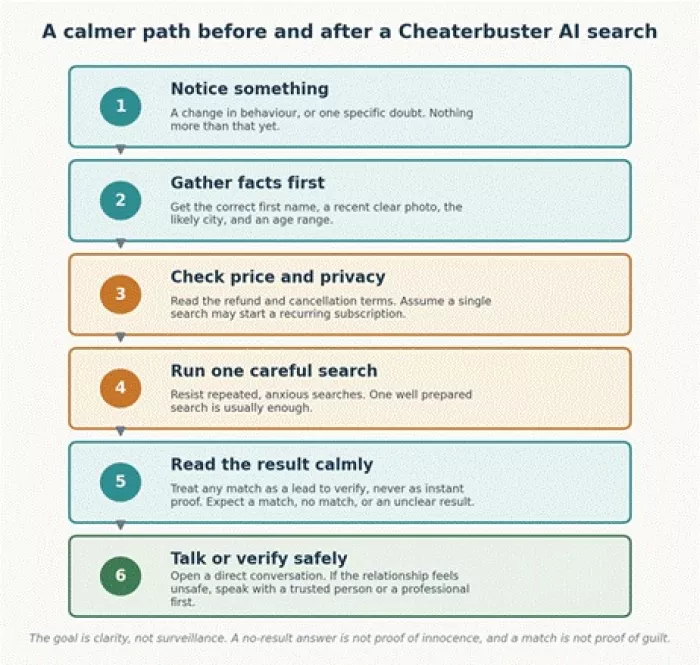
A calmer sequence: gather facts, check price and privacy, run one careful search, then verify safely.
Cheaterbuster does not show a clear price on every public page. The amount usually appears inside the search and payment flow. Based on independent reviews and at least one hands on checkout, a single search has recently been priced at about $17.99, with some sources reporting figures closer to $19.99 or $20. Bundles lower the per search cost, and an Instant Update option has been reported at around $9.99.
The detail that causes the most pain is not the headline number. According to its Trustpilot page and multiple independent reviews, what looks like a one-time purchase often starts a recurring subscription that re-runs the search and bills again, in many reports on a weekly basis. Reviewers describe charges continuing after they believed they had cancelled, and difficulty stopping payments made through PayPal. The company, for its part, says its pricing includes different plan options, including longer term plans billed upfront, and points unhappy customers to its support email for cancellations and refunds.
| Plan or search | Price seen in research | Source | Searches | Subscription or one-time | Refund and cancel note | Last checked |
| Single search | ~ $17.99 (some report $19.99 to $20) | Independent reviews; one hands on checkout | 1 | Often starts a recurring charge | Cancel terms must be checked first | Jun 2026 |
| Multi search bundle | Lower per search (a 3 search bundle reported near $11.66 each) | Independent reviews | 2 to 3 | Billed upfront | Same recurring caution applies | Jun 2026 |
| Instant Update | ~ $9.99 (reported) | Independent reviews | Re-run | Add on | Verify before buying | Jun 2026 |
| "Free" version | Not offered by the official site | Official site; independent reviews | None | Not applicable | Treat any free Cheaterbuster as a likely copycat or scam | Jun 2026 |
| Before you pay: Cheaterbuster AI does not make the full pricing experience equally visible on every public page. Before paying, confirm whether the amount covers one search, a bundle, or a recurring subscription, and screenshot the terms you agreed to. |
Cheaterbuster's site advertises very high accuracy, in the range of 97 to 99 percent. That figure is the company's own marketing claim, not an independently verified result, and it deserves to be read that way.
Independent testing tells a more modest story. Hands on reviews have found the tool can return a close match when the inputs are precise, with real world accuracy often landing somewhere around 80 to 90 percent in those favourable cases, and falling sharply, by some accounts to under half, when the name is common or the details are vague.
Other testers running searches against dating profiles they controlled got no result at all, or unrelated faces. Accuracy here is not a fixed number. It is a range that swings on conditions you partly control and partly cannot.
| Situation | Chance of a useful result | Reason |
| Recent profile, same photos, correct details | Higher | Everything the match needs lines up. |
| Old or inactive profile | Lower | Stale profiles may not surface, or may mislead. |
| Fake or different name used | Lower | The primary filter is pointed at the wrong label. |
| Person is in a different city | Lower | Location is one of the strongest narrowing signals. |
| No profile actually exists | None | There is simply nothing to find. |
| Private, hidden, or deleted profile | Very low | Incognito and privacy settings block discovery. |
| Common first name | Mixed | Expect extra, unrelated matches to sort through. |
| Poor quality uploaded photo | Lower | Weak reference photos undermine face matching. |
| Hold this in mind: A match should be treated as something to verify, not something to immediately confront someone with. |
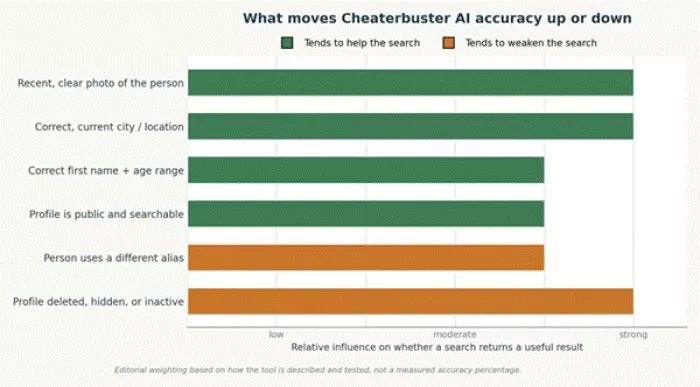
Relative influence of each factor on whether a search returns something useful. It is an editorial weighting, not a measured percentage.
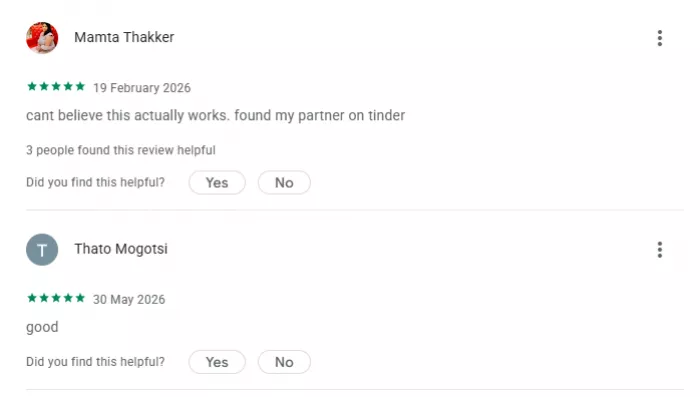
Public reviews are not proof of how a tool will behave for you, and they skew toward people motivated to write. Even so, when the same complaints repeat across hundreds of reviews, the pattern is worth respecting. Cheaterbuster has a Trustpilot profile with hundreds of reviews (roughly 290 as of mid 2026), and the company replies to many negative ones, sometimes by flagging them as not genuine. Reddit threads add a similar, skeptical mix.
| Complaint theme | Seen in public discussions | Possible meaning for users | Before-you-pay check |
| Surprise recurring charges | Frequently | A single search may bill weekly until cancelled. | Read and screenshot the billing terms. |
| Hard to cancel | Frequently | Stopping charges can take a card or PayPal dispute. | Locate the cancel path before paying. |
| Failed or empty results | Frequently | You can pay and still get nothing useful. | Expect a no-result outcome as a real possibility. |
| Slow or absent support | Often | Refund and cancel emails may go unanswered. | Keep records; know your card dispute rights. |
| Inaccurate or random matches | Often | Common names return strangers. | Verify any match independently. |
| Mixed Reddit reliability | Anecdotal | Experiences range from helpful to scam claims. | Weight your own inputs over the hype. |
It is fair to note the other side. The company is a real, operating business rather than a phishing front, some reviewers report genuinely useful results, and at least one trust rating service marks the site as likely safe. Legitimate, though, is not the same as reliable or comfortable.
This is the part that is easy to skip when you are anxious, and the part that matters most. Using a face search tool on another person means uploading their photo into a facial recognition system, usually without their knowledge or consent.
That has drawn serious scrutiny. A 404 Media investigation tested services in this category and found the claims largely held up, locating real dating profiles from a single selfie and a few details, and in one case narrowing a person to a specific neighbourhood. Privacy researchers quoted in that reporting described such tools as close to ideal stalking tools. The Verge has carried similar criticism, with one advisor calling the category vigilante surveillance that quietly builds databases of people without consent.
Outlets including Biometric Update and Big Brother Watch have raised the same alarm about facial recognition, scraped dating data, and marketing that leans on jealousy and fear.
| Privacy question | Reader friendly explanation | Risk level | Safer action |
| Are uploaded photos stored? | Often unclear; retention varies and is rarely spelled out plainly. | Medium to high | Read the current privacy policy before uploading. |
| Is the searched person notified? | Generally no, the search is silent. | Medium | Consider whether silent searching sits right with you. |
| Is dating app data scraped? | The company says it aggregates public data; exact sources are not detailed. | Medium | Do not assume results are complete or authorised. |
| Can results be wrong? | Yes, false matches happen. | High | Never treat a match as confirmation on its own. |
| Can this harm the relationship? | Yes, a secret search can damage trust either way. | High | Decide whether a conversation is the better first step. |
| Is this legal everywhere? | It varies by place and by purpose. | Varies | Get professional advice for any formal use. |
| Please note: For legal, workplace, stalking, divorce, or custody related matters, speak with a qualified professional instead of relying on an online search tool. |
If you decide to use it anyway, the difference between a calm, contained check and a spiral usually comes down to a few habits.
Use it for one narrow question, not as a nightly ritual. Running search after search rarely produces new truth; it mostly produces new anxiety, and more charges. Prepare your details once, run a single careful search, then step back. Compare any result against what you already know, the photo, the name, the city, the age, the bio, the last active signal, and look for consistency rather than a single detail that confirms your fear. Save a result only if it is legally and ethically appropriate to do so. And go in expecting one of three outcomes, because all three are normal.
| Result type | What it means | Best next step |
| Clear match | A public profile lines up with your details. | Verify independently before raising it; stay calm. |
| No result | Nothing surfaced for your inputs. | Not proof of innocence; it may be hidden or elsewhere. |
| Possible match | Something close, but not certain. | Treat as a question, not an answer; gather context. |
| Outdated looking result | An old or inactive profile appears. | An old account is not evidence of current activity. |
| Conflicting result | Details do not fully agree. | Assume noise from a common name; do not over-read it. |
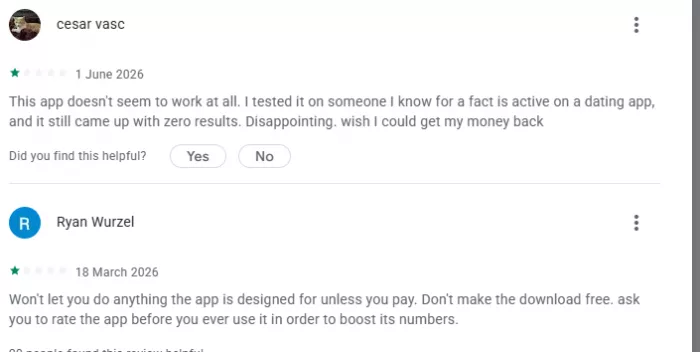
Most people who look up Cheaterbuster are really asking one question: can it check Tinder. In practice, Tinder is where the tool is strongest and where its reputation was built. A search leans on the first name, age, location, and photo you supply, and it works best when those are current and the target profile is public.
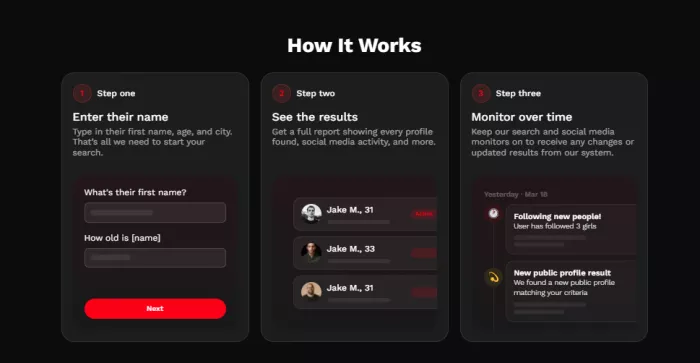
The limits are equally specific. If the person uses a different name, an old photo, Tinder's travel or incognito features, or a paid setting that hides them from people they have not liked, the search can come back empty even when an active profile exists. Independent testers have hit exactly this wall. For that reason, a no-result answer should never be read as solid proof that no profile exists. It often just means the tool could not see it.
It is also worth being careful about claims of direct Tinder access. The company describes itself as aggregating publicly available information, while some reviewers and Reddit users question how reliably any third party can reach Tinder data, given that the platform actively limits scraping. The safest assumption is that coverage is partial and can change without notice.
| Tool | Closer to dating search or people search? | Best use case | Limitation | Privacy caution |
| Cheaterbuster AI | Dating profile search | A single, narrow Tinder profile check | Tinder leaning; recurring billing; mixed accuracy | Facial recognition on a non-consenting person |
| Social Catfish | Identity search with image lookup | Verifying an online date or catching a catfish | Subscription cost; broad, not dating specific | Silent identity search; read retention terms |
| Spokeo | People search | Looking up a known person's public records | No reverse image search; not dating focused | Aggregates personal data into one report |
| BeenVerified | People search | Background style records on a known name | Not a dating profile finder | Same data aggregation concerns |
| PimEyes | Facial recognition (open web) | Finding where a face appears online | Excludes social and dating apps; pricey | Powerful face search; heavy privacy weight |
| Manual reverse image search | Image lookup (free) | Tracing where one photo already appears | Will not match a person across different photos | Lowest cost and lowest intrusion |
Here is the thing most reviews leave out. Often the real problem is not which tool to buy. It is the uncertainty itself, the kind that makes you read into a glance or a slow reply. A search can hand you a clue. It cannot hand you intent, context, or the difference between an account someone forgot to delete and one they are using tonight.
So hold a few things loosely. An old profile is not the same as active cheating; people leave accounts dormant for years. A no-result does not erase whatever made you uneasy, and it will not rebuild trust on its own. A possible match can easily create more anxiety than relief. And almost regardless of what a tool returns, a real conversation is usually still the thing standing between you and an answer you can live with.
| If safety is a factor: If the relationship involves fear, control, or the risk of harm, an online search is not the right tool, and it can make you less safe. In that situation the priority is a safety plan and support from people trained to help, not a profile lookup. |
| Where it helps | Where it falls short |
› Simple, fast, and genuinely easy to use › Useful for one narrow dating profile question › Can work well when your inputs are accurate › Often quicker than searching by hand › Most relevant for Tinder related doubts | › A paid search can return nothing useful › Recurring billing and cancellation complaints are common › False positives and missed profiles both happen › Real privacy and consent concerns › Not a relationship fix, and not legal proof on its own |
Put simply, a tool like this lands in an uncomfortable spot: meaningful privacy risk, paired with proof that is rarely conclusive.
Cheaterbuster AI can be worth trying for one specific, narrow question, if you understand that a result is a starting point and not the end of the story. It is a poor fit for anyone expecting guaranteed truth, full coverage of every dating app, instant certainty, or emotional closure. The safest way to hold it is as a limited search tool, not a decision maker for your relationship.
If your details are accurate, your expectations are realistic, and you have read the billing terms, it may give you a useful lead. If you are paying in a moment of panic and hoping a screen will tell you how to feel, it will almost certainly disappoint, and it may bill you again next week.
| Category | Score | Reason |
| Pricing clarity | 2.0 / 5 | Real cost is obscured by recurring billing and hidden pricing. |
| Accuracy confidence | 2.5 / 5 | Works with precise inputs, but misses and false matches are common. |
| Ease of use | 4.0 / 5 | The interface is simple and results arrive quickly. |
| Privacy comfort | 1.5 / 5 | Facial recognition on a non-consenting person carries real weight. |
| Support and reliability | 2.0 / 5 | Cancellation and support complaints recur across reviews. |
| Emotional usefulness | 2.0 / 5 | It can raise anxiety rather than resolve it. |
| Overall value | 2.5 / 5 | Situationally useful, but easy to misuse and to overpay for. |
| Bottom line: A narrow, occasionally useful tool that asks a lot in privacy and billing risk for an answer it cannot guarantee. |

Marketing teams often need images before a product is ready for a phot...
Creating a logo that will grab customers' attention is one of the main...

Enterprise software has a well-known failure mode. The demo goes great...

Most people who produce video at any real scale hit the same wall even...

A cinematic AI video needs more than realistic skin, dramatic lighting...

Have you noticed how difficult it is not to watch spoilers of a sporti...
Discussion