

I remember opening GravityWrite AI for the first time with a very specific doubt in mind, is this actually a tool I can trust, or just another AI writer dressed up with better marketing? The promises sounded familiar: faster content, SEO-ready blogs, human-like writing. But anyone who has worked seriously with AI tools knows that those claims rarely hold up once you move beyond short demos.
The quick answer is straightforward. GravityWrite is legitimate, safe for general use, and genuinely useful in the right context. But the longer answer is where things get interesting, because its real value depends entirely on how you use it and what you expect from it.
Before diving into details, here’s a realistic scoring based on platform structure, company background, user feedback, and actual performance:
Safety Score: 8.2 / 10
GravityWrite uses standard SaaS-level security practices, including encrypted connections and API-based processing through providers like OpenAI. There are no known major security breaches. However, like all AI tools, it should not be used for sensitive or confidential data.
Trust Score: 8.5 / 10
The platform has a growing user base, visible reviews across platforms, and consistent product updates. Testimonials highlight efficiency and ease of use, though some claims (like “undetectable AI”) are not always consistent in real-world testing.
Legitimacy Score: 9 / 10
Owned by Website Learners Private Limited, a registered and established entity. The platform has structured pricing, integrations, and long-term positioning—clear indicators of a real SaaS business rather than a temporary tool.
Overall Reliability Score: 8.5 / 10
Strong for productivity and scaling content, but not a standalone solution for high-quality, human-level publishing.
If you look at GravityWrite’s positioning, it tries to solve a very specific frustration. Instead of juggling multiple tools like ChatGPT, design platforms, SEO tools, and schedulers, it brings everything into one system. According to its own platform messaging, it aims to “eliminate the chaos” by offering 250+ tools that handle blogs, social media, ads, and even visuals in one place.
That positioning is not just marketing; it reflects how the product is actually built. The tool is less about raw AI intelligence and more about workflow simplification. You are not expected to think like an AI expert. You simply choose a use case, fill structured inputs, and get a ready-made output.
At first glance, this feels incredibly efficient. And in many cases, it is.
GravityWrite is owned by Website Learners Private Limited, which already has a presence in the digital learning and tools ecosystem. This is important because most unreliable AI tools fail at the very first check, they don’t have a traceable company or a long-term vision.
In contrast, GravityWrite shows clear signs of legitimacy. It has an active user base, structured pricing plans, public-facing policies, and integrations with tools like analytics platforms and publishing systems . The platform also claims adoption by multiple known brands, which, while partially promotional, still signals that it is not operating in isolation.
Legitimacy here is not just about registration. It is about continuity. And GravityWrite passes that test.
Most AI tools today operate on a conversational model. You open something like ChatGPT, write a prompt, refine it, and iterate until you get what you need. GravityWrite takes a different approach. It removes the need for prompt engineering entirely and replaces it with structured inputs.
Instead of asking the AI what to do, you guide it through fields. You define your topic, select a tone, add keywords, and the system builds a formatted output using models such as GPT-4 and Claude.

This shift may seem minor, but it fundamentally changes the user experience. It lowers the learning curve, speeds up execution, and standardizes outputs. At the same time, it introduces a trade-off: less flexibility and more predictable patterns in the content.
From a technical standpoint, GravityWrite follows the same security standards as most SaaS platforms. It uses encrypted connections, secure authentication, and third-party APIs such as OpenAI to process content.
There have been no major reports of data breaches or misuse associated with the platform. Its privacy policy also states that generated content is not used to train proprietary models, which is an important reassurance for users concerned about intellectual property.
However, there is a nuance here that many users overlook. AI tools do not operate in isolation. When you input data into GravityWrite, that data is processed through external AI systems. This means that while the platform itself may be secure, it is still not designed for handling highly sensitive or confidential information.
In practical terms, it is safe for marketing, blogging, and general business use, but it should not be treated as a secure environment for legal, financial, or proprietary data.
The first impression of GravityWrite is often positive. The content looks clean, organized, and ready to use. Blog posts come with headings, logical flow, and keyword placement. Social media content feels tailored and purposeful. For many users, this is enough to justify the tool.
But when you analyze the content more closely, a pattern begins to emerge. The writing tends to follow a consistent structure, with predictable phrasing and limited originality. It is effective at assembling information, but it rarely introduces new perspectives or insights.
This is where the difference between “usable content” and “high-quality content” becomes clear. GravityWrite excels at the former but struggles with the latter.
One of the most critical aspects of modern AI content is detectability. Tools like GPTZero and Originality.ai have become standard for evaluating whether content appears human-written.
GravityWrite content is often flagged by these systems with high confidence. Even with built-in humanization features, the outputs typically retain patterns that detection tools can identify.
This does not mean the content is unusable, but it does limit where and how it can be published. For casual blogs, internal content, and marketing materials, this is rarely an issue. For academic writing, high-authority publications, or SEO strategies focused on long-term ranking, it becomes a significant factor.
GravityWrite promotes itself as a platform that combines writing, image generation, social media scheduling, and even website building into one system .
From a workflow perspective, this is powerful. You can generate a blog, create visuals, and schedule social posts without switching tools. For small teams and solo creators, this reduces complexity significantly.
However, the depth of each feature varies. While the writing tools are relatively strong, the image generation is basic compared to tools like Midjourney or DALL-E 3. The platform prioritizes convenience over specialization.
This is not necessarily a flaw, it is a design choice. But it defines how the tool should be used.
GravityWrite positions itself as an SEO-friendly platform, and in many ways, that claim is valid. It helps with keyword placement, meta descriptions, and structured formatting, all of which are important for search optimization.
However, SEO today is no longer just about structure. Search engines increasingly prioritize experience, originality, and authority. Content that feels templated or lacks depth may struggle to compete, regardless of how well it is optimized.
Using GravityWrite for SEO can be effective if it is part of a larger workflow. It works well as a drafting tool, but relying on it for final content without human refinement can limit performance, especially in competitive niches.
One of GravityWrite’s strongest selling points is its library of over 250 tools and templates. These cover a wide range of use cases, from blog writing and ad copy to storytelling and product descriptions.
Templates make the tool accessible and efficient, particularly for beginners. They remove guesswork and provide a clear starting point for content creation.
At the same time, they introduce a level of rigidity. Because many users rely on the same templates, the outputs can start to feel similar across different projects. This is not immediately obvious, but it becomes noticeable when producing content at scale.
GravityWrite performs best in environments where speed and consistency are more important than depth. It is particularly useful for marketers, agencies, and small businesses that need to produce content regularly without investing significant time in writing.
It is also effective for brainstorming, outlining, and generating first drafts. In these roles, it acts as a productivity tool rather than a replacement for human creativity.
For professionals working in specialized fields, the tool is less reliable as a standalone solution. It can support the process, but it cannot replace domain expertise.
Every tool has a ceiling, and GravityWrite is no exception. Its reliance on structured inputs limits creative exploration. Its outputs, while clean, often lack nuance. Its AI detection footprint makes it less suitable for certain types of content.
The inclusion of additional features like image generation suggests an attempt to create an all-in-one platform, but these features do not match the quality of specialized tools such as Midjourney or DALL-E 3.
These limitations do not make the tool ineffective, but they do define how it should be used.
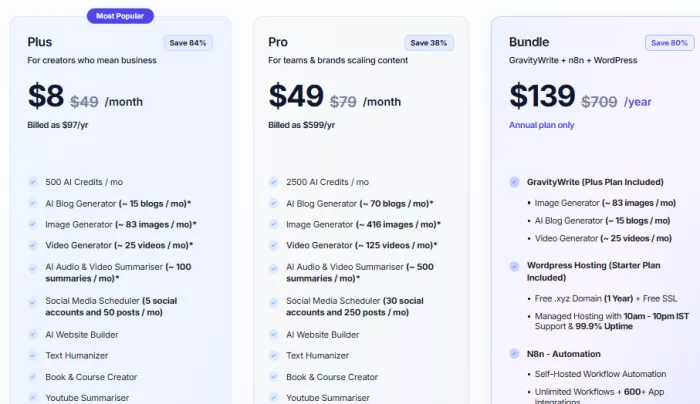
GravityWrite’s pricing is structured around usage credits, with plans designed for individuals and teams. The entry-level plan provides limited output, acting more like a trial, while higher tiers allow large-scale content generation.
What stands out is the bundling. Instead of paying separately for writing, images, and scheduling tools, users get everything in one subscription .
From a cost perspective, this can be efficient. But value depends on usage. If you only need one feature, specialized tools may perform better. If you need an integrated workflow, GravityWrite becomes more compelling.
The biggest mistake users make is expecting AI tools to deliver finished content. GravityWrite is far more effective when used as a starting point rather than an endpoint.
A practical workflow would involve generating a draft, refining the language, adding original insights, and aligning the content with specific goals. This approach not only improves quality but also reduces detectability and enhances overall effectiveness.
GravityWrite is a legitimate and safe platform that delivers real value, particularly in terms of speed and efficiency. It is not a scam, nor is it an empty tool with exaggerated claims.
At the same time, it is not a complete solution for high-quality content creation. Its outputs require human input, its structure can become predictable, and its detectability limits certain use cases.
The tool works best when you understand its role. It is not a replacement for thinking, writing, or expertise. It is a system designed to accelerate those processes.
And in the end, that distinction is what determines whether it becomes a powerful asset or just another tool that falls short of expectations.

Marketing teams often need images before a product is ready for a phot...

Creating a logo that will grab customers' attention is one of the main...

Enterprise software has a well-known failure mode. The demo goes great...

Most people who produce video at any real scale hit the same wall even...

A cinematic AI video needs more than realistic skin, dramatic lighting...

Have you noticed how difficult it is not to watch spoilers of a sporti...
Discussion