

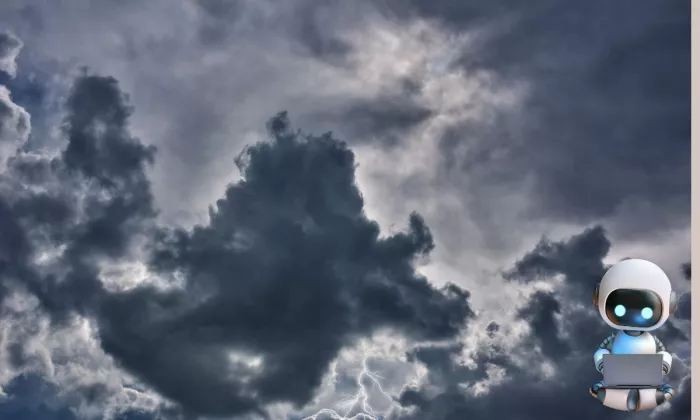
A U.S.‑based weather technology startup says its latest artificial intelligence‑driven forecasting model is surpassing traditional government forecasts from established meteorological agencies, underscoring how machine learning is rapidly transforming weather prediction. WindBorne Systems, founded in 2019 by Stanford alumni, today released WeatherMesh‑6, an AI model that it claims produces hourly weather predictions and matches the five‑day accuracy of conventional models used by major government centers one day ahead of time.
WeatherMesh‑6 forecasts multiple variables including surface temperature, at a 3 kilometer resolution across Europe and the continental United States, a level of detail equivalent to or finer than many official public weather systems. Unlike traditional forecast models that run physics‑based simulations on supercomputers and update output every six hours, WindBorne’s system ingests direct sensor data and runs continuous predictions, enabling hourly updates that adapt more dynamically to changing conditions.
Government meteorological agencies such as the European Centre for Medium‑Range Weather Forecasts (ECMWF) and the National Weather Service (NWS), part of the U.S. National Oceanic and Atmospheric Administration, have long held the gold standard for accuracy. ECMWF models, based on decades of numerical weather prediction expertise, use physics‑based equations to simulate atmospheric behavior. The NWS’s models and supercomputer systems have historically been essential for public safety and national weather services across the United States.
WindBorne’s model, by contrast, blends advanced deep learning with a global network of sensors including data from roughly 400 weather balloons launched from 15 sites worldwide that feed direct real‑time observations into its transformer‑based forecasting engine. According to industry trackers, the startup has raised around $25 million at an $85 million valuation and licenses balloon data to organizations including NOAA and the U.S. military while selling forecasts to commercial traders and investors.
Weather forecasting is one of the most computationally intensive scientific problems, involving vast data streams from satellites, radars, surface stations and atmospheric probes. Traditional approaches solve complex physics equations at large scale, which can take hours on government supercomputers and typically update forecasts at intervals such as six hours or more. AI systems like WeatherMesh‑6 use machine learning to approximate atmospheric dynamics and generate rapid updates with lower latency.
AI weather models are improving quickly, and academic benchmarks show that deep learning systems can outperform older statistical approaches on many forecast accuracy metrics, although they still face challenges on rare extremes and very long‑range forecasts. Research published in arXiv finds that while AI models excel at short‑to‑medium range predictions, traditional numerical methods still outperform them for unprecedented extreme events and long horizons, underlining why hybrid or ensemble systems remain important for operational use.
WindBorne’s progress arrives amid growing interest in AI weather forecasting across public and private sectors. Startups such as Tomorrow.io are building AI‑native satellite constellations and real‑time forecasting networks validated by agencies such as NOAA, showing that commercial systems can complement official models.
Government agencies themselves are incorporating AI into their forecasting pipelines to accelerate predictions and improve data assimilation, though they stress that AI tools are additive rather than replacements for established physics‑based models. The U.S. National Oceanic and Atmospheric Administration launched its own AI‑driven forecast suite while continuing traditional forecasting as part of ensemble approaches.
Industry observers see these developments as part of a broader trend where AI enhances forecasting speed and resolution for sectors such as agriculture, logistics, emergency planning and energy, areas that depend on timely and precise weather information to manage risk and optimize operations.

The Artificial Intelligence world is progressing at a fast pace, becom...

Pink Video Chat can be fun for quick conversations, but it is not perf...
That Uneasy Feeling Before You SearchMaybe the replies started landing...
Airbnb Chief Executive Brian Chesky is planning to launch a new artifi...
Memes carry more reach on social media in 2026 than almost any other f...

I tested Indown.io because Instagram still does not give people a simp...
Discussion