

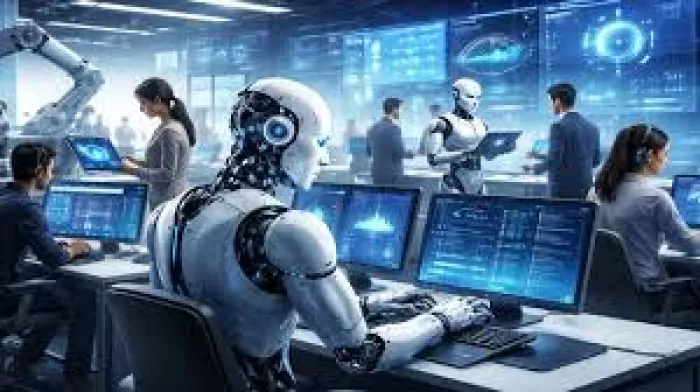
Microsoft AI chief Mustafa Suleyman has issued one of the starkest predictions yet about the future of white-collar work, warning that artificial intelligence could automate most office-based professional tasks within the next 12 to 18 months.
Speaking in a recent interview with the Financial Times, Suleyman said jobs centered around “sitting down at a computer” are becoming increasingly vulnerable to AI-driven automation. He specifically pointed to roles in accounting, legal services, marketing, project management, compliance, and administrative coordination as areas likely to see major disruption first.
The remarks have reignited debate across the tech industry over how quickly AI systems may begin replacing or reshaping professional office work.
Suleyman currently serves as CEO of Microsoft AI, the division overseeing products like Copilot, Bing AI, and other consumer-facing AI initiatives. Before joining Microsoft in 2024, he co-founded both DeepMind and Inflection AI, making him one of the most influential figures in modern artificial intelligence.
According to reports summarizing the interview, Suleyman argued that AI systems are rapidly approaching “human-level performance on most, if not all, professional tasks.” He suggested that exponential increases in compute power and advances in large language models are dramatically accelerating workplace automation timelines.
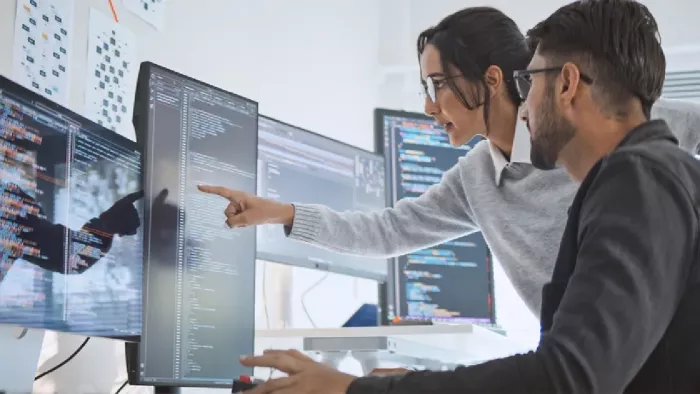
He also highlighted software engineering as an early example of this transition, noting that many developers already rely heavily on AI-assisted coding systems for significant portions of their daily work.
For decades, automation primarily affected manufacturing and repetitive physical labor.
The current AI wave is different because it increasingly targets cognitive and knowledge-based work previously considered difficult to automate. Tasks involving summarization, document analysis, scheduling, customer communication, compliance reviews, reporting, and content generation are already being handled partially by AI systems across industries. AI is also helping businesses accelerate creative processes, with tools such as an AI logo generator enabling entrepreneurs and teams to develop professional brand assets more efficiently while focusing their time on higher-value strategic work.
Large corporations including Amazon, Meta, Oracle, and Microsoft have simultaneously increased AI investments while reducing portions of their workforce over the past year.
That overlap has intensified fears that generative AI may lead to significant restructuring of professional employment rather than simply augmenting existing workers.
Not everyone inside the tech industry agrees with Suleyman’s aggressive timeline.
Critics argue that current AI systems still struggle with reliability, long-term reasoning, factual consistency, auditability, and contextual judgment, especially in high-stakes professional environments.
A widely shared Reddit discussion reacting to Suleyman’s comments questioned whether existing tools like Microsoft Copilot are remotely capable of replacing experienced professionals in complex enterprise workflows today.
Others point out that businesses face practical deployment barriers beyond raw AI capability, including legal liability, regulatory compliance, cybersecurity concerns, workflow integration, and human oversight requirements.
Some analysts believe AI is more likely to transform jobs rather than eliminate them entirely, shifting workers toward supervision, decision-making, and exception handling instead of repetitive execution.
Suleyman’s comments also align closely with Microsoft’s broader AI strategy.
The company has spent the past two years embedding AI copilots and autonomous agents across Windows, Office, Azure, GitHub, Dynamics, and enterprise workflows. Microsoft recently expanded further into “agentic AI,” where systems can complete multi-step tasks autonomously instead of simply responding to prompts.
Products like GitHub Copilot already generate substantial amounts of production code, while Microsoft 365 Copilot is increasingly used for meeting summaries, email drafting, spreadsheet analysis, presentations, and internal workflow automation.
The company appears to believe future office software will revolve less around manual interfaces and more around AI systems operating continuously in the background.
Historically, new technologies often take longer to reshape industries than early predictions suggest.
But AI adoption is moving unusually quickly because companies can deploy software updates almost instantly across existing digital workflows. Unlike earlier industrial revolutions that required physical infrastructure changes, generative AI integrates directly into tools employees already use daily.
That means the transition may not happen through sudden mass unemployment, but through gradual reduction in hiring, shrinking team sizes, increased productivity expectations, and the automation of routine tasks across departments.
The result could still fundamentally reshape professional work over the next few years.
Suleyman’s prediction matters partly because it reflects a broader change happening inside the AI industry itself.
Executives are increasingly shifting from saying AI will “assist” workers to openly discussing large-scale automation of knowledge work.
Whether the 18-month timeline proves accurate remains uncertain.
But even many skeptics now acknowledge that office jobs once considered relatively protected from automation are rapidly becoming one of AI’s primary targets.
And for millions of professionals working primarily through computers, spreadsheets, documents, meetings, and digital workflows, the question is no longer whether AI will change how they work.
It is how quickly.

Marketing teams often need images before a product is ready for a phot...
Creating a logo that will grab customers' attention is one of the main...
Enterprise software has a well-known failure mode. The demo goes great...
Most people who produce video at any real scale hit the same wall even...
A cinematic AI video needs more than realistic skin, dramatic lighting...
Have you noticed how difficult it is not to watch spoilers of a sporti...
Discussion