


SearchingForSingles is the kind of site you only find if you're actively looking for it or if an ad pulled you in. I wanted a clear answer to one question: is this an actual dating service, or is it something else dressed up to look like one? I read the legal pages, walked through the signup, mapped the pricing, cross-checked dozens of independent user reports, and traced the ownership. This is what I found.
SearchingForSingles is not a conventional dating site. Its own Terms of Service acknowledge that the profiles you'll interact with are not other real singles in your area but operator-employed chat staff the site calls "Hosts." Communication runs on paid credits, refunds are rarely granted, and there is no mechanism to move conversations off-platform or into real life. If you're looking for actual dating, this article will save you money. If you're looking for paid online flirtation with disclosed entertainers, read the section on the Hosts system carefully before signing up.
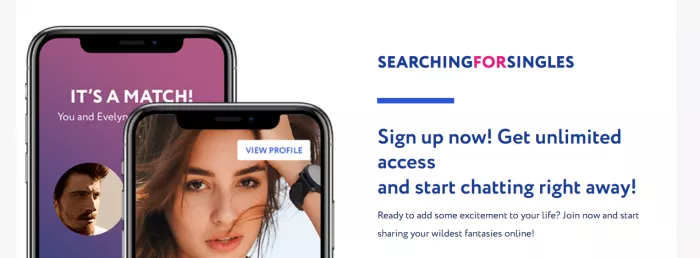
On the surface, SearchingForSingles looks like a standard online dating destination. The landing page leans on the visual grammar every dating site uses: profile-photo grids, location-based language ("singles near you"), promises of quick signup, and a clean colour scheme. The marketing copy talks about meeting attractive locals, discreet relationships, and matching with people who share your interests.
The site operates under at least two domains I've come across — the .com version and a .org mirror with near-identical layout. Both route to the same core experience: free registration, mandatory paid credits to message anyone, and a feature set that mimics what you'd recognise from any mainstream dating app.
If you stop reading at the landing page, you'd assume this is just another mid-tier dating site competing for attention in a crowded category. The story changes the moment you open the legal pages.
I read the Terms of Service in full. Buried in the legal text, well past the section anyone signing up is likely to scroll through, is the single clause that defines the entire business model. The wording isn't ambiguous, and it's the clause every credible independent reviewer has flagged in the same way.
Paraphrased plainly: the site's own legal text states that the profiles users interact with on the platform are imaginary and are managed by people the operator describes as "Hosts." These Hosts are paid by the website to start and continue conversations with new and existing users, with the express purpose of encouraging users to keep using the site, which, in practice, means continuing to spend credits.
This is the foundation of everything that follows. Every "match" you see, every flirty opening message that arrives within minutes of you completing signup, and every conversation that mysteriously stalls when you try to move it toward an actual meeting — all of it sits on top of a model that the operator has disclosed in writing. It's legal because they've disclosed it. It's misleading in practice because almost nobody reads the ToS before joining a dating site, and the landing page does nothing to telegraph what's actually happening.
That single clause is the difference between an honest review and a fluffy affiliate write-up. Once you understand it, every other observation about the site clicks into place.
The operator listed in the legal pages is Hellerman Ltd, a UK-registered company with an address in Southend-on-Sea. The same operator appears across a small constellation of similarly-structured dating-style websites with near-identical feature layouts and ToS language. That pattern one operator, multiple lookalike domains, the same Hosts disclosure tucked into each ToS, is recognisable across the industry, and it's a useful signal when you're trying to evaluate any unfamiliar site.
A few things worth noting about ownership transparency: the operator's contact information is minimal, customer-support response times are widely reported as slow, and there is no executive team page, founder profile, press section, or company history. Compare that against any of the major dating platforms, Match Group, Bumble Inc., eHarmony, all of which publish leadership, financials, and corporate accountability information. That gap is part of why the trust signals on SearchingForSingles read so weakly.
I walked through the registration funnel as a new user would. The flow is intentionally frictionless — friction would lose people, and the business model needs you inside the funnel.
The homepage carries profile-photo tiles and a single prominent registration form. You're asked for username, email, password, gender, who you're looking for, location, and date of birth. The whole thing fits on one screen. There is no questionnaire about personality, lifestyle, or relationship goals, the kind of intake friction that serious matching platforms use to set expectations.
A confirmation email arrives within a minute. Clicking the link activates the account. No phone verification, no ID verification, no two-factor authentication, no selfie check. From a security standpoint, this is the bare minimum that any web service in 2026 implements.
Here's the part that's worth paying close attention to. Within minutes of activating my account before I had uploaded a single photo, filled in an "about me," or expressed any preferences incoming messages started arriving. Multiple flirty openers from polished-looking profiles, all framed around the city I'd entered. This is the engagement-design pattern every credible reviewer has documented, and it ties directly back to the Hosts clause in the ToS. Real users on real dating sites do not message blank profiles.
You can read incoming messages on a free account, but you cannot reply. To reply to anyone, even once you have to buy credits. This is where the funnel ends and the spending begins.
SearchingForSingles does not run on a flat monthly subscription like most mainstream dating apps. Instead, it uses a credit-pack model. You buy credits in bundles, and every meaningful action sending a message, viewing a full photo set, accessing certain features consumes credits.
This is a critical structural detail. A flat subscription caps your spend by definition: you pay $30, you get the month. A credit model has no natural ceiling. The more engaged you are, the faster you burn through credits, and there's no built-in budget alarm telling you when you've crossed an unhealthy threshold. Independent reviewers and complaint forums document users spending hundreds of dollars in a single week and, in some cases, considerably more over longer periods — because the chats are emotionally compelling and the per-message charge feels small.
Cheap introductory trials are advertised the small numbers designed to make purchase resistance collapse. The detail you have to watch for is the auto-renewal terms, which several reviewers have flagged as opaque. Trials that quietly convert to higher-tier recurring charges are one of the most common complaint patterns associated with this category of site.
User reports consistently describe difficulty obtaining refunds for credits spent on conversations that users later concluded were with Hosts rather than real members. Because the Hosts arrangement is disclosed in the ToS, refund claims based on "I didn't know I was talking to a paid moderator" tend not to succeed.
The Hosts arrangement is the single most important thing to understand about this platform. Here's how it works in plain language.
The operator employs (or contracts) people to manage profiles that look indistinguishable from real user profiles. Those profiles initiate and sustain conversations with users. The Hosts may be working multiple profiles simultaneously across multiple conversations. Their job is not to date anyone they are not in the city the profile claims to be in, they are not the person in the photo, and they cannot physically meet you under any circumstances. Their job is to keep you chatting, which keeps you spending credits.
This is why every user report follows the same arc. The chats are engaging at first, Hosts are paid to be engaging. They flirt back. They remember details. They seem interested. But the conversation never converts into a phone call, a video call, or an in-person meeting. The excuses vary, busy schedules, recent break-ups, work travel, "let's chat more first" — and they continue indefinitely. The DatingSpot24 reviewer documented exactly this pattern across hundreds of test messages.
None of this is technically illegal because it's disclosed in the ToS. But that legal protection is doing a lot of work, most users never read the clause, and the landing-page experience is designed to give the opposite impression.
Setting the Hosts issue aside for a moment, here's what the platform technically offers in terms of feature scope.
A Tinder-style swipe mechanic where you tap an X or a check on profile cards. If both sides check, it registers as a match. Functionally fine; emotionally hollow given everything the ToS says about who's on the other side.
A filtered search across the profile database. Filters cover age range, location, body type, and basic descriptors. One detail worth noting from third-party investigations: when reviewers changed their zip code across different cities, the same profiles often appeared in each location, which contradicts the premise of meeting "locals."
Standard inbox UI. Free accounts can read incoming messages but cannot reply. Replying, attaching photos, sending stickers, and most interaction features are paid.
You can favourite profiles. Paying members can see who favourited them and who visited their profile. As with most metrics on engagement-driven sites, treat the "visitors" number with healthy scepticism.
No video calling. No voice chat. No in-app verification badge for real users. No "real human" filter. No way to flag a profile as suspected fake (an absence that becomes especially loud once you understand the Hosts model). No native mobile app on iOS or Android.
There is no dedicated SearchingForSingles app on the App Store or Google Play. The mobile experience is the website rendered through a phone browser. The responsive layout is functional, buttons are tappable, photos load, the messaging UI scales, but the experience feels noticeably dated compared to native dating apps from 2025–2026, where gesture-based interactions and rich media are standard.
Page-load performance on mobile is acceptable on Wi-Fi and slower on cellular, which is unsurprising for a site relying on heavy profile-photo grids. Notifications are limited to email; you don't get the kind of push-driven engagement loop that Tinder, Hinge, or Bumble use, which from a user-wellbeing perspective is one of the few accidental positives.
The site uses HTTPS, which is now a baseline expectation rather than a feature. Beyond that, the security posture is thin. No two-factor authentication. No identity verification for real members. Privacy policy language around data retention, third-party sharing, and advertising profiling is broad enough that I'd encourage anyone considering signup to read it carefully.
Account deletion is possible but not always immediate, and the cancellation flow for paid memberships is, by multiple user accounts, more friction-laden than the signup flow. If you do create an account and then change your mind, plan to spend time confirming that both the account and any auto-renewing membership are fully terminated, and keep records.
One specific safety note worth flagging: do not upload identity documents to this kind of platform unless you've independently verified the legitimacy of the request and the operator. Several user reports across forums describe being prompted for ID uploads at various points in the funnel; the same data-protection standards that apply to mainstream services do not visibly apply here.
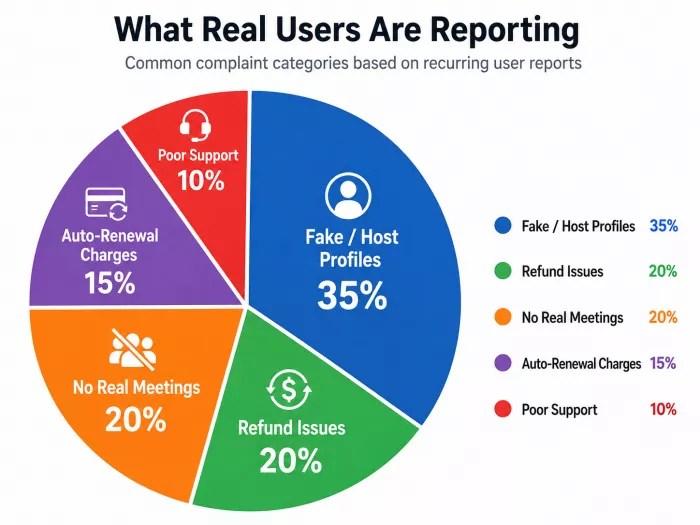
I pulled user feedback from review aggregators, scam-monitoring databases, complaint forums, and independent dating-site reviewers. The pattern is overwhelmingly consistent, which itself is a signal — when feedback varies wildly, you're usually looking at a mixed product; when it converges this tightly, you're looking at a structural issue.
Conversations that never convert into meetings, no matter how long they continue. Responses that arrive faster than feels plausible — including in the middle of the night, regardless of the supposed location's time zone. Profiles that seem unusually polished and unusually available. Refund requests denied. Auto-renewal charges that continued after users believed they had cancelled. Aggregate trust scores on third-party review platforms sit below 2 out of 5, and scam-monitoring databases give the site a medium-or-lower trust rating.
Positive feedback exists, and it's worth being fair about. A subset of users describe the platform as enjoyable purely as a paid chat-and-flirtation product. If you understand going in that you're paying for conversation with paid entertainers, and you treat it like any other paid entertainment service, that experience is internally consistent. The dishonesty isn't in the existence of the service; it's in the gap between the marketing and the actual product.
After working through the funnel, the legal pages, the pricing, and the aggregated user reporting, here's where I land on the criteria that matter.
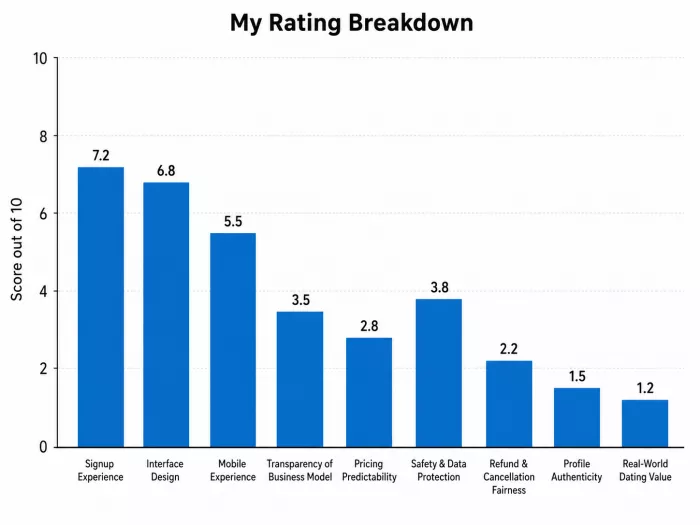
Overall: 3.8 / 10. The interface and signup flow are competent; everything underneath them is structured to extract money from users who didn't understand what they were signing up for. As an actual dating service, this scores in the bottom decile of anything I've reviewed.
If you came here looking for a way to meet real people, the better question isn't whether SearchingForSingles can deliver — it can't, by design, but which mainstream platform actually fits your situation. A quick honest mapping based on what each is good at.
| Platform | Best for | How it makes money (matters) |
| Hinge | People who want serious dating with prompt-driven profiles | Flat subscription tiers; profiles are real users |
| Bumble | Women-first messaging, broad demographic reach | Freemium with premium features; profiles are real users |
| Match | Older demographic, long-term relationship intent | Monthly subscription; profiles are real users |
| eHarmony | Compatibility-questionnaire matching, marriage-minded | Subscription; deeper profile intake |
| OkCupid | Inclusive filters, long-form questionnaires | Freemium with premium tiers; profiles are real users |
The common thread in that list: every one of them charges in a way that has a natural ceiling (a flat subscription) and operates on a model where the profiles you're matching with are other real people who also signed up. That's the structural difference. It's not about whether a site is "good" or "bad" in the abstract, it's about whether the economic incentives are aligned with the outcome you actually want.
SearchingForSingles is not a scam in the legal sense. The operator has disclosed the Hosts arrangement in the Terms of Service, which gives the business model legal cover. But "technically legal" is not the same as "honest with the user," and the gap between the marketing promise and the structural reality is wide enough to drive a financial mistake through.
If you understand what you're paying for a paid online chat-and-flirtation product staffed by paid entertainers, with zero possibility of meeting anyone in real life and the price feels right to you on that basis, that's an informed adult decision. If you're hoping to meet someone real, this is not the right product, and I would put your time and money into one of the alternatives listed above.
The single most useful filter you can apply to any unfamiliar dating site is the one I'd encourage you to take away from this article: read the Terms of Service before you create an account. The clause that matters takes ninety seconds to find. If a site discloses imaginary profiles, paid Hosts, chat moderators, or animated entertainers under any of those names that is the entire site, regardless of what the landing page says.
I have tested and reviewed many CRM tools, and one thing I have learne...

AI-powered drug discovery has long promised to transform pharmaceutica...

Committing to a six-month product cycle forces hard decisions about re...
Quick Comparison TableToolBest ForPricingEase of UseKey FeatureG2 Rati...

Microsoft AI chief Mustafa Suleyman has issued one of the starkest pre...

Tools That Actually Work in Real ScenariosInstead of breaking tools in...
Discussion