
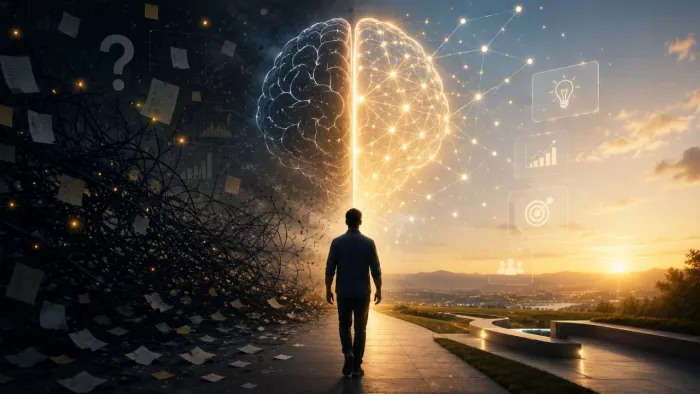
For most of the conversation around artificial intelligence, the word doing the heavy lifting has always been "intelligence." Can machines think. Can they reason. Can they understand. These are the questions that dominate headlines, philosophy departments, and dinner table arguments about whether we're building something genuinely new or just a very convincing imitation of thought.
But spend enough time actually using these systems for real work, and a different question starts to feel more urgent than the philosophical one: what happens when capability stops being scarce?
Because that's the shift actually underway. Not some abstract awakening of machine consciousness, but a much more concrete and immediately consequential development — entire categories of skilled human labor, the kind that used to take years to acquire and access to even attempt, are becoming available to anyone with a clear idea and the patience to direct a tool toward it.
There's a reason so much of the AI conversation in research circles centers on reasoning benchmarks, and so much of the AI conversation among actual working creators centers on something much more mundane: can it finish the thing I'm trying to make.
For a graphic designer, a marketer, a filmmaker, or a small business owner, the philosophical question of whether a model "really" understands what it's producing is almost beside the point. What matters is whether the output is usable, whether it saves real time, and whether it lets them accomplish something that was previously out of reach.
Judged by that standard — the only standard that actually changes how people work and live — artificial intelligence has crossed a threshold that's easy to underappreciate because it happened gradually and without a single dramatic announcement. Capabilities that required years of specialized training a decade ago are now accessible through plain-language instruction. That's not a minor convenience. It's a restructuring of who gets to participate in entire categories of skilled creative and technical work.
If you want to see this restructuring in its most visible form, look at video.
Video has always been the most resource-intensive creative medium — more expensive than writing, more technically demanding than photography, more collaborative than almost any other form of individual creative expression. Producing even a short, professional-quality video traditionally required a camera operator, lighting knowledge, editing software fluency, sound design awareness, and enough hours to assemble all of it into something coherent.
The modern AI video generator has compressed nearly that entire pipeline into a conversation. Describe a scene, a mood, a sequence of events, and the system produces footage that would have required a camera crew and a location just a few years ago. This isn't a claim that the technology has replaced cinematography as a craft — it hasn't, and the best human directors and cinematographers still produce things current AI can't match. But it has done something almost as significant: it's removed the binary choice that used to define independent video production, where you either had access to production resources or you simply didn't make the video.
What's most interesting about watching this technology mature isn't the headline capability — generating video from text — but the secondary effects rippling out from it. Educators who never considered video as a teaching format are now producing explainer content. Small business owners who couldn't justify hiring a videographer are now producing product demonstrations. People with stories to tell who had no path into traditional production are finding one.
The technology didn't make everyone a great filmmaker. It made the attempt possible for people who previously couldn't attempt it at all — which is a different and, in some ways, more important achievement.
If video production broadly represents the most visible AI transformation, there's a narrower, more specialized discipline within it that's worth examining specifically because almost nobody predicted it would become accessible this quickly: trailer editing.
Cutting a trailer is not the same skill as editing a film. It's a distinct craft focused on compression — taking a complete story and constructing a two-minute argument for why anyone should spend two hours with it. The specific techniques involved (selective revelation, emotional pacing across a radically shorter runtime, the precise placement of a title card or a beat of silence) were historically concentrated among a small number of specialists, often working at dedicated trailer houses that studios hired specifically because the skill was too narrow and too valuable to keep in-house.
The arrival of a genuinely capable AI movie trailer generator matters precisely because it targets one of the most specialized, hardest-to-acquire skills in the entire creative pipeline. It's one thing for AI to help someone write a paragraph or generate an image — those are capabilities most people have some baseline familiarity with even if they're not professionally skilled at them. Trailer editing is different. Almost nobody outside the industry has any practical experience with it, which means the gap between "can't do this at all" and "can do this convincingly" used to be enormous and is now substantially smaller.
For independent filmmakers, this closes a gap that had nothing to do with the quality of their actual film and everything to do with whether anyone would ever discover it. A genuinely good independent movie with an amateur trailer often dies quietly — not because the film was bad, but because the marketing failed to communicate what made it worth watching. AI trailer generation is addressing exactly that failure point, for a population of creators who finished the hardest part of the work and got stuck on a problem that was never really about their filmmaking ability.
Looking at video generation and trailer generation together reveals something useful about where artificial intelligence creates the most value — and it's not where most casual observers expect.
The popular imagination of AI risk and AI value tends to center on creativity itself — will AI replace the artist, the writer, the director, the person with the original vision. But the more immediate and measurable transformation is happening one layer down, in the technical execution that surrounds creative vision rather than the vision itself.
Someone with a genuinely good story idea was never short on creativity. They were short on the technical capability to execute that idea to a professional standard, and short on the specialized marketing skill to make sure anyone encountered the finished work. Both of those are technical, learnable, historically gatekept skills — exactly the category where AI systems, trained on enormous amounts of existing professional work, excel at pattern-matching and execution.
This distinction matters because it suggests a more useful way to think about AI's actual trajectory than the binary "will it replace humans" framing that dominates public discussion. The technology isn't replacing the part of creative work that requires genuine original judgment — knowing what story is worth telling, what makes a particular angle compelling, what emotional truth a piece of work is actually built around. It's replacing the technical execution layer that sat between that judgment and its realization, a layer that was never really about creativity in the first place, even though it functioned as a gatekeeper for who got to express theirs.
If technical execution is becoming abundant, what becomes scarce — and valuable — by comparison is judgment. Knowing which story is worth telling. Knowing which two seconds of footage contain something irreplaceable. Knowing when the obvious creative choice is wrong for this specific piece of work and a less obvious one is right.
That's not a skill any current AI system demonstrates convincingly, and it's not obviously a skill that becomes automatable just because execution does. If anything, the abundance of technical capability raises the relative importance of having a genuine point of view, because technical polish alone no longer differentiates anyone — when everyone has access to professional-quality execution, the only remaining differentiator is whether you had something worth executing in the first place.
This is, in a sense, a return to first principles for creative work, after decades where access to expensive technical resources functioned as an accidental filter on whose voices got heard. Remove that filter, and what's left standing is closer to a true meritocracy of ideas — not perfect, not without new problems of its own, but a meaningfully different selection mechanism than the one that's governed creative industries for most of their history.
The most useful framing for artificial intelligence right now isn't whether it thinks, whether it's conscious, or whether it will eventually surpass human intelligence in some general sense. Those are interesting questions for researchers and philosophers, but they're disconnected from what's actually changing in the daily experience of creative and professional work.
The more honest and more immediately relevant framing is simpler: capability that used to be scarce, expensive, and gatekept is becoming abundant, accessible, and directable by ordinary people with clear ideas. That shift is visible in video production, in trailer marketing, and in dozens of other specialized disciplines that are quietly becoming available to people who never had institutional access to them before.
Intelligence, it turns out, was never really the hard part — at least not in the sense that mattered for most people trying to make something. Access was the hard part. And access is the thing that's actually changing.

Creating a logo that will grab customers' attention is one of the main...

Enterprise software has a well-known failure mode. The demo goes great...
Most people who produce video at any real scale hit the same wall even...
A cinematic AI video needs more than realistic skin, dramatic lighting...
Have you noticed how difficult it is not to watch spoilers of a sporti...

Most investors building around AI stocks are chasing growth, and that...

Discussion