

FaceCheck ID can feel useful when a profile photo looks suspicious or when someone wants to check whether a personal image already appears online. A reverse face search promises a quick way to spot catfishing, flag a possible scammer, or trace where a picture has spread. The appeal is understandable, especially for online dating, marketplace deals, and open source research.
Before anyone uploads a face to FaceCheck ID, it helps to separate what the tool can suggest from what it cannot prove. This review covers privacy, accuracy, legal limits, removal options, pricing, and ethical use, so the decision to use it rests on facts rather than first impressions.
| Factor | Verdict |
|---|---|
| Safety | Caution required |
| Privacy risk | Medium to high |
| Accuracy | Useful but not proof |
| Best use | Self-checking, dating scam checks, reused photo detection |
| Worst use | Hiring, housing, lending, public accusations, minors |
| Free version | Limited/blurred preview |
| Payment model | Credit packs |
| Main concern | False matches and biometric privacy |
| Best alternative | PimEyes, Google Lens, TinEye, Social Catfish, Lenso.ai |
| Final rating | 3.7/5 |
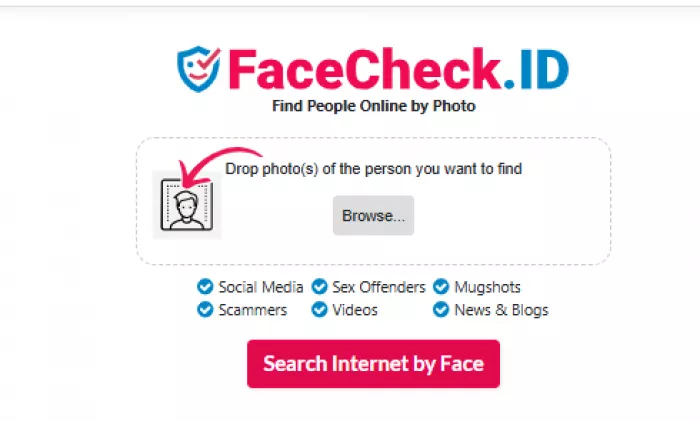
FaceCheck ID is a reverse face search tool. A user uploads a face image, and the engine looks for visually similar faces across indexed public web sources, then returns links to pages where those similar faces appear. Instead of matching an entire image like a standard reverse image search, it focuses on the face itself.
According to FaceCheck ID public materials, the index draws on a wide range of sources, and the service highlights coverage that includes mugshot sites, sex offender registries, and people who have appeared as suspects in news reports. Results are presented with confidence labels, reported as tiers such as Certain, Confident, Uncertain, and Weak, and some matches may carry red flag indicators when certain source categories or score thresholds appear.
Those red flags and confidence labels are signals, not verdicts. A similar face on a mugshot page does not establish that an uploaded person has a criminal record, and a high confidence label does not establish identity. FaceCheck ID is best understood as a starting point for further checking, not as proof of identity, criminal history, safety, or character.
| Item | Details |
| Tool name | FaceCheck ID |
| Type | Reverse face search engine (facial recognition based image search) |
Primary use | Finding where a similar face appears across indexed public web sources |
Typical users | People checking dating profiles or possible scammers, people checking their own online image exposure, and OSINT researchers |
Result format | Source links with confidence labels such as Certain, Confident, Uncertain, and Weak |
Access model | Prepaid credit packs, with blurred preview results shown before payment |
| Official website | facecheck.id |
| Safe use level | Caution required |
| Last checked | June 2026 (review-time snapshot) |
This review follows the Six-Vector Face-Search Safety Review, a fixed framework applied to facial recognition and reverse face search tools. The six vectors are upload and data handling, match reliability, legal exposure, removal and opt-out pathways, pricing transparency, and ethical use. Each vector is assessed against the tool official pages, its published terms and removal information, independent user feedback, and a careful hands-on check performed only with a consent based image.
The assessment avoids fabricated ratings and invented statistics. Pricing and access details are recorded as a review-time snapshot, because credit systems and payment rules change.
Accuracy is described through documented behavior and reported testing rather than a single guaranteed score. Where a question depends on jurisdiction or current policy, the review points readers to the official page or a qualified professional rather than offering a firm answer.
The summary below rates eight common ways people use FaceCheck ID. Risk rises sharply when a search moves from self checking toward judging or exposing other people, and it becomes unsafe when results feed regulated decisions or harmful tracking.
The rating reflects how much depends on who is searched and how results are used.
| Safety area | Risk level | Practical meaning |
| Uploading someone else's face |
Medium to High | Raises consent, privacy, and legal questions even when the photo is public |
Dating safety checks |
Medium | Useful as one signal, but a match is not proof and should never trigger public accusation |
Employment screening |
High | Regulated in many regions and not a reliable or lawful basis for hiring decisions |
| Assuming criminal history from a match |
High | A similar face on a mugshot page does not establish any record or wrongdoing |
Public shaming or exposure |
High | Can cause serious harm to a misidentified person and may carry legal liability |
Stalking or harassment use |
Very High | Unsafe, likely unlawful, and never an acceptable use |
Uploading minors' faces |
Very High | Serious safety, privacy, and legal concerns, and should be avoided entirely |
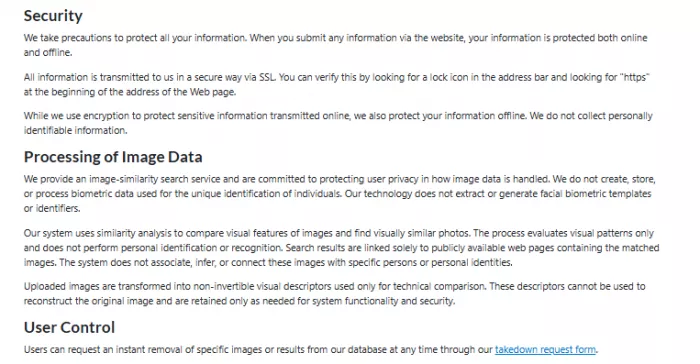
A face image is among the most sensitive types of personal data, because it can connect a person across accounts and locations. FaceCheck ID processes that image to build a match, which raises practical questions about storage, deletion, logging, and reuse. Independent reviewers have also raised questions about how uploaded data is handled, which is reason enough to read the current privacy policy and terms directly rather than rely on marketing language. The questions below are worth answering before any upload.
| Privacy question | What users should check |
Is the uploaded face stored? | Whether uploads, search images, or facial templates are retained, and for how long |
Can uploads be deleted? | Whether the service offers deletion of uploaded images and search history on request |
Is search activity logged? | Whether searches, results, and account activity are recorded or linked to a profile |
Could data be reused or shared? | Whether uploaded data could expand the index or be shared with third parties |
| Is the account and connection secure? | Whether the site uses secure connections and what account data is required |
What does the current policy say? | The live privacy policy and terms, read directly rather than from summaries |
| A face image is sensitive personal data. Treating every upload as something that could be stored or seen by others is the safer assumption. | |
Face matching compares patterns, so visually similar people can be returned as matches. Image quality, lighting, angle, ageing, makeup, facial hair, filters, and AI generated faces all affect reliability. A result that looks confident can still point to the wrong person.
Real world signals reinforce this. On Trustpilot, the listing carries only a small number of reviews, including a detailed complaint from a person who said the tool surfaced none of their many public photos. An independent multi month test published by AllAboutAI reported a true positive rate of roughly two thirds alongside a meaningful false positive rate, which fits the pattern that confident looking matches still need verification. FaceCheck ID itself presents results with confidence tiers, reported as Certain, Confident, Uncertain, and Weak, and those tiers describe similarity, not confirmed identity
The figure above shows where match results and confidence labels appear during a consent based test. The live screenshot is captured at publication, using only an image that is lawful and ethical to search.
| Accuracy issue | Practical risk | Safer response |
Lookalike faces | Different people with similar features can be matched | Treat any match as a lead and verify identity through other evidence |
Low quality or edited images | Blurred, angled, filtered, or aged photos reduce reliability | Use clear images and expect lower accuracy on poor inputs |
AI generated faces | Synthetic or altered faces can distort matching | Be cautious with profile photos that may be artificial |
Missed matches |
Real public photos are sometimes not found at all | Do not assume an absent result means a person has no online presence |
Confidence label misread | A high label signals similarity, not confirmed identity | Read labels as similarity scores, never as proof |
Outdated or mislabeled sources | Linked pages can be old, duplicated, or wrongly captioned |
Open each source and check its date and context before trusting it |
Red flag misread | A flagged source category is not evidence of wrongdoing | Never assume guilt or a record from a flag alone |
FaceCheck ID can suggest similarity, but it cannot prove a person identity, intentions, criminal record, or trustworthiness by itself.
Face search sits inside a patchwork of privacy, biometric, and consumer protection laws that vary by country, state, and purpose. In the European Union, the GDPR treats facial data used for identification as a special category of personal data, and the UK ICO takes a similar view. In the United States, laws such as the Illinois Biometric Information Privacy Act can apply to facial templates, while the Fair Credit Reporting Act restricts how background style information is used in decisions about people.
The safest reading is simple. Self checking and cautious safety checks are generally low risk. Using a face match to drive hiring, lending, insurance, or housing decisions is high risk and often unlawful. Harassment, stalking, doxxing, discrimination, blackmail, and public shaming are never acceptable and can be illegal. Businesses should obtain a legal and privacy review before any use, and individuals should keep use legitimate, proportionate, and free of harm
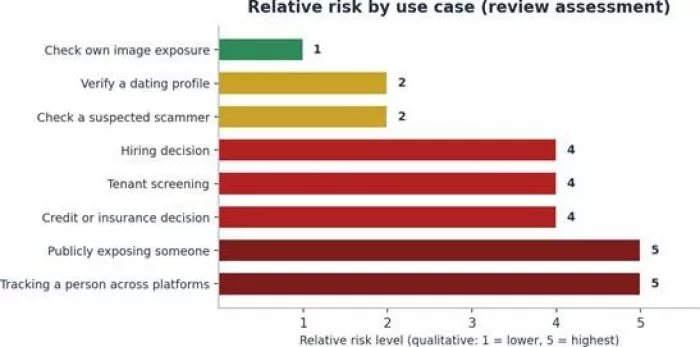
Figure . Relative risk of common use cases, as assessed in this review.
The figure above shows the relative risk of common use cases as assessed in this review. Self checking sits at the low end, while public exposure and cross platform tracking sit at the top.
| Use case | Safer or unsafe? | Reason |
| Checking one's own online image exposure |
Safer | Self checking is generally a legitimate and lower risk use |
Verifying a dating profile for personal safety |
Caution | Reasonable as one signal, provided results are not used to harass or accuse |
Checking a suspected scammer profile |
Caution | Can help spot reused photos, but intent still needs independent confirmation |
Making a hiring decision |
Unsafe | Employment screening is regulated and a face match is not a lawful or reliable basis |
Screening a tenant |
Unsafe | Housing decisions carry discrimination and fair housing risks |
Informing a credit or insurance decision |
Unsafe | These decisions are regulated and must not rely on face search results |
Publicly exposing or naming someone |
Unsafe | High risk of harm to a misidentified person and potential legal liability |
Tracking a person across platforms |
Unsafe | Surveillance style tracking raises serious legal and ethical concerns |
| Use case | Safer or unsafe? | Reason |
| Legal note: This article is general information, not legal advice. Face search laws vary by location and use case. Businesses and higher risk users should consult a qualified legal professional before using facial recognition search in any decision making process. | ||
Running through this checklist before each search keeps use lawful, ethical, and far less likely to harm anyone.
| Safe use check | Done |
| Read the current privacy policy and terms before uploading | ☐ |
| Upload only images there is a lawful and ethical reason to search | ☐ |
| Avoid sensitive, intimate, medical, school, or workplace photos | ☐ |
| Never upload a minor's face | ☐ |
| Treat every match as a lead, not as proof of identity | ☐ |
| Open and read each source page manually | ☐ |
| Check the date and context of every result | ☐ |
| Verify findings with at least one independent source | ☐ |
| Never use results for hiring, lending, insurance, or housing | ☐ |
| Never use results to harass, shame, stalk, or expose anyone | ☐ |
| Use the official removal tools if a personal image appears | ☐ |
Anyone who finds a personal image appearing in face search results can usually request its removal, though one request rarely clears every copy. FaceCheck ID provides a removal page, reported as free at review time, where people can ask for indexed results to be taken down.
That removal applies to the FaceCheck ID index, not to the websites that originally published the image, so the original sources and any search engine caches need separate requests.
| Removal step | Purpose |
| Open the official removal page | Start an opt out request through the FaceCheck ID process |
Submit the requested details | Provide what the service needs to locate and remove indexed results |
| Confirm the request | Complete any verification the removal process requires |
| Allow time for processing | Removal from the index may not be instant |
Contact the original websites | Source sites must be addressed separately, since removal applies to the index |
Request search engine removal | Cached or indexed copies elsewhere need their own removal requests |
| Keep records | Save confirmations in case results reappear or need follow up |
| Pricing item | Details (review-time snapshot, June 2026) |
Free search access | Limited free searches return blurred preview results with confidence scores, and full results unlock only after paying |
Paid access | Prepaid credit packs across named tiers, reported as Just a Peek, Rookie Sleuth, Private Eye, Deep Investigator, and The Professional |
Credit and search limit | Each search is reported to use three credits, with pack sizes and expiry windows that differ by tier |
Payment methods | Cryptocurrency reported as the primary method, for example Bitcoin, Litecoin, and Solana, with some listings referencing other routing options |
Refund policy | Reported in the terms as no refunds |
| Best for | Occasional, legitimate checks rather than high volume or business use |
| Pricing checked | June 2026 |
As reported at review time in June 2026, access uses named credit packs rather than a single subscription, with tiers commonly listed as Just a Peek, Rookie Sleuth, Private Eye, Deep Investigator, and The Professional. Entry packs have been listed from a few US dollars, with higher tiers running into the hundreds, and each search is reported to use three credits while credit validity ranges from roughly two days on the smallest pack to about a year on the largest. These figures change, so the official site remains the only reliable source before paying
The figure above shows where pricing and search access details appear. The live screenshot is captured at review time and dated, since these details change
Public feedback on FaceCheck ID is unusually thin for a tool that handles identity data, which is itself worth noting. The signals that exist point in two directions: some users find it useful for surfacing reused photos, while others report missed matches and friction from the payment model.
On Trustpilot, the listing carries only a handful of reviews, including one detailed complaint from a person whose many public photos were not found. On Reddit, a discussion in a general advice community questioned the reliability of the tool, and several comments noted that the pay before results model means paying before knowing whether it works for a given photo.
These are anecdotal signals, but together they support a cautious reading.
| Source | Feedback theme | Useful signal | Caution |
Trustpilot | Very limited reviews, including a missed match complaint |
Shows some direct customer experience |
Very low review count limits confidence |
Reddit and OSINT communities | Questions about reliability and the pay before results model |
Useful for real usage patterns |
Comments are anecdotal and unverified |
Official FAQ | Explains match scores and red flag indicators | Primary source for reading results | Still needs independent verification |
Removal page | Notes on opt out and discouraged uses | Useful for privacy and legal limits | Does not remove source websites |
| Software directories | General listing and sentiment context | May indicate broad sentiment | Verify listing relevance and review authenticity |
| User reviews can help identify patterns, but they should not replace hands-on testing, privacy policy review, and legal caution. | |||
Several tools cover similar ground, each with its own trade offs. None removes the need for careful, consent aware use, and a match from any of them is still only a lead.
| Alternative | Best for | Strong point | Limitation |
PimEyes | Broad reverse face search | Large index and an opt out process | Subscription cost and the same privacy concerns |
Google Lens | General reverse image search |
Free and widely available | Not optimized for faces specifically |
TinEye | Tracing where an exact image appears | Strong at finding image copies |
Matches images, not faces |
Social Catfish | Dating and scam verification | Combines several lookup signals | Paid, and still needs independent checks |
A few other tools sometimes come up, including Yandex image search where it is regionally available and Berify for image tracing. Caution matters with newer face search sites: some have drawn complaints about charging users without delivering working results, so reputation and refund terms are worth checking before paying. Whatever tool is used, a match is still only a lead that needs independent verification.
Both FaceCheck ID and PimEyes are dedicated reverse face search engines, and both raise the same core privacy questions. The practical differences sit in pricing, removal, and how each presents results.
| Factor | FaceCheck ID | PimEyes | Practical take |
Focus | Face search with safety framing |
Broad face search | Both are dedicated face search engines |
Pricing model |
Prepaid credit packs |
Typically subscription based | FaceCheck can suit occasional use; PimEyes suits frequent use |
Free preview | Blurred results before paying | Limited free preview (verify) |
Neither shows full results free |
Removal | Reported free removal page |
Paid opt out (verify) | FaceCheck removal is reported as lower cost |
Payment |
Largely cryptocurrency |
Card based (verify) | Crypto can be a barrier for some users |
Privacy concern | Significant, as with any face search | Significant, with past controversy |
Caution applies to both |
FaceCheck ID fits a narrow set of careful, legitimate users.
• People checking whether their own face already appears across public web sources
• Users trying to detect a catfish or a reused scam profile photo
• OSINT researchers working strictly within legal and ethical limits
• People confirming whether a public profile image appears elsewhere
• Users who treat every result as a lead to verify, not as proof
For many other users, the risks outweigh the convenience.
• Anyone planning employment, credit, insurance, housing, or tenant decisions
• Users without consent or a lawful reason to search another person's face
• Users who might publicly accuse someone based on a single match
• People seeking guaranteed identity verification
• Anyone dealing with minors' photos
• Users uncomfortable uploading face images at all
• Businesses without a legal and privacy review in place
• Anyone intending harassment, stalking, doxxing, discrimination, or blackmail
Most harm from face search comes from a few avoidable mistakes.
| Mistake | Risk | Better approach |
Trusting a single match as proof | Misidentifying an innocent person | Verify with independent sources before any conclusion |
Reading a high label as identity | False confidence in a wrong match | Treat labels as similarity, not confirmation |
Using results for hiring or housing | Legal exposure and unfair decisions | Keep face search out of regulated decisions |
Uploading sensitive images | Privacy and data exposure | Avoid intimate, medical, school, or workplace photos |
Publicly accusing someone | Serious harm and possible liability |
Keep findings private and verify first |
Ignoring pricing and refund terms | Unexpected cost with no refund | Check credits, expiry, and terms before paying |
Assuming a flag means guilt | Unfair assumptions from a source category | Open the source and judge the full context |
| Pros | Cons |
|---|---|
| Useful for finding reused profile photos | Can return false matches |
| Helps with self-checking online image exposure | Uploading face images raises privacy concerns |
| Shows confidence labels and red flag indicators | Results can be misunderstood as proof |
| Has a removal/opt-out route | Full results usually require payment |
| Useful for OSINT-style research | Not suitable for employment, housing, lending, or minors |
FaceCheck ID is a capable reverse face search engine with a genuine niche. It can surface where a similar face appears across public web sources, which makes it useful for spotting a reused scam photo, sanity checking a dating profile, or seeing where a personal image has spread. Used for self checking and cautious personal safety, within privacy and legal limits, it can be a reasonable tool.
It is not a tool that proves anything on its own. Matches can be wrong, real photos can be missed, confidence labels describe similarity rather than identity, and the payment model asks for money before results are fully visible. The overall positioning is caution required: helpful as a starting point, unsafe as a verdict.
The clearest rule is about use. FaceCheck ID should never decide a hiring, lending, insurance, or housing outcome, never be aimed at minors, and never be turned into a tool for harassment, stalking, or public exposure. Treated as one investigative lead among several, verified through independent sources, and used lawfully and ethically, it can add value. Treated as proof, it can cause real harm.

Marketing teams often need images before a product is ready for a phot...
Creating a logo that will grab customers' attention is one of the main...

Enterprise software has a well-known failure mode. The demo goes great...
Most people who produce video at any real scale hit the same wall even...

A cinematic AI video needs more than realistic skin, dramatic lighting...
Have you noticed how difficult it is not to watch spoilers of a sporti...
Discussion