

A stranger sends a friendly message on a dating app. The profile looks polished, the photos are almost too clean, and something about the story does not quite line up. The natural next step for a cautious person is to ask whether those images are genuine, borrowed, or copied from somewhere else on the web. That question is exactly where tools like FaceCheck ID enter the conversation.
The point worth settling early is that reverse face search is not identity verification. A visual match shows that a similar face appears somewhere online. It does not prove who the person on the other end of the conversation actually is. FaceCheck ID even states on its own site that it identifies websites showing similar faces rather than people, and that its results should not be used to confirm identity for legal or prosecutorial purposes.
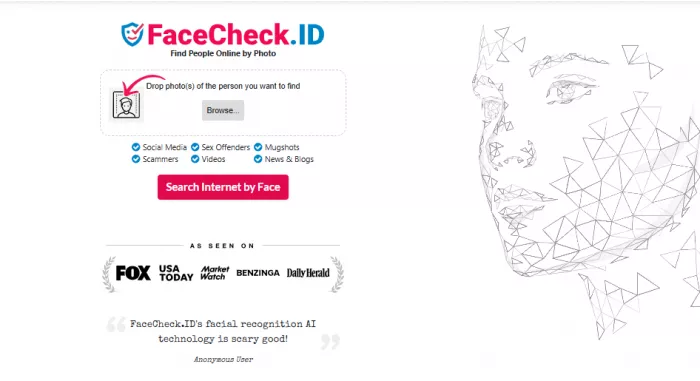
This guide is written for that careful reader. It covers when FaceCheck ID may genuinely help, when it should be avoided entirely, how to interpret a match responsibly, what privacy and removal rights exist, and which safer alternatives are worth comparing depending on the goal. The tone throughout is deliberately cautious, because reverse face search is powerful enough to help protect someone and powerful enough to harm an innocent person when used carelessly.
Before discussing situations, settings, or alternatives, one principle has to come first. FaceCheck ID is a lead-finding tool, not a verdict machine. It can show where a similar face appears across public web pages, but it cannot confirm that the person in a specific profile is the same person in every result it returns.
The distinction matters more than it first appears. A match in a face search engine signals visual similarity, nothing more. A result page means that a face resembling the uploaded photo has appeared somewhere the system has indexed. It does not establish guilt, identity, intent, or current behaviour, and it should always be checked by hand before it informs any decision.
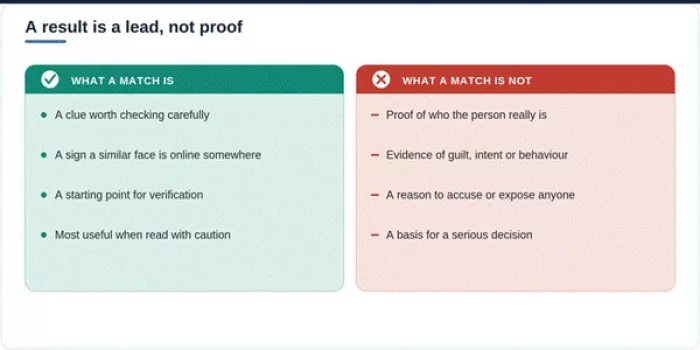
• A match means visual similarity between two faces, not a confirmed identity.
• A result page means a similar face appeared on an indexed page at some point in time.
• A result does not prove guilt, identity, intent, or current behaviour.
• A result should be reviewed manually, at the source, before it shapes any decision.
Many mistakes with reverse face search come from reading too much into a single screen. The table below separates the common assumption from what a result actually supports.
| Common assumption | What the result actually means |
| The result is definitely the same person | It may only be a similar-looking face |
| A result proves the profile is fake | It may be a clue, not proof |
| No result means the person is genuine | No result may simply mean the image is not indexed |
| A mugshot-style result proves danger | Sensitive matches need extra, careful verification |
| The person can be exposed online | Public accusations can cause serious, lasting harm |
A single search result should never be used on its own to accuse, shame, reject, hire, fire, report, or publicly identify anyone.
Reverse face search sounds complex, but the underlying process is straightforward, and understanding each step makes the limits of the tool easier to see. The system begins with an uploaded face photo. It detects the face inside the image, then converts the facial features into a mathematical pattern, sometimes called an embedding, which works like a numeric fingerprint of that face. It compares that pattern against faces extracted from a large index of public images, and returns the pages where similar faces appear. The final and most important step belongs to the user, who has to open those pages and judge the context for themselves.
| Step | What happens | User caution |
| Upload photo | A face image is submitted to the engine | Search only photos there is a legitimate reason to check |
| Face detection | The tool isolates the face in the image | Poor or cluttered photos weaken detection |
| Similarity pattern | Facial features become a numeric pattern | Similarity is not the same as identity |
| Index comparison | The pattern is matched against public images | Coverage is never complete or current |
| Result list | Pages with similar faces are returned | Each source page needs separate review |
| Manual review | The user evaluates context and sources | Avoid jumping to conclusions from one hit |
FaceCheck ID positions itself as a way to check public web appearances, including social media profiles, blogs, videos, news pages, and other indexed sources, and it also indexes images from mugshot and offender-related websites. On its own FAQ, the service is explicit that it does not identify people and that results should not be used to confirm identity for legal or prosecutorial purposes. It also publishes a match quality score from zero to one hundred, where a higher number reflects closer visual similarity rather than confirmed identity. Treating that score as a probability of similarity, not a probability of identity, keeps expectations realistic and is the heart of using FaceCheck ID accuracy claims sensibly.
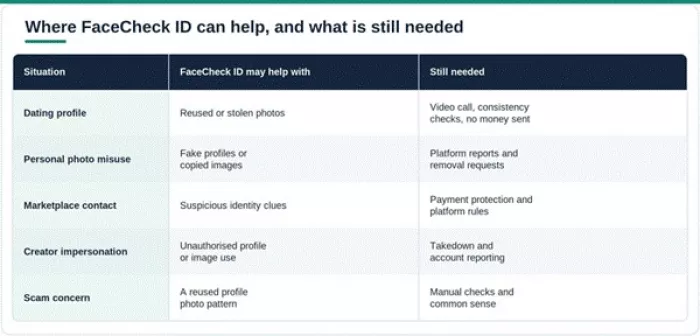
The honest answer is that FaceCheck ID can help in specific, limited situations, almost all of which involve protecting the person doing the searching rather than investigating a stranger. The situations below show where reverse face search adds value and what still has to be handled separately.
Online dating is where reverse face search earns most of its reputation. When a dating profile uses photos that look stolen, unusually polished, or inconsistent with the person's story, a face search can reveal whether the same face appears under different names or on unrelated pages. A single face attached to several identities is a recognised warning sign of a romance scam or catfish profile.
The caution here is firm. A FaceCheck ID catfish check is a reason to slow down, ask better questions, and protect oneself, not a licence to harass or publicly expose the other person. The goal is personal safety, not punishment, which is also the right frame for any FaceCheck ID dating scam concern.
People can also search their own image to find out whether it is being reused on fake profiles, scam pages, impersonation accounts, or copied websites. This is one of the lower-risk uses of the tool, because the person already has the right to check their own face.
For anyone who finds their photos in places they did not authorise, FaceCheck ID also runs a removal process. Its official removal page explains that users can locate their face in the results, select the images they want gone, and confirm the request with a selfie capture, which is usually approved quickly, or with an anonymised identity document if a selfie is not possible.
When a buyer, seller, or new business contact asks for money, pushes a suspicious deal, or uses a profile photo that feels fake, reverse face search can sometimes surface signs of image reuse. It can be one input among several, but a financial decision should never rest on a face search result alone. Payment protections, platform rules, and direct verification carry far more weight.
Creators, influencers, freelancers, and other public-facing professionals are frequent targets of impersonation. A face search engine can help them find copied photos, cloned profiles, and accounts pretending to be them, which is often the first step before filing a platform report or a takedown request.
The same capability that helps a cautious dater can cause real damage in the wrong hands. Reverse face search becomes harmful when it is used to judge, expose, or control other people, especially when the subject has no idea they are being searched. FaceCheck ID should not be used for any of the following:
• Hiring or recruitment decisions
• Tenant or housing screening
• School or college admissions
• Public shaming or callouts
• Doxxing or exposing private individuals
• Stalking or tracking a current or former partner
• Harassing private people
• Building legal accusations
• Drawing police-style conclusions
• Discrimination of any kind
• Revenge or deliberate embarrassment
• Searching minors or vulnerable people without a serious safety or legal reason
A responsible approach separates capability from permission. The fact that a tool can search a face does not mean it should be used to search every face. Many of the uses above are not only ethically wrong, they can carry legal and compliance consequences, because formal decisions about employment, housing, and credit are governed by rules that public reverse face search results were never designed to meet.
A result screen can look convincing even when it is weak. A simple framework helps separate a genuine lead from a coincidence. This guide uses a four-part check, summarised by the letters S, A, F, and E.
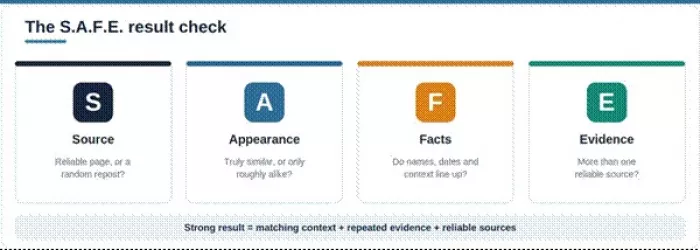
A strong result usually combines matching context, repeated evidence, and reliable source pages. A weak result is often a single similar-looking face on an obscure page with nothing else to support it.
A few examples make the difference concrete. If a face appears on one random page with no matching name or context, the result deserves little weight. If the same image shows up under five different names across several dating profiles, that pattern is a far stronger warning sign. If a result links to a sensitive source, such as an arrest-record style page, it calls for careful verification and, above all, no public conclusions, because a false match in that context can ruin a reputation.
The quality of the uploaded image has a direct effect on what a face search engine can return. A blurry screenshot, a tightly cropped group photo, a heavily filtered selfie, or a side-angle shot can all produce weak or misleading matches. Clearer, front-facing images give the detection step the most to work with.
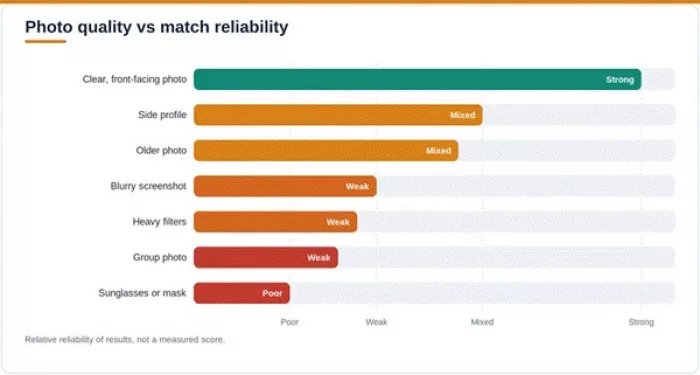
The practical takeaway is to use the clearest available image, but only when there is a legitimate reason to run the search and the search does not intrude on someone else's privacy. Better input does not change the rule that results remain leads, not proof.
Before running any face search, a short set of privacy questions helps keep the activity responsible. They take seconds to answer and prevent most misuse.
| Privacy question | Safer direction |
| The photo is a personal image | Lower privacy concern |
| The photo belongs to someone else | Search only with a legitimate reason |
| The result may be published | Do not publish private identity claims |
| The search supports a hiring or legal decision | Use a formal, compliant process instead |
| Personal images should be removed | Use the official removal route |
There is rarely a single best tool, only the right tool for a specific goal. Grouping the FaceCheck ID alternatives by purpose makes the choice clearer than a flat list ever could.
To find copied images, reused product photos, or where a picture appears across the web, general visual search tools are the better fit. Google Lens, TinEye, Bing Visual Search, and Yandex Images all excel at matching whole images rather than faces, although they are not built for face-specific searching.
When the goal really is to track a face rather than an image, face-focused engines apply. PimEyes, FaceOnLive, Social Catfish, and Lenso.ai sit in this category alongside FaceCheck ID. PimEyes, for example, describes itself as an online face search engine that goes through the internet to find pictures containing given faces, and it focuses on the open web rather than social platforms. Each of these tools differs in coverage, pricing, and privacy policy, so comparing their data sources and removal options matters as much as comparing their results.
Catfish and romance scam checks work best as a layered routine, not a single search. A reverse image or face search can flag reused photos, but it is strongest when combined with a live video call, a check for consistency across social profiles, a look through scam-report databases, a firm refusal to send money, and a willingness to report the account to the platform. A reverse face search is one layer in that routine, never the whole defence.
For anyone trying to clean up their own footprint, the options are different again. The FaceCheck ID remove photos route, platform takedown forms, Google's personal content removal requests, DMCA notices where a copyright claim applies, and ongoing privacy monitoring services each play a part. Used together, they cover far more ground than any one route alone.
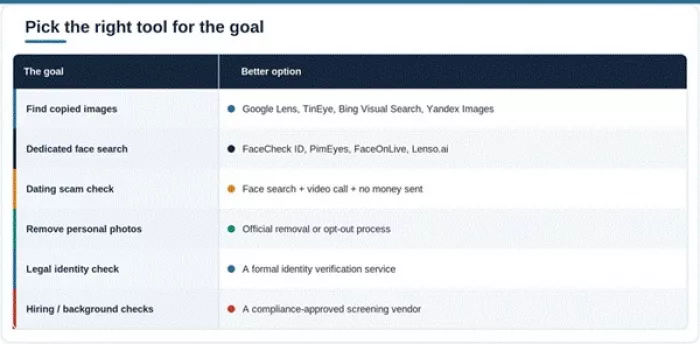
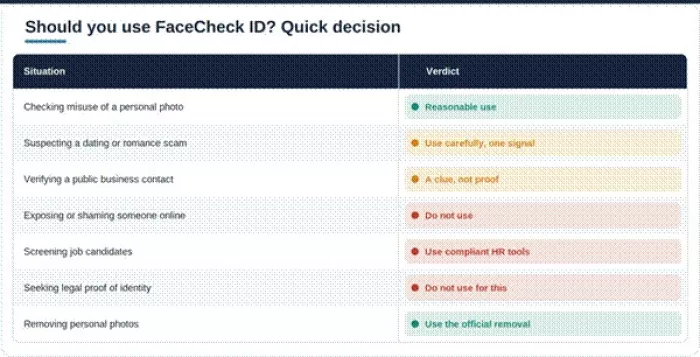
The decision comes down to matching the situation to a responsible use. The table below maps common goals to a clear recommendation.
FaceCheck ID can be useful, but only for a user who understands its limits. At its best, it helps people ask sharper questions and take sensible precautions. It was never designed to deliver final judgments about who someone is.
FaceCheck ID can help locate where a similar face appears online, which has real value for romance-scam checks, monitoring the misuse of personal photos, and spotting online impersonation. What it cannot do is serve as a final identity checker. A visual match is not proof, an empty result is not a guarantee of authenticity, and a sensitive match can do genuine harm when it is misread.
The safest way to use FaceCheck ID is to treat every result as a lead that still needs verification. Used with that mindset, checking sources carefully, avoiding public accusations, respecting privacy, and reserving formal verification methods for serious decisions, it becomes a useful safety tool rather than a risky one. That single habit is what keeps FaceCheck ID safe in practice.

Marketing teams often need images before a product is ready for a phot...

Creating a logo that will grab customers' attention is one of the main...

Enterprise software has a well-known failure mode. The demo goes great...

Most people who produce video at any real scale hit the same wall even...

A cinematic AI video needs more than realistic skin, dramatic lighting...
Have you noticed how difficult it is not to watch spoilers of a sporti...
Discussion