

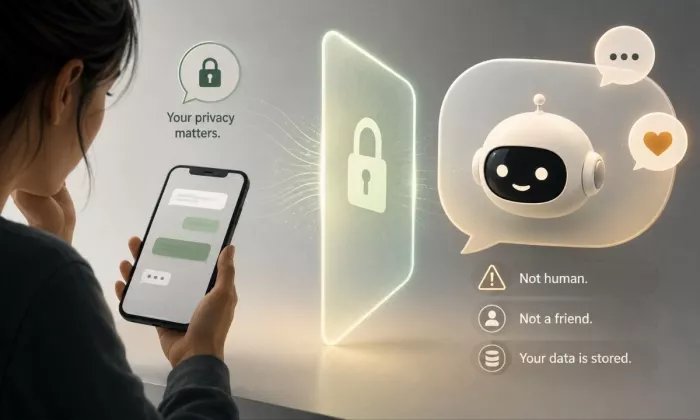
Signal President Meredith Whittaker has a clear message for people forming emotional bonds with AI chatbots: do not confuse software with friendship.
Speaking to TechCrunch, Whittaker warned that chatbots such as ChatGPT, Claude, Gemini and similar systems should not be treated as conscious beings, trusted companions or emotional partners. Her point was blunt: these systems may sound human, but they are still products controlled by companies, business incentives and data systems.
Whittaker’s argument is not that AI tools are useless. It is that people should understand what they are interacting with.
Chatbots can answer questions, summarize documents, write drafts and help with simple tasks. But when they are designed to sound warm, patient and emotionally available, users may begin to treat them like real relationships.
That is the line Whittaker wants people to notice.
She told TechCrunch that AI chatbots are not friends, conscious beings or sentient conversation partners.
Modern AI chatbots are often built to feel personal.
They respond instantly. They remember context. They use friendly language. Some are designed as companions, coaches or always-available listeners.
That design can make users feel understood, especially when the chatbot gives supportive responses. But the interaction still happens inside a corporate system that may log, process, analyze or use data depending on the company’s policies.
This is where Whittaker’s privacy concern becomes serious. A chatbot that feels like a friend may encourage users to share things they would normally keep private.
Signal’s entire brand is built around private messaging and end-to-end encryption. So Whittaker’s warning fits her larger view that AI systems can create new forms of surveillance.
She has previously argued that AI becomes dangerous when it is connected to large stores of personal data, because it can make private information searchable, analyzable and easier to exploit. Axios reported in 2024 that Whittaker described AI’s access to personal information as a major privacy risk, especially when companies integrate AI into email, documents and device activity.
The concern is simple: the more people talk to chatbots like confidants, the more sensitive data they may hand over.
The timing of Whittaker’s comments matters because AI chatbots are no longer used only for productivity.
Many people now use them for emotional support, advice, journaling, relationship questions, loneliness and daily decision-making. Research on AI companions has found that these systems can blur the line between interpersonal intimacy and institutional software, making users more likely to disclose personal information while still feeling uncertain about platform-level data control.
That is exactly the tension Whittaker is pointing toward: the interface feels personal, but the infrastructure is corporate.
The better way to use chatbots is as tools with limits.
Use them for drafting, brainstorming, formatting, summarizing or learning. But do not treat them as neutral friends, therapists, partners or private diaries unless the privacy protections are extremely clear.
Whittaker herself has said she keeps her AI use limited, using tools for practical tasks rather than handing over deeper thinking or personal trust. India Today also reported her view that users should be “straight” with AI chatbots and treat them as tools, not friends.
Whittaker’s warning is part of a wider debate about how AI should be designed.
Some companies are making chatbots more humanlike because it increases engagement. The more natural the conversation feels, the more people may use the product.
But that creates risks. Humanlike AI can encourage dependence, emotional confusion and oversharing. Researchers have also warned that chatbot interfaces are not neutral and can reshape how people work, learn, make decisions and relate to technology.
This does not mean all AI chatbots are harmful. It means users need stronger boundaries, and companies need clearer responsibility.
Signal is not trying to become an AI companion company.
The messaging app has repeatedly positioned itself as a privacy-first alternative to Big Tech platforms. TechCrunch has previously covered Whittaker’s argument that AI can become a surveillance technology when tied to data-hungry business models.
That background makes her latest comments less surprising. For Signal, the risk is not only bad chatbot answers. The deeper concern is that people may pour intimate data into systems that are not built around the same privacy principles as encrypted messaging.
Meredith Whittaker’s message is simple but important: AI chatbots may talk like people, but they are not people.
They do not care, understand or protect you the way a real friend can. They are software systems shaped by companies, models, policies and incentives.
AI tools can be useful, but users should keep emotional and privacy boundaries clear. The safest mindset is not fear. It is clarity.
A chatbot can help you write, search, summarize or think through a task. But it should not replace trust, friendship or human judgment.

Marketing teams often need images before a product is ready for a phot...

Creating a logo that will grab customers' attention is one of the main...

Enterprise software has a well-known failure mode. The demo goes great...

Most people who produce video at any real scale hit the same wall even...

A cinematic AI video needs more than realistic skin, dramatic lighting...
Have you noticed how difficult it is not to watch spoilers of a sporti...
Discussion