

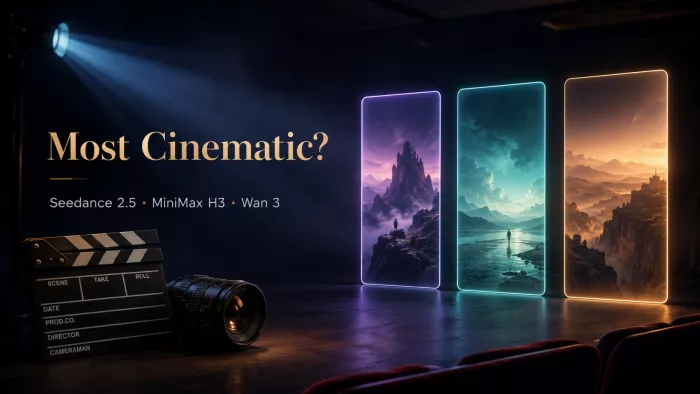
A cinematic AI video needs more than realistic skin, dramatic lighting, and a slow camera move. The shot has to feel directed. The subject needs to occupy the frame naturally, the camera has to move with purpose, light must remain believable as the scene changes, and motion cannot fall apart halfway through.
Seedance 2.5, MiniMax H3, and Wan 3 approach that challenge differently. Seedance leans heavily into references, longer sequences, and editing. H3 treats picture and sound as parts of the same scene. Wan 3 gives creators several ways to establish how a shot begins, develops, and ends.
For creators interested in film, commercials, music videos, or polished social video, those differences matter more than a simple resolution number.
Seedance 2.5 makes the strongest first impression as a model designed around direction rather than simple generation.
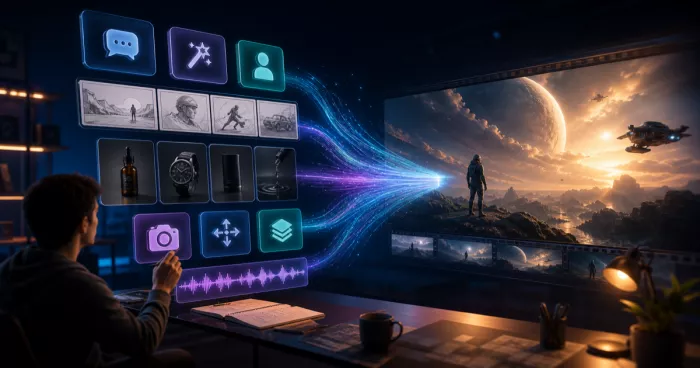
ByteDance describes it as an audio-video model built for 30-second storytelling, with expanded multimodal reference controls and editing. A generation can use images, video clips, and audio as references, while the system also supports motion guidance and more targeted changes to existing video.
That matters for cinematic work because a film shot is rarely defined by one sentence.
Consider a simple scene: a woman enters an old theatre, walks between rows of empty seats, pauses near the stage, and looks toward a single light above her.
A text prompt can describe all of that, but the prompt does not necessarily tell the model exactly what the actress should look like, what type of theatre you want, how the camera should track behind her, or how restrained the performance should feel.
Seedance's reference-oriented structure gives creators more ways to communicate those choices visually.
A reference image can establish the character. Another can establish a wardrobe. A location image can lock the architectural mood. Existing footage can demonstrate camera movement. Audio can provide another layer of context. ByteDance also highlights spatial and motion-reference techniques intended to give creators greater control over movement and camera behavior.
That is closer to the language of filmmaking. Instead of endlessly adding adjectives such as "cinematic," "moody," and "professional," the creator can begin supplying evidence of what the shot is supposed to look and feel like.
Seedance 2.5 is therefore especially interesting for cinematic work where specificity matters more than surprise.
If you already know how the shot should look, where the actor should move, and how the camera should behave, its reference-heavy approach gives you more ways to communicate that direction.
MiniMax H3 approaches cinematic video from another angle.
H3 is designed as a multimodal video model supporting text, image, first-and-last-frame, and reference inputs. MiniMax lists output at 768p or 2K with durations between 4 and 15 seconds. More importantly for filmmaking, H3 generates video with native stereo audio.

The cinematic value of that becomes obvious when you move beyond silent establishing shots.
Imagine a close shot inside a restaurant kitchen.
A chef drops butter into a hot pan. It begins to sizzle. Another chef calls something from behind him. He turns, answers without stopping what he is doing, then slides a plate across the counter.
The image alone does not create the scene.
The hiss from the pan, the distant kitchen noise, the voice from off camera, the chef's reply, and the timing of the reaction all affect whether the shot feels convincing.
H3's multimodal design is interesting because those elements can be considered as part of the generation rather than as unrelated pieces assembled afterward. MiniMax positions the model specifically around understanding and generating combinations of visual and audio information.
That makes H3 particularly relevant to creators working with:
● dialogue scenes where facial performance and speech need to feel connected;
● music-driven videos where movement should relate to sound;
● advertisements where product actions need convincing sound effects;
● environmental scenes where ambience helps establish space;
● short dramatic moments where off-screen sound triggers an on-screen reaction.
This does not mean native audio automatically makes H3 more cinematic.
Badly timed sound can damage the illusion just as quickly as bad motion. A door closing half a second before the sound arrives immediately feels synthetic. So does dialogue that technically matches the mouth but lacks the rhythm of a believable performance.
The real attraction of H3 is that it gives creators a chance to treat sound as part of scene direction, rather than automatically postponing it until editing.
Wan 3 brings another useful filmmaking idea into the comparison: the creator does not always need to start with text.
Alibaba describes Wan 3.0 as an all-in-one video generation model that brings text-to-video, first-frame image-to-video, first-and-last-frame generation, and reference-based video generation into the same system. It can generate clips as long as 30 seconds.
That range of starting methods can be surprisingly valuable for cinematic work. Sometimes the scene exists only as an idea. Text-to-video makes sense.
Sometimes you already have the perfect opening composition. Perhaps it is a product photograph, storyboard frame, concept image, or shot generated elsewhere. Starting from that image gives the model a stronger visual anchor.
Then there are shots where both ends matter.
Imagine a perfume commercial that begins with a close-up of a bottle resting on black stone. The camera circles the bottle as water moves around it, eventually arriving at a wider hero composition with empty space on the right for advertising copy.
In that situation, the final frame is not incidental. It is part of the design. A first-and-last-frame workflow gives the model two visual anchors and asks it to build believable motion between them.
That could be more useful than writing increasingly complicated instructions about exactly where the bottle and camera should finish.
Wan's wider video ecosystem already uses first-and-last-frame generation as a way to control transitions between defined visual states, including workflows where the ending frame of one clip becomes the beginning of another.
For cinematic creators, that makes Wan 3 particularly interesting when composition is planned before generation begins.
Seedance feels strongly reference-directed. H3 feels strongly audiovisual. Wan 3 feels particularly concerned with giving the creator several ways to construct the shot itself.
Camera movement is one of the quickest ways to separate an attractive AI clip from something that genuinely feels filmed.
AI models can make cameras move easily. Making them move believably is harder. A cinematic tracking shot has weight. Foreground objects pass the lens at the correct speed. Perspective changes naturally. The subject moves through the environment rather than appearing fixed while the background transforms around them.
Seedance 2.5 looks particularly well positioned for shots where the creator already has a camera language in mind. ByteDance explicitly highlights control over motion, camera behavior, spatial relationships, and references.
For a creator, that means a reference tracking shot can potentially be more useful than writing:
"Slow dolly backward, 35mm lens, subtle handheld movement, cinematic camera motion."
You can communicate the movement itself rather than hoping the model interprets filmmaking terminology in exactly the intended way.
H3 presents a different challenge.
Its camera movement needs to coexist with other multimodal instructions. If the character is speaking, music is playing, and an action is happening simultaneously, the camera still needs to behave deliberately.
This may make H3 especially interesting for performance-based shots where the camera is not the sole focus but one component of a larger audiovisual moment.
Wan 3's strength may appear when the creator wants stronger boundaries around the movement.
If the opening and closing composition are already known, first-and-last-frame generation can reduce uncertainty about where the scene needs to arrive.
The three approaches therefore suggest different ways of thinking about camera control:
| Model | Camera Approach | Most Relevant When |
| Seedance 2.5 | Guide movement through rich references and spatial direction | You know the style or path of camera movement you want |
| MiniMax H3 | Keep camera movement working alongside performance and audio | The shot combines movement, dialogue, sound, and character action |
| Wan 3 | Use different input structures, including defined starting and ending frames | The beginning and final composition of the shot are important |
The best choice depends on whether you want to demonstrate the movement, coordinate it with performance, or constrain where it ends.
Lighting is another area where AI video can look impressive in a screenshot and much less convincing in motion.
Suppose a character walks from a dark corridor toward a large window.
At the start, warm lamps illuminate one side of the face. As the person approaches the window, cooler daylight should gradually become stronger. Reflections should change. Shadows should respond to the character's position.
If the face remains illuminated exactly the same way throughout, the individual frames may still look beautiful, but the scene loses physical credibility.
Seedance 2.5's reference system gives creators a useful way to establish a lighting target alongside the character, location, and movement. Its broader focus on controlled scenes makes it especially relevant when visual continuity needs to survive a longer sequence.
H3 adds another dimension because lighting may have to coexist with more expressive performance. A singer moving through coloured stage lighting, for example, needs believable facial motion, camera movement, sound, and changing illumination at the same time.
Wan 3 becomes interesting when the desired lighting states at the beginning and end of a scene are known. A sunset transformation, moving spotlight, day-to-night transition, or product reveal could benefit from stronger endpoint control.
For all three, creators should look beyond whether the lighting is attractive.
Watch how it changes. Cinema is temporal. Lighting needs to survive time just as motion does.
All three models become much harder to judge once a recurring character enters the project.
One impressive portrait is easy to admire.
The real filmmaking problem begins when that person has to walk, turn, speak, move through different lighting, appear from another angle, and return several shots later still looking like the same character.
Seedance's extensive reference capacity is particularly relevant here. Multiple images can provide more information about appearance, costume, setting, and other elements rather than expecting one photograph to define everything.
H3 makes character consistency interesting in another way because visual identity may need to remain stable alongside voice and performance. For a dialogue-led short, the audience is not only tracking a face. They are tracking a person.
The face, voice, posture, reaction timing, and emotional delivery all contribute to that identity.
Wan 3's combination of reference-based generation and keyframe-oriented workflows gives creators another way to anchor a subject when the composition changes across a shot.
This distinction becomes useful when choosing a model for different projects.
A fashion film may prioritize clothing and face consistency. product advertisement may care more about the bottle or shoe staying exact and a narrative scene may need character identity and performance to survive together.
A cinematic model is not simply one that can reproduce a character. It needs to preserve whatever the viewer is subconsciously using to recognize continuity.
People receive most of the attention in AI video demos, but products and vehicles can expose weaknesses very quickly.
Viewers know what a car is supposed to look like. Four wheels should remain four wheels. Headlights should stay in the same place. Body panels should not subtly change shape as the camera passes around them.
Products can be even less forgiving. A perfume bottle, phone, watch, or sneaker used in an advertisement cannot suddenly become wider, lose a logo, or change material halfway through the shot.
For these scenes, Seedance's reference-heavy direction has obvious appeal because the product itself can remain part of the supplied visual context.
Wan 3's first-frame and first-and-last-frame options may also be particularly useful when a commercial begins or ends on a carefully art-directed product composition.
H3 becomes more interesting when product movement is tied closely to sound. A car commercial is a perfect example. Engine tone, tire noise, water spray, road ambience, and visible acceleration all contribute to whether the sequence feels expensive rather than synthetic. H3's native stereo audio gives creators a way to generate those relationships together with the visuals.
For commercial creators, the most cinematic model may therefore be the one that preserves the product while still allowing the camera and environment to move around it. A spectacular camera move is useless if the product quietly changes halfway through it.
Seedance 2.5 and Wan 3 can both generate up to 30 seconds, while MiniMax H3's documented range is 4 to 15 seconds.
The obvious interpretation is that 30 seconds is better for filmmakers.
It is not that simple. A 30-second shot gives the model much more time to make a mistake.
A face may drift. Background architecture may change. The camera may lose its original trajectory. A prop can disappear. The lighting may slowly stop matching the location.
Long duration therefore becomes a test of shot memory, not merely clip length.
Seedance 2.5 is particularly interesting here because ByteDance explicitly positions the model around longer-form storytelling, connected scenes, reference control, and extensions.
Wan 3 also gives creators the option of longer generation while combining several input modes.
H3's shorter duration should not automatically count against it.
Many professionally edited videos rarely hold one shot for 15 seconds. Advertisements, music videos, trailers, and social films may cut every three to eight seconds.
For those creators, a highly controlled eight-second audiovisual shot could be more valuable than a 30-second generation of which only eight seconds survive the edit.
The useful question is not: How long can it generate?
It is: How long can it stay convincing?
If you want to understand the difference between these models rather than simply generate attractive examples, use scenes that put camera control, movement, lighting, and scene consistency under pressure.
Use a lone traveler waiting on an almost empty railway platform just after rain.
The camera starts several metres away and slowly moves toward him as a train approaches in the background. Reflections from overhead lights stretch across the wet platform, his coat moves slightly in the wind, and he steps forward as the train slows beside him.
For Seedance 2.5, use character, environment, and camera-motion references. Pay attention to whether the model can preserve the platform layout, character appearance, and intended camera movement while the train and subject are both moving.
For MiniMax H3, add environmental sound such as rainwater dripping from the roof, the approaching train, distant station announcements, footsteps, and the mechanical sound of the train slowing down. The interesting part is whether those sounds feel connected to the visible movement rather than simply layered over the scene.
For Wan 3, consider defining the opening composition with the traveler separated from the distant train and the final frame with the train stopped beside him. This gives the shot a clear visual destination while still leaving the model to generate the movement between those two moments.
Place a musician in a small dressing room moments before a live performance.
The shot begins with her sitting in front of a mirror surrounded by warm bulbs. She adjusts an earring, picks up her guitar, stands, and walks toward a dark stage entrance as cool venue lighting gradually replaces the warmer dressing-room light.
Seedance's references can be used to preserve the performer's appearance, clothing, guitar, room design, and intended camera movement as the scene moves from one lighting environment into another.
H3 can be pushed toward a richer audiovisual scene with the muffled crowd becoming louder as the performer approaches the stage, along with footsteps, clothing movement, the guitar being lifted, and distant venue announcements.
Wan 3's first-and-last-frame structure is especially relevant because the opening mirror composition and the final silhouette at the stage entrance can both be planned beforehand.
These two scenes reveal much more than another generic landscape prompt.
One tests large-scale movement, environmental reflections, depth, and spatial consistency. The other tests subtle human performance, object consistency, changing light, sound perspective, and controlled camera movement.
Do not pause each video on its best frame and decide from there. Watch the entire generation from beginning to end.
A useful comparison would look like this:
| Cinematic Area | Seedance 2.5 | MiniMax H3 | Wan 3 |
| Composition | Look for whether the supplied references maintain deliberate framing as the scene develops | Check whether composition stays controlled while sound, movement, and performance happen together | Look at how effectively keyframes or references guide the shot toward its planned composition |
| Camera movement | Watch whether reference-led camera direction remains stable through character and environmental movement | Check whether the camera stays believable while several audiovisual events happen at once | Examine whether movement between the defined opening and closing states feels natural |
| Character performance | Focus on identity, clothing, and small movements as camera angle and lighting change | Pay particular attention to reaction timing, body movement, and its relationship with environmental sound | Check whether the character remains visually stable while the framing changes |
| Lighting | Watch how reflections and changing light remain consistent through the moving scene | Look at whether lighting remains believable while performance and sound become more complex | Examine how naturally the lighting develops between planned visual states |
| Audio | Judge whether sound supports the changing environment without distracting from the shot | Pay close attention to whether footsteps, voices, ambience, and visible actions feel spatially connected | Judge how naturally audio works alongside the visual references and selected generation method |
| Editability | Consider whether a strong section of the sequence could still be refined without losing the rest | Judge how much of the audiovisual take could be used without replacing major elements in post | Consider whether stronger opening and ending constraints produce footage that requires less correction |
One additional measure deserves its own attention: usable seconds.
If a model generates 15 seconds and only four are clean enough to keep, record four. If another generates 10 seconds and nine are usable, that result may be more valuable even if its single best frame is less dramatic. That is how an editor thinks.
The three models do not point toward exactly the same kind of creator.
Seedance 2.5 looks especially suited to creators who want to direct before generating. If you work with detailed visual references, recurring characters, specific camera movement, longer sequences, or scenes that may need targeted revisions, its control-oriented design is highly relevant.
MiniMax H3 makes the strongest case for creators who think about image and sound together. Dialogue scenes, musical performances, environmental storytelling, character reactions, and sound-heavy commercial shots are better ways to explore H3 than silent beauty shots. Its 2K option and native stereo audio also make its audiovisual output a central part of the model rather than an optional side feature.
Wan 3 looks particularly useful for creators who want different ways to construct a shot. Text can define one scene, a first frame can anchor another, and first-and-last-frame generation can be useful when transitions or final composition matter. Its all-in-one approach means the starting material can change with the needs of the shot.
That gives us three different creative personalities:
● Seedance 2.5 is the most obviously director-oriented of the three.
● MiniMax H3 is the most obviously audiovisual-performance-oriented.
● Wan 3 is the most obviously shot-construction-oriented.
Those distinctions are far more useful than declaring one model universally “cinematic.”
If cinematic work means carefully directed scenes with controlled characters, camera movement, references, longer storytelling, and the ability to refine footage, Seedance 2.5 currently presents the most complete filmmaking-oriented toolset on paper. Its emphasis on reference control and editing is particularly relevant because cinematic video depends as much on controlling decisions as generating beautiful images.
MiniMax H3 becomes more compelling when performance and sound are central to the scene. Its strength is not simply that it can make attractive moving images. The more interesting proposition is generating a visual performance and its audio context together.
Wan 3 takes a different route. Its combination of text, first-frame, first-and-last-frame, and reference-based generation makes it particularly interesting for creators who plan compositions and transitions carefully before asking the model to generate the movement between them.
So there is no useful answer based only on which one makes the most dramatic frame.
For cinematic creators, Seedance 2.5 looks strongest when direction and sustained control matter. H3 looks particularly strong when performance and sound need to belong to the same moment. Wan 3 looks most interesting when the structure and destination of the shot are already part of the creative plan.
The real measure of cinematic AI video is not how impressive it still looks. It is whether the model can hold the viewer's belief from the first frame to the last.
Marketing teams often need images before a product is ready for a phot...
Creating a logo that will grab customers' attention is one of the main...
Enterprise software has a well-known failure mode. The demo goes great...
Most people who produce video at any real scale hit the same wall even...

Have you noticed how difficult it is not to watch spoilers of a sporti...

Most investors building around AI stocks are chasing growth, and that...
Discussion