

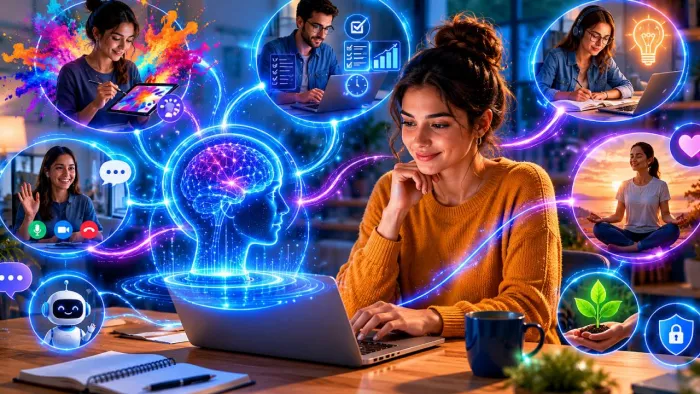
Artificial intelligence is no longer a futuristic concept reserved for technology companies and research laboratories. It has become an everyday tool that helps people write content, manage workloads, learn new skills, solve problems, and even support their mental wellbeing.
Just a few years ago, AI adoption was largely concentrated among developers, data scientists, and large enterprises. Today, students use AI to accelerate learning, marketers rely on it to generate campaign ideas, entrepreneurs use it to streamline operations, and professionals leverage it to automate repetitive tasks.
The speed of adoption has been remarkable. According to the Stanford AI Index, AI has become one of the fastest-adopted technologies in history, rapidly embedding itself into both personal and professional workflows across the globe.
But while headlines often focus on breakthroughs in large language models and AI agents, the most significant impact of AI may be happening much closer to home—in everyday life.
From boosting creativity and productivity to supporting mental wellness, AI is fundamentally changing how people live, work, and interact with information.
Historically, technology has primarily been used to improve efficiency. Computers helped automate calculations, the internet improved access to information, and smartphones connected people in real time.
AI represents the next stage of this evolution.
Unlike previous technologies that simply stored or transmitted information, modern AI systems can interpret language, generate ideas, summarize knowledge, identify patterns, and assist with decision-making. This allows AI to act less like a traditional software tool and more like a collaborative assistant.
As a result, people are increasingly integrating AI into daily routines.
Common uses include:
● Writing emails and reports
● Generating content ideas
● Learning new skills
● Planning schedules and tasks
● Conducting research
● Translating languages
● Creating visual content
● Managing personal productivity
● Supporting mental wellness practices
The growing accessibility of AI means that individuals no longer need technical expertise to benefit from advanced technology. A simple conversation with an AI assistant can now accomplish tasks that previously required multiple applications or specialized knowledge.
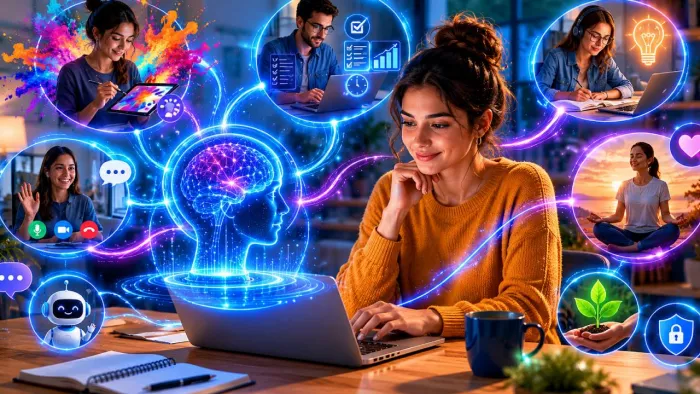
One of the biggest misconceptions about AI is that it threatens creativity.
In reality, many creators are finding that AI expands creative potential rather than replacing it.
Creative work often involves two separate challenges: generating ideas and refining them into something valuable. While humans remain superior at originality, storytelling, emotional intelligence, and strategic thinking, AI excels at helping users overcome creative bottlenecks.
For writers, AI can generate outlines, alternative headlines, and fresh angles for articles. Designers can use AI to quickly explore visual concepts before committing to a final direction. Musicians can experiment with melodies and arrangements. Marketers can generate campaign ideas in minutes rather than hours.
This dramatically reduces the time spent staring at a blank page.
Research from McKinsey suggests that generative AI has the potential to create between $2.6 trillion and $4.4 trillion in annual economic value across industries, with marketing, customer operations, research, and software development among the areas expected to benefit most.
Importantly, the greatest gains often occur when AI augments human creativity rather than attempting to replace it.
The most effective creators are using AI as a brainstorming partner, editor, and research assistant while maintaining full control over the final output. This combination allows professionals to spend less time on repetitive work and more time on strategic and creative thinking.
If creativity is one side of AI's impact, productivity is the other.
Organizations around the world are increasingly investing in AI because of its ability to automate repetitive tasks and improve efficiency.
McKinsey's research found that generative AI could automate activities that currently consume between 60% and 70% of employees' working time, particularly tasks involving communication, documentation, information processing, and content generation.
In practical terms, this means AI can help:
● Summarize lengthy documents
● Draft reports and proposals
● Organize meeting notes
● Generate presentations
● Conduct market research
● Respond to customer inquiries
● Streamline administrative workflows
The productivity gains can be substantial.
Research cited by McKinsey found that customer service agents using generative AI resolved issues 14% faster, reduced handling times by 9%, and experienced lower turnover rates. Notably, the greatest improvements were seen among less-experienced workers, suggesting that AI can help close knowledge gaps and accelerate skill development.
For entrepreneurs and small businesses, these gains can be particularly meaningful. Tasks that once required dedicated staff can now be partially automated, allowing lean teams to operate more efficiently.
However, productivity gains are not guaranteed.
Emerging workplace research suggests that excessive reliance on multiple AI tools can create cognitive overload. Some organizations are discovering that using too many disconnected AI systems can actually reduce efficiency by increasing review time, context switching, and mental fatigue. (Reddit)
The lesson is clear: successful AI adoption is not about using more AI. It is about using AI more intelligently.
Education is another area experiencing rapid change.
Traditional learning often follows a one-size-fits-all model, where students consume the same materials regardless of their experience, pace, or learning preferences.
AI introduces a more personalized approach.
Instead of spending hours searching for answers across multiple websites, learners can ask direct questions and receive customized explanations tailored to their knowledge level.
This creates opportunities for:
● Faster skill acquisition
● Personalized learning paths
● Real-time feedback
● Interactive tutoring
● Improved knowledge retention
Professionals are increasingly using AI to learn coding, improve writing skills, understand complex business concepts, and explore new technologies.
As industries continue to evolve, the ability to learn quickly may become one of the most valuable professional advantages. AI-powered learning tools help reduce barriers to education by making expertise more accessible and available on demand.
Rather than replacing teachers and educators, AI has the potential to enhance learning experiences by providing continuous support outside traditional classroom environments.
While productivity and creativity often dominate discussions about AI, mental wellbeing may become one of its most important applications.
Mental health challenges are a growing global concern.
Stress, anxiety, burnout, loneliness, and emotional exhaustion affect millions of people worldwide. Unfortunately, access to traditional mental health services remains limited for many individuals due to cost, location, availability, or social stigma.
AI-powered wellness tools are emerging as a potential solution to help bridge this gap.
Today, people are increasingly using AI for:
● Guided journaling
● Emotional reflection
● Mood tracking
● Mindfulness exercises
● Stress management
● Self-awareness development
● Wellness coaching
The growth of AI therapy platforms reflects this broader trend.
While AI therapy should never be viewed as a replacement for licensed mental health professionals, it can provide accessible support between therapy sessions, offer structured reflection exercises, and help users develop healthier emotional habits.
Recent real-world research involving a mental-health-focused generative AI platform found significant reductions in depression and anxiety symptoms among participants. Researchers also observed improvements in hope, social interaction, perceived social support, and reductions in loneliness. Importantly, these improvements remained evident during follow-up assessments, suggesting sustained benefits over time.
Additional research examining GPT-powered support systems found that participants receiving empathetic AI interactions experienced greater reductions in anxiety and depression symptoms compared to control groups. Researchers concluded that AI-driven mental health interventions may serve as valuable complementary resources when combined with traditional care.
These findings highlight the growing potential of AI to expand access to mental health support, particularly for individuals who might otherwise struggle to receive help.
Despite its promise, AI is not without limitations.
AI systems can generate inaccurate information, reflect biases present in training data, and occasionally produce misleading recommendations. This makes human oversight essential.
Mental health applications require particular caution. Researchers studying mental health chatbots have emphasized the importance of privacy, personalization, emotional support, and crisis-management safeguards to minimize risks and improve user outcomes. (arXiv)
Organizations also face challenges related to governance, transparency, and employee training.
As AI becomes increasingly integrated into everyday life, individuals and businesses must focus not only on adoption but also on responsible implementation.
The future belongs to those who understand both the capabilities and limitations of AI.
The most interesting aspect of AI is not that it can write articles, generate images, or automate tasks.
It is that AI is becoming a practical companion for everyday life.
Whether helping someone overcome writer's block, organize a busy schedule, learn a new skill, or manage stress after a difficult day, AI is steadily moving beyond productivity software and becoming part of the human experience.
The evidence increasingly suggests that the greatest value of AI will come from augmentation rather than replacement.
Human creativity, empathy, judgment, and critical thinking remain irreplaceable. AI simply provides a powerful set of tools that can amplify those qualities.
As the technology continues to mature, individuals who learn to collaborate effectively with AI will be best positioned to thrive.
The future of AI is not just about smarter machines. It is about empowering people to become more creative, more productive, and ultimately, more capable in every aspect of their daily lives.

Marketing teams often need images before a product is ready for a phot...
Creating a logo that will grab customers' attention is one of the main...

Enterprise software has a well-known failure mode. The demo goes great...

Most people who produce video at any real scale hit the same wall even...

A cinematic AI video needs more than realistic skin, dramatic lighting...
Have you noticed how difficult it is not to watch spoilers of a sporti...
Discussion