


Helping a younger sister with homework showed one thing very clearly: the problem was rarely laziness. The problem was usually the first stuck step. A math question looked simple until she had to decide which formula to use. A science answer made sense in the textbook but became confusing when written in her own words. That is where this Gauth AI Review begins, because the app looked useful not as a shortcut, but as a second explanation when no teacher, tutor, or elder sibling was immediately available.
So the question driving this review is narrow and honest. If a younger student is stuck on homework, does Gauth AI actually help them learn, or does it only help them copy answers faster? To answer that, Gauth AI was not judged as a magic homework machine. It was graded like an elder sibling would grade it for a younger sister: does it explain clearly, reduce panic, improve understanding, and still keep learning honest?
Some quick context that frames the stakes. Gauth AI (formerly Gauthmath) is owned by ByteDance, the company behind TikTok, and it climbed to the top of education app charts in the United States in 2024. The pull is real: Pew Research Center found that the share of US teens using a chatbot for schoolwork doubled from 13 percent in 2023 to 26 percent in 2024, and by late 2025 about 54 percent of teens reported using AI tools for schoolwork. In the same period, 59 percent of teens said AI-assisted cheating had become a regular feature of student life. A homework app sits exactly on that fault line, which is why the grading below separates help from shortcut at every step
Before the detail, here is the glance version. Each area below answers one practical worry an elder sibling would have before handing the phone to a younger student.
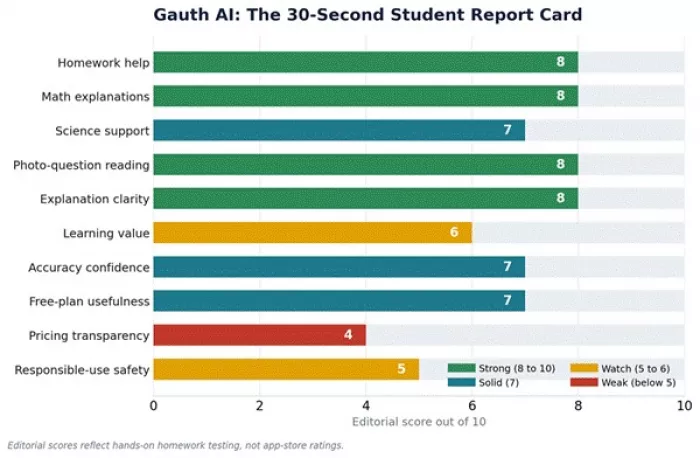
Figure 1. Editorial report card across ten homework situations. Scores reflect hands-on testing, not app-store ratings.
| Review Area | Score / 10 | What It Measures |
| Homework help | 8 | Can it unblock stuck questions? |
| Math explanations | 8 | Does it show usable steps? |
| Science support | 7 | Does it simplify without becoming wrong? |
| Photo-question reading | 8 | Can it read real notebook or textbook questions? |
| Explanation clarity | 8 | Can a younger student understand the answer? |
| Learning value | 6 | Does it help with the next similar question? |
| Accuracy confidence | 7 | How much checking is still needed? |
| Free-plan usefulness | 7 | Is it useful before paying? |
| Pricing transparency | 4 | Are limits and subscriptions clear? |
| Responsible-use safety | 5 | Does it encourage learning over copying? |
Best for: stuck homework questions, math steps, science doubts, and quick explanation support when no human is free. Not best for: blindly finishing homework, replacing teachers, writing full answers without understanding, or exam preparation without practice. Main caution: if the student does not re-solve the question alone afterward, the tool may finish the homework but skip the learning. |
The younger sister was not weak at the subject. She was stuck at the starting point, which is a very different problem. Textbook examples did not match the exact homework question. A quick search returned scattered results. A video explanation was too slow for one narrow doubt at nine in the evening. A calculator produced a number but never the reasoning behind it. Parents and elder siblings were not always free at that moment. The need was simple and specific: explain the next step clearly, in plain language.
| Situation at Home | Why Normal Help Failed | What Gauth AI Does |
| One math question stopped the whole homework | No one was free to explain right away | Show a step-by-step method |
| A science answer felt too textbook-heavy | The language was not simple enough | Rephrase in student-friendly words |
| A word problem looked confusing | She could not identify the formula | Highlight the correct method |
| A deadline was close | Copying temptation increased | Teach quickly, not just answer |
| Revision felt unstructured | The same mistakes kept repeating | Help identify the weak area |
This is the methodology, presented as a controlled homework test rather than a vague claim of perfect coverage. Gauth AI was put through a fixed set of question types that mirror a real school week, so the same app faced easy and hard cases under the same lens.
| Test Question Type | Why It Was Included | Main Evaluation Point |
| Basic algebra | Common school homework | Step clarity |
| Word problem | Tests reasoning | Method selection |
| Geometry question | Tests diagrams and formulas | Explanation accuracy |
| Physics numerical | Tests formula use | Unit handling |
| Chemistry question | Tests concepts and equations | Accuracy and balancing |
| Biology definition | Tests simplification | Syllabus-friendly wording |
| English grammar | Tests non-math help | Explanation quality |
| Short answer writing | Tests humanities support | Originality risk |
| Methodology note: this is a structured review framework. Subject-level claims should be re-verified live against the current app version and the student's own syllabus before publishing, because exam wording and app behaviour both change over time. |
Photo solving is the headline feature, so the first test is reading, not answering. A clear photo of printed text was handled reliably. Tighter cropping helped, and loose cropping that captured two questions at once sometimes confused the parse. Handwriting was the weaker case: neat handwriting was usually fine, while rushed or slanted writing occasionally produced a misread symbol. Math notation and simple diagrams were read better than dense multi-part pages.
| Photo-Test Factor | Score / 10 | Notes |
| Printed question reading | 8 | Reliable on clean, well-lit text |
| Handwritten question reading | 6 | Neat writing fine, rushed writing slips |
| Math symbol detection | 8 | Standard notation handled well |
| Diagram understanding | 6 | Basic shapes fine, complex figures vary |
| Cropping tolerance | 7 | Tight crops give the cleanest reads |
| Multi-question page handling | 5 | Best with one question per scan |
| Practical line: if the app reads the question incorrectly, even a perfect explanation becomes useless. The first accuracy check should always be the detected question, not the final answer. |
Science split into two stories. Formula-driven work (physics numericals, chemistry calculations) followed the same clear-steps pattern as math and was the safer ground. Concept and definition answers in biology and chemistry were readable and exam-friendly in tone, but carried a quiet risk: simplification can drift away from the precise wording a school expects. Diagrams received basic explanations rather than deep visual interpretation.
| Science Area | Gauth AI Help With |
| Physics | Formula-based numericals |
| Chemistry | Equations and core concepts |
| Biology | Definitions and processes |
| Diagrams | Basic explanation |
| Short answers | Simple wording |
| Exam-safety note: science answers should be compared with the school textbook, because exact wording often carries marks in exams even when the meaning is correct. |
This is the section that mattered most. A tool can produce a flawless solution and still teach nothing. So every solved question went through a five-step check designed to separate learning from collecting.
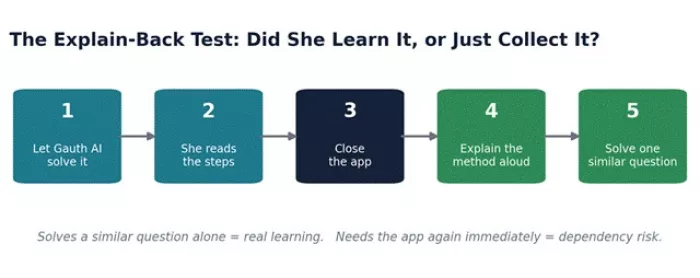
Figure 2. The Explain-Back Test. Solving a similar question alone signals real learning.
| Explain-Back Result | What It Means |
| She explains the method clearly | The tool helped learning |
| She remembers only the final answer | The tool helped copying |
| She repeats the same mistake | The explanation was not enough |
| She solves a similar question alone | Real learning happened |
| She needs the app again immediately | Dependency risk |
This is the difference between a homework helper and a homework shortcut.
Gauth AI is not the problem by itself. The problem is how the student uses it. The same app sits anywhere on the scale below depending on one habit: whether the student tries first. One feature raises the stakes here, since the app can generate a submission-ready answer with no explanation attached, which is precisely the mode that turns a study aid into a copying machine.
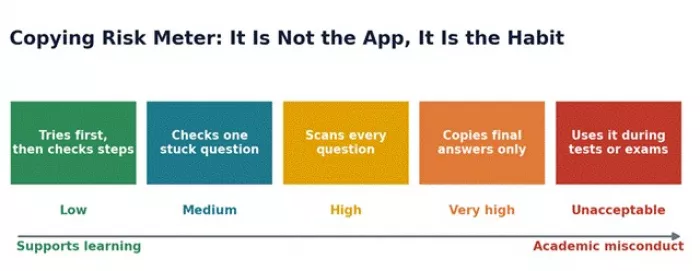
Figure 3. The same tool, five very different habits.
| Use Pattern | Risk Level | Why |
| Student tries first, then checks the steps | Low | Supports learning |
| Student scans after one failed attempt | Medium | Useful, but needs re-solving |
| Student scans every question immediately | High | Builds dependency |
| Student copies final answers only | Very high | No learning happens |
| Student uses it during a test or exam | Unacceptable | Academic misconduct |
| Feature | Grade | Why It Matters |
| Photo question solver | A | The main reason students open the app |
| Step-by-step solutions | A | Determines whether it teaches or just answers |
| AI tutor chat | B | Handles follow-up doubts well, accuracy varies |
| Expert or human help | B | Useful for harder questions on paid tiers |
| Math coverage | A | The core homework category, and its strongest |
| Science support | B | Good on numericals, watch concept wording |
| App experience | A | Clean, fast, and notably ad-free even when free |
| Answer history | B | Helps revision and reveals study patterns |
| Language support | B | Helpful for non-native learners, varies by subject |
| Pricing limits | C | Free cap and billing friction hold this back |
Whether the price is worth it depends entirely on usage. Light users rarely need to pay, while exam-week users may hit the free cap quickly. The scenario table reframes pricing around the student rather than the plan name.
| Student Scenario | Free Plan Enough? | Paid Worth It? | Why |
| One or two doubts a week | Likely yes | No | Light usage stays under the cap |
| Daily homework help | Maybe not | Maybe | Daily limits start to bite |
| Exam-week revision | Often not | Yes, if explanations hold up | Heavy, time-pressured usage |
| Parent-supervised learning | Depends | Maybe | Cost must match real learning value |
| Only copying answers | No | No | Wrong use case at any price |
Live-pricing snapshot. Figures below were reported in early-to-mid 2026 and vary by region and platform (iOS, Android, and web can differ). Treat every cell as verify in-app before publishing; do not publish these as fixed prices.
| Access Type | Reported Price | Question Limit | AI Help | Expert Help | Renewal | Source |
| Free | 0 | ~11 / day | Yes | Limited | None | App / site |
| Free trial | 0 for 3 days | Expanded | Yes | Tier-based | Auto-renews | App / site |
| Plus (monthly) | ~$9.99 to $11.99 | Unlimited* | Yes | Limited | Monthly | App / site |
| Tutor (monthly) | ~$19.99 | Unlimited* | Yes | Live tutors | Monthly | App / site |
| Annual | ~$99.99 / yr | Unlimited* | Yes | Tier-based | Yearly | App / site |
* Fair-use limits may still apply. Both free and paid tiers are reported to be ad-free, which is unusual for an education app.
Here the source is the story. Gauth AI carries a striking ratings split: roughly 4.9 stars on the Apple App Store against roughly 2.1 stars on Trustpilot at the time of writing. That gap is not a contradiction. Store ratings reward the product experience, while Trustpilot collects billing and cancellation complaints, including reports of trial-to-paid confusion and difficulty cancelling. Both numbers should be read as current store data to verify, and kept separate from the editorial score in this review.
| Source | Signal to Check |
| Google Play | App stability, subscription complaints, answer quality |
| Apple App Store | Rating trend, payment issues, student feedback |
| Trustpilot | Refund, billing, support, and cancellation complaints |
| Real student experiences, cheating concerns, pricing frustration | |
| Quora | Beginner questions, safety doubts, comparisons |
| YouTube | Live solving demos and walkthroughs |
| Education forums | Parent and teacher concerns |
| Official pages | Claimed features and current pricing |
| Verification rule: ratings and reviews above must be confirmed live before publishing. Do not invent ratings, reviews, or community comments. Where review data is thin, say so plainly and keep store ratings separate from the editorial verdict. |
Gauth AI is a broad, multi-subject helper, which is its advantage and also where focused tools can beat it. The shelf below maps a specific need to a tool worth comparing before settling on any one app.
| Need | Tool to Compare | Reason |
| Pure math camera solving | Photomath | Strong, math-focused workflow |
| Step-by-step symbolic math | Symbolab | Better for equations and calculus |
| General concept learning | Khan Academy | Teaches from the basics |
| Flashcards and revision | Quizlet | Better for memorization |
| Community homework discussion | Brainly | Peer and community answers |
| Textbook solutions | Chegg | Structured paid solution library |
| Flexible explanation and chat | ChatGPT | Good for simplified explanations |
| Search-backed learning | Socratic | Helpful for source-based explanations |
| Technical computation | Wolfram Alpha | Strong for exact math and science |
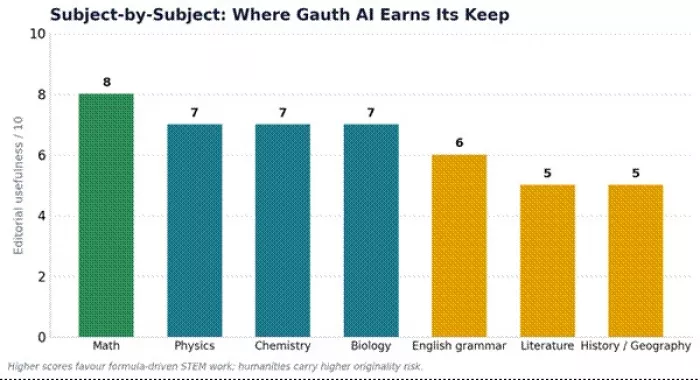
Figure 4. Subject usefulness skews toward formula-driven STEM. Humanities carry higher originality risk.
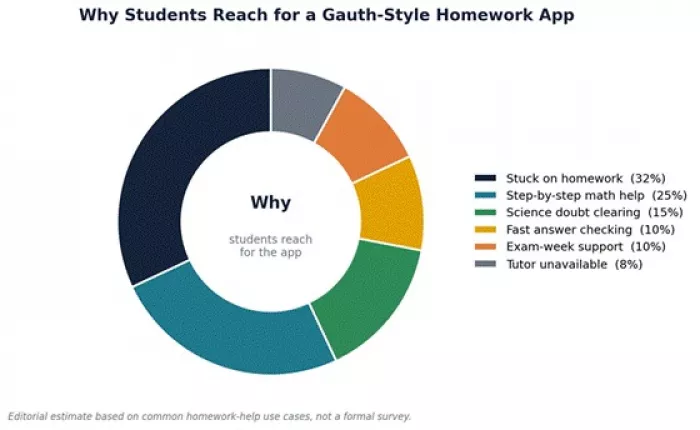
Figure 5. Why students reach for the app. Editorial estimate, not a formal survey.
| Category | Score / 10 | Final Note |
| Math homework support | 8 | Clear steps, strongest area |
| Science doubt support | 7 | Solid on numericals, watch wording |
| Explanation clarity | 8 | Plain language a younger student follows |
| Photo recognition | 8 | Reliable on clean, single questions |
| Learning transfer | 6 | Only if the student re-solves alone |
| Responsible-use safety | 5 | Answer-only mode invites copying |
| Pricing value | 6 | Fair if used, billing friction hurts |
| Parent trust | 5 | Trial and cancellation need attention |
| Alternative pressure | 6 | Focused rivals win on single needs |
| Overall rating | 7 | A good guided helper, not a shortcut |
| Verdict. Gauth AI passes when it helps a student understand the next step, and it does that well for math and formula-based science. It struggles when the student uses it only to collect answers, and its answer-only mode plus billing friction are the real weak points. For a younger sister, it should be treated like a guided study helper, not a private shortcut machine. Used with a simple try-first rule and the explain-back check, it earns its place. Used as a copy-paste tool, it only helps her fail faster. |

Marketing teams often need images before a product is ready for a phot...

Creating a logo that will grab customers' attention is one of the main...

Enterprise software has a well-known failure mode. The demo goes great...

Most people who produce video at any real scale hit the same wall even...

A cinematic AI video needs more than realistic skin, dramatic lighting...

Have you noticed how difficult it is not to watch spoilers of a sporti...
Discussion