
My younger brother was doing exactly what most students do two weeks before exams. He had class notes open in one tab, three PDF chapters saved on the desktop, and a handful of YouTube explainers bookmarked. He was studying for hours. The problem was not effort. The problem was that he was rereading the same pages and quietly hoping the information would stay put. It rarely did.
This Gizmo AI review comes out of that exact situation: I wanted to see whether the app could convert his existing study material into flashcards, quizzes, and active recall practice, so he could revise smarter instead of just reading more.
Gizmo AI is a study tool, not a homework machine. It takes content a student already has, notes, PDF chapters, pasted text, even lecture recordings, and turns it into flashcards and quiz-style recall sessions wrapped in spaced repetition. That distinction shaped everything I tested, and it is the thread that runs through this entire review.
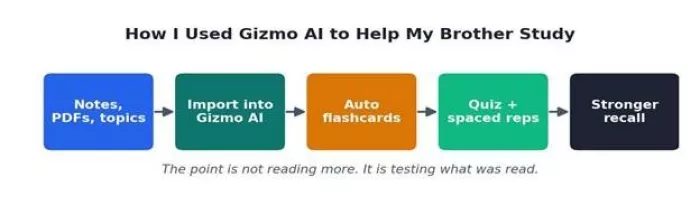
Figure 1. The study loop I built: existing material in, recall practice out.
If you only have thirty seconds, here is what I concluded after putting Gizmo AI through real revision sessions with my brother.
| The question I had going in | My answer after testing it |
| Does it help students revise? | Yes, especially when they need flashcards and quizzes built from their own notes |
| Is it better than rereading notes? | Yes, because it forces active recall instead of passive review |
| Is it useful for exam prep? | Yes, mainly for memory-based subjects and concept revision |
| Is it a homework solver? | No. It is a revision and learning assistant, not an answer engine |
| Best feature | Turning raw study material into flashcards and quizzes in seconds |
| Biggest weakness | Output quality depends heavily on the quality of the notes you feed it |
| Best for | Students who need structured, repeatable revision |
| Not best for | Students who only want direct homework answers |
Everything below is the longer version of those answers, with the testing behind them.
Watching him study was the real diagnosis. He could recite a definition perfectly while the page was open in front of him, then go blank when I closed the book and asked the same question two minutes later. That gap, fluent while reading and lost while tested, is the single clearest sign that revision is not working.
A few patterns stood out:
• He reread the same notes repeatedly and mistook familiarity for memory.
• He remembered material while reading it but forgot it during practice questions.
• He had no self-testing routine at all.
• He spent more time reorganizing and highlighting notes than actually recalling them.
• He needed active recall, not another round of highlighting.
This is the exact gap a tool like Gizmo AI is built to close. It does not teach the material for the first time. It makes you prove you remember it.
I refused to test it on the marketing homepage examples. Instead I used the messy, real material my brother actually studies from, so the results would reflect a normal student, not a demo.
| Study material | Why I tested it | What I checked |
| Class notes | Most students revise from notes first | Whether the flashcards were accurate |
| PDF chapter | Tests long-form study material | Whether key concepts were extracted, not just trivia |
| Short topic summary | Tests quick last-minute revision | Whether the quizzes were genuinely useful |
| Exam revision points | Tests focused cramming | Whether it created tight, focused cards |
| Weak concepts | Tests learning support | Whether it helped surface gaps in understanding |
Gizmo AI accepts PDFs, pasted text, PowerPoint files, and YouTube links, and it can import existing decks from Quizlet and Anki, so the import side was rarely the bottleneck.
The first useful thing happened before any studying did: my brother did not have to sit and manually turn every paragraph into a flashcard. He dropped in a biology PDF, and within seconds Gizmo had generated a deck. That single step, removing the boring manual card-making, is what made him willing to start at all.
The interface stayed out of the way. The dashboard nudges you toward the core actions without burying you in settings, which matters for a younger student who gives up the moment a tool feels complicated. He was practicing questions within a couple of minutes of importing, not forty minutes later.
The cards arrive in a clean question-and-answer format. For straightforward material like lecture notes or a well-structured PDF, the output was clean and usable with very little editing. Here is the kind of transformation that happened repeatedly:
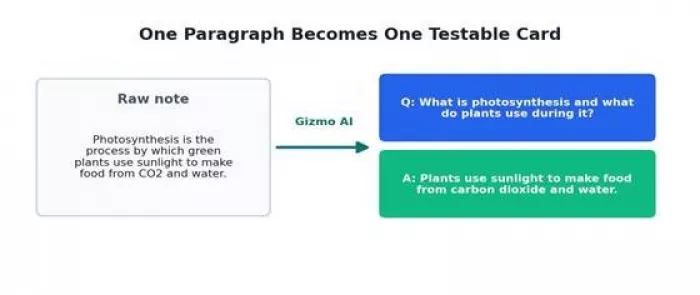
Figure 2. A single textbook sentence becomes one testable question-answer card.
| Original note | Gizmo AI-style flashcard |
| Photosynthesis is the process by which green plants use sunlight to synthesize food from carbon dioxide and water. | Q: What is photosynthesis, and what do plants use during the process? |
What worked: the cards pushed recall instead of recognition, my brother could edit weak cards, and a wrong answer triggered an AI tutor explanation that he could ask follow-up questions about. What I watched for: on dense or badly formatted material the cards sometimes turned vague or oversimplified, which is the honest limit of any one-pass AI. In testing across a dense academic chapter, accuracy held up well, but a few cards paraphrased a concept loosely enough that I corrected them before he revised.
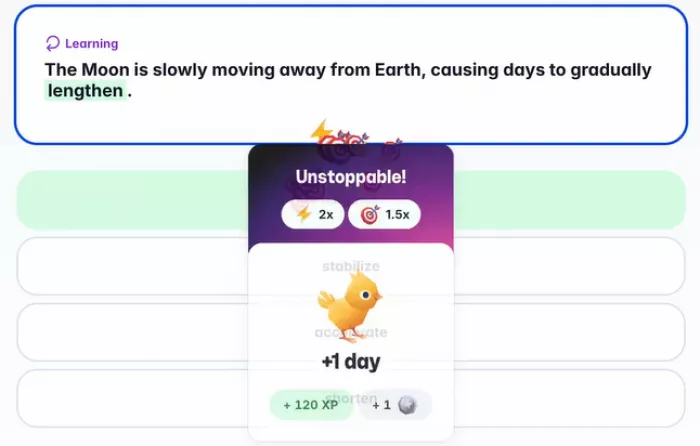
Reading gives students the feeling that they know a topic. Quizzing shows whether they actually remember it. That one sentence is the center of this whole review.
Instead of passively flipping cards, Gizmo pushes you into quizzes with multiple-choice and written answers, and a spaced-repetition engine surfaces the cards you keep getting wrong more often. For my brother, this did three things rereading never did: it forced retrieval, it exposed exactly which topics were still weak, and it built visible confidence as the same questions got easier across days.
Gizmo AI is useful because it makes a student follow a better study method, not because it makes them smarter. The method is decades old and very well evidenced.
Figure 3. Retrieval practice retained far more than rereading after one week.
In one of the most cited 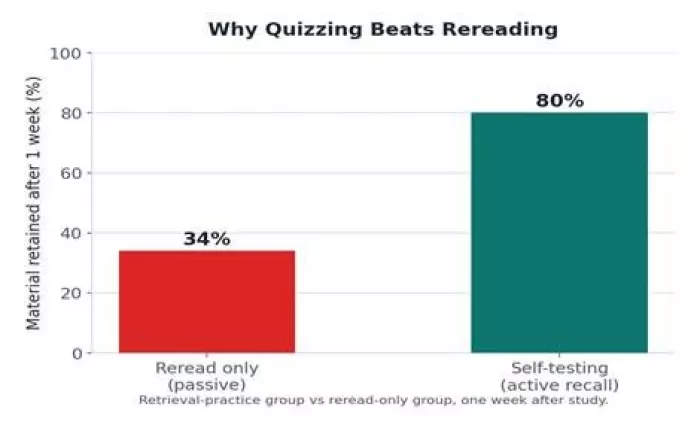 studies in this area, students who tested themselves retained roughly 80 percent of the material after a week, while those who only reread retained about 34 percent. Reviews of learning techniques have rated practice testing and spaced repetition among the highest-utility strategies available, far above highlighting or rereading. Research summaries also estimate that spacing reviews over time can improve long-term retention by 200 to 300 percent compared with single-session study.
In plain terms: students forget most of what they only read, and they forget it fast. Active recall and spaced repetition fight that forgetting curve. Gizmo AI is a convenient delivery system for both. The benefit comes from the method; the app just removes the friction of setting it up.
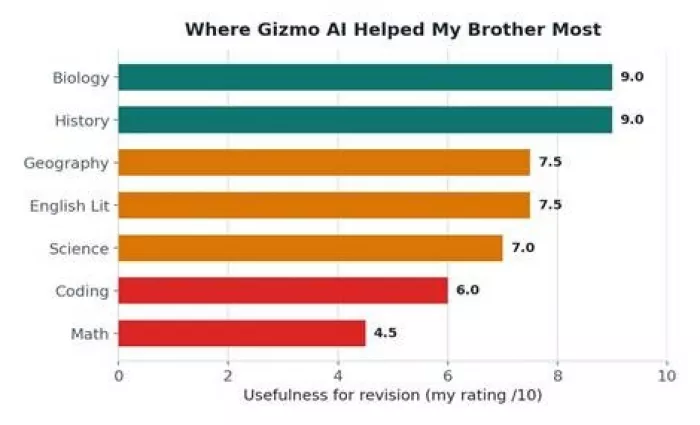
Figure 4. My experience-based usefulness rating by subject type.
| Subject | Usefulness | My experience-based take |
| Biology | High | Strong for definitions, processes, and labeled-diagram facts turned into cards |
| History | High | Excellent for dates, events, causes, and effects |
| Geography | Good | Useful for terms, processes, and map-related theory |
| English literature | Good | Helpful for themes, characters, and summaries |
| Science concepts | Good | Works well when the source notes are clear |
| Coding | Moderate | Fine for definitions, syntax, and concepts, weak for real debugging |
| Math | Limited | Better for formulas and theory than for solving full problems |
The pattern is consistent: Gizmo AI is built for revision and recall, not for working through problems. The more a subject rewards memory of facts and concepts, the more it helps.
The part he liked most was not the AI branding. It was that studying felt like answering small questions instead of staring at a long PDF. In his words it stopped feeling like a chore. Concretely:
• Far less boredom during revision
• Faster sessions, because cards were already made
• No manual flashcard creation
• Easy self-testing on demand
• A real sense of feeling prepared, backed by quiz scores
• Shorter, repeatable revision blocks instead of marathon reading
Honesty matters more than promotion here. A few things needed a human in the loop:
• AI can miss context, so a card may be technically correct but miss the point of a topic.
• Weak or messy notes produce weak flashcards. Garbage in, garbage out.
• Long PDFs sometimes needed cleaning before import for the best results.
• Some generated questions were too simple to be worth practicing.
• Genuinely complex topics still needed the textbook or a teacher.
• Editing the bad cards meaningfully improved deck quality.
My rule for him was simple: use Gizmo AI to test recall, but verify anything that feels off against the actual textbook before exam day.
This is the most important positioning point in the review. Gizmo AI should not be confused with a homework solver like Gauth or Photomath. It is most useful after a student already has content and wants to revise it, not when they want an answer handed to them.
| What you need | Better tool type | Why |
| Solve a math problem | Homework solver | Gives step-by-step worked answers |
| Revise a chapter | Gizmo AI | Turns content into flashcards |
| Memorize definitions | Gizmo AI | Supports repeated recall practice |
| Understand a hard question | Tutor, teacher, or ChatGPT | Needs real explanation |
| Practice before an exam | Gizmo AI | Builds quizzes and recall loops |
Pricing on AI study apps changes often, so verify the current numbers on the official Gizmo AI site before relying on them. At the time of writing, the structure looked like this:
• Free plan: gives you a limited number of daily lives (around 15) and a daily cap on AI-generated quizzes (about 10). Wrong answers cost a life, and running out triggers a roughly 10-minute lockout.
• Paid plans: an Unlimited Weekly option around 13.99 US dollars per week, reportedly about 6.99 with a student discount, and an Unlimited Yearly plan working out to roughly 2.98 per week. Paid tiers unlock unlimited lives, quizzes, AI tutor access, and imports.
The honest catch is the free tier. The life-based system interrupts exactly the kind of intensive, repeated practice the app is built for, which nudges heavy users toward a subscription. For a casual learner the free plan is enough to evaluate it. For exam-season cramming it is not.
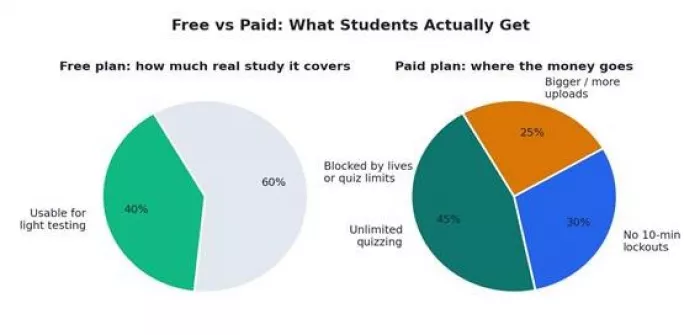
Figure 5. How much real study the free plan covers, and where paid money actually goes.
| Pricing question | Why it matters for students |
| Is there a free plan? | Students need to test before paying |
| Are there flashcard or quiz limits? | Heavy revision hits the daily caps quickly |
| Are uploads limited? | PDF-heavy study may require a paid tier |
| Is there a student discount? | Affordability decides adoption |
| Can it be used only during exams? | Weekly plans suit short bursts better than monthly |
Beyond my own testing, the sentiment across student reviews and reviewer write-ups was fairly consistent. Before recommending it to other students I would always check live sources, since ratings and complaints shift over time.
| Where to check | What to look for |
| Real student complaints and how people actually use it | |
| Quora | Common beginner questions and comparisons |
| Product Hunt | Early-adopter feedback and feature reactions |
| App Store and Google Play | Mobile experience and current ratings |
| YouTube | Real demos and walkthroughs |
| Trustpilot | Support, billing, and pricing complaints |
| Official site | Claimed features and testimonials, read skeptically |
The recurring themes: students like the genuine time savings on card creation, the reduced exam anxiety from structured daily queues, and the clean, low-configuration interface. The common frustrations: the free-tier limits make serious long-term use hard without paying, the AI occasionally produces low-value questions that need filtering, and a recurring honest line in reviews is that it is an excellent tool but pricey if you are not using it heavily. App-store ratings generally sit in the high-4-star range. Treat any single number as a snapshot and verify before publishing.
| Alternative | Best for | My practical comparison |
| Quizlet | Flashcards and study sets | More established with a generous free tier, but Gizmo feels faster at generating cards from raw material |
| Anki | Spaced repetition | More powerful for serious learners, far less beginner-friendly, and free |
| Knowt | Notes to flashcards | A strong direct alternative with similar auto-generation |
| StudyFetch | AI tutor and study sets | Broader AI study workflow, less focused on the flashcard loop |
| Gauth | Homework solving | Better for direct answers, not for revision |
| Photomath | Math problem solving | Better for step-by-step math |
| Socratic | Homework explanations | Better for quick concept help |
| ChatGPT | Explanations and summaries | More flexible, but less structured for flashcards |
| Notion AI | Note organization | Better for note systems than dedicated recall |
| Brainscape | Flashcard mastery | Strong for structured, confidence-based flashcards |
Gizmo AI works best as one part of a study system, not the whole thing. The workflow that worked for my brother:
1. Use the textbook or class notes as the source of truth.
2. Use ChatGPT or teacher notes to simplify the genuinely confusing concepts first.
3. Put the cleaned notes into Gizmo AI.
4. Turn them into flashcards and quizzes.
5. Revise daily using active recall and spaced repetition.
6. Use Gauth or Photomath only for actual homework problems.
7. Keep the weak flashcards flagged for exam week.
| Time | Activity | Tool use |
| 20 minutes | Read class notes | No AI, understanding only |
| 10 minutes | Clean confusing points | Teacher notes or ChatGPT |
| 15 minutes | Create flashcards | Gizmo AI |
| 20 minutes | Practice quizzes | Gizmo AI |
| 10 minutes | Mark weak cards | Manual review |
| Next day | Repeat weak cards | Gizmo AI revision |
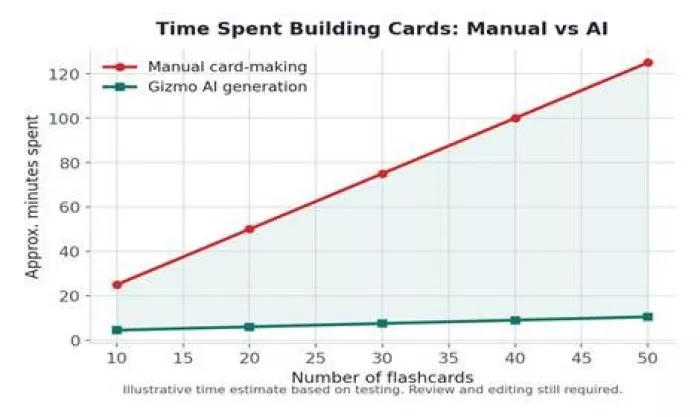
Figure. Illustrative time to build cards manually versus with Gizmo AI.
Two evidence threads explain the results. First, retention: without reinforcement, learners forget a large share of new information within a day and most of it within a week, and active recall has been shown to roughly double or triple long-term retention versus passive review. Second, friction: the slowest part of evidence-based studying is building the practice material by hand, and that is exactly the step Gizmo automates. The time chart above is illustrative rather than measured, but it matches what I saw: the manual route scales painfully with deck size, while AI generation stays nearly flat. Every retention figure cited here comes from published cognitive-science research, and pricing figures should be reconfirmed on the official site before publishing.
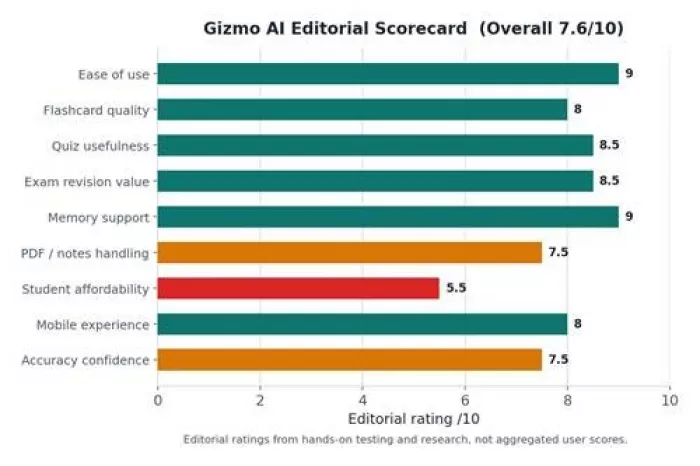
Figure 9. Editorial ratings from hands-on testing and research.
| Category | Rating / 10 | My reason |
| Ease of use | 9.0 | Clean dashboard, fast onboarding, friendly for younger students |
| Flashcard quality | 8.0 | Strong on clean notes, needs editing on dense material |
| Quiz usefulness | 8.5 | Genuine recall practice with adaptive difficulty |
| Exam revision value | 8.5 | Excellent for memory-based subjects |
| Memory support | 9.0 | Active recall plus spaced repetition done well |
| PDF and notes handling | 7.5 | Good import range, quality depends on source |
| Student affordability | 5.5 | Free tier limits and weekly pricing add up |
| Mobile experience | 8.0 | Solid app, high store ratings |
| Accuracy confidence | 7.5 | Mostly reliable, verify on complex topics |
| Overall rating | 7.6 | A capable revision tool, priced for heavy users |
These are editorial ratings based on hands-on testing and research, not aggregated third-party user ratings.
• Do not feed it weak or messy notes and expect strong cards.
• Do not trust every generated card blindly. Edit the bad ones.
• Use textbooks and teachers for genuinely difficult concepts.
• Do not treat it as a homework solver.
• Revise repeatedly across days, not once the night before.
• Pair it with actual writing practice for written exams.
• Do not upload private or sensitive school documents without checking the privacy terms first.
Because this was for my younger brother, I treated privacy as non-negotiable. Gizmo is not uniquely risky compared with similar tools, but it still demands basic digital hygiene. Before letting a younger student upload anything, I would confirm:
• Whether uploaded notes are stored, and for how long.
• Whether content is used to train models, and if that can be turned off.
• Account privacy and what an email sign-up exposes.
• That no school documents with names, IDs, or addresses are uploaded.
• That a parent is aware for younger students.
• The terms of any paid plan, including refund and cancellation policy, before paying.
Gizmo AI is not the tool I would use to solve my brother's homework for him. It is the tool I would use after he has studied a chapter and needs to check whether he actually remembers it. That is where it earns its place. It turns notes into questions, makes revision active instead of passive, and gives students a real way to practice before exams.
It is best for revision, flashcards, and self-testing, and weakest as a homework solver or a math tutor. Its quality rises and falls with the notes you give it, so it works best alongside textbooks and teachers, not instead of them. Given the free-tier limits, I would test it free first and only pay if a student is revising heavily through exam season. For my brother, who was studying hard but revising badly, it changed how he prepared, and the change was for the better.
Is Gizmo AI free?
Yes, there is a free plan, but it is limited. You get a capped number of daily lives and AI-generated quizzes, and wrong answers can trigger a short lockout. It is enough to evaluate the app, not to cram with.
Is Gizmo AI good for students?
For revision, yes. It is strongest for memory-based subjects where turning notes into flashcards and quizzes pays off. It is weak for solving problems.
Can Gizmo AI make flashcards from PDFs?
Yes. It accepts PDFs, pasted text, PowerPoint files, and YouTube links, and generates flashcards automatically. Cleaner source files produce better cards.
Does Gizmo AI help with exams?
It helps with exam preparation by forcing active recall and spaced repetition, which are well-evidenced for retention. It does not predict or answer exam questions for you.
Is Gizmo AI better than Quizlet?
It often feels faster at generating cards from raw material. Quizlet is more established with a more generous free tier. The better choice depends on whether you value speed of generation or a larger free allowance.

Marketing teams often need images before a product is ready for a phot...
Creating a logo that will grab customers' attention is one of the main...
Enterprise software has a well-known failure mode. The demo goes great...

Most people who produce video at any real scale hit the same wall even...
A cinematic AI video needs more than realistic skin, dramatic lighting...
Have you noticed how difficult it is not to watch spoilers of a sporti...
Discussion