

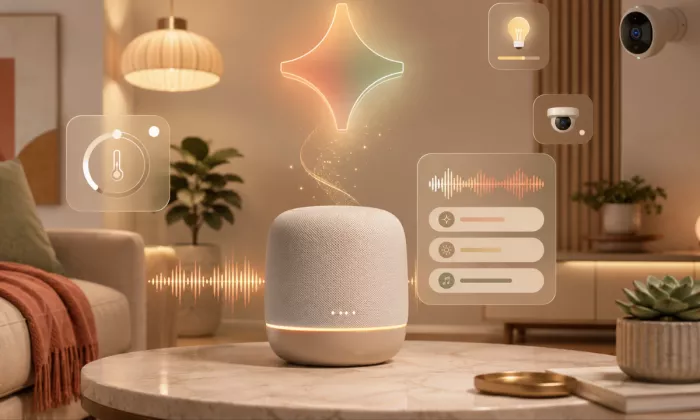
Google is giving the smart home speaker another serious try, and this time the company is putting Gemini at the center of the experience.
The new Google Home Speaker is Google’s first fresh smart speaker in nearly six years. Priced at $99.99, the compact speaker is built specifically for Gemini for Home, Google’s upgraded AI assistant for smart home devices. Preorders open on June 17, and the device begins shipping on June 25.
This is not just a speaker refresh. Google is trying to fix one of the biggest problems with smart speakers: they often feel too limited, too rigid, and too dependent on exact voice commands.
The biggest change is not the shape of the speaker. It is the assistant inside it.
Gemini for Home is designed to understand more natural language than the older Google Assistant. Users should be able to speak in a more normal way, ask follow-up questions, and combine multiple requests without carefully phrasing every command. Google says the new assistant can handle more conversational smart-home control, information requests, and household tasks.
That could make the device feel less like a command box and more like a real home assistant.
| Feature | Google Home Speaker |
|---|---|
| Price | $99.99 |
| Preorders | June 17, 2026 |
| Shipping | June 25, 2026 |
| Assistant | Gemini for Home |
| Audio | 360-degree sound |
| Smart home support | Matter controller and Thread 1.3 border router |
| Connectivity | Wi-Fi 6 and Bluetooth 5.4 |
| Colors | Porcelain, Hazel, Jade and Berry |
| Premium offer | 6 months of Google Home Premium |
The speaker has a compact rounded design, a light ring for visual feedback, touch controls, and 360-degree audio. It is also designed to work as a smart home hub with Matter and Thread support.
Smart speakers were once expected to become the center of the connected home. But over time, many users ended up using them mainly for music, timers, alarms, weather, and basic device control.
Google is now trying to move past that limited experience.
With Gemini, the company wants users to ask more complex questions, control multiple devices in one sentence, and get better responses when they speak naturally. For example, instead of saying separate commands for lights, temperature, and music, a user should be able to ask for a full room setup in one request.
That is the real promise of the new speaker: less command memorization, more natural interaction.
Some of the most advanced features will sit behind Google Home Premium.
Early buyers get six months of the subscription, which unlocks features such as Gemini Live, AI-powered Nest camera search, stronger automation tools, enhanced notifications, and video history.
This shows that Google is not only selling hardware. It is also building a subscription layer around the AI-powered home.
That may help Google generate recurring revenue, but it also creates a question for users: how much of the smarter home experience should require a paid plan?
Google says the new speaker uses local AI models to improve sound handling and voice command recognition. That matters because smart speakers often struggle in noisy rooms, from across the house, or when music is already playing.
The speaker also supports 360-degree audio and stereo pairing, though it is smaller than the older Nest Audio. The focus appears to be convenience and smarter interaction rather than high-end home audio.
Google’s launch comes as Amazon and Apple are also trying to make their smart home assistants more useful with AI.
The smart speaker market has been quiet for years, but generative AI has created a new reason to revisit the category. If AI assistants can understand context, handle multi-step tasks, and connect more intelligently with devices, smart speakers could become more important again.
Google’s advantage is that it already has Gemini, Android, Nest cameras, Google Home, search, YouTube, and a large smart-home ecosystem. The challenge is making all of that feel simple inside one speaker.
The Google Home Speaker looks like a modest piece of hardware, but it carries a bigger ambition.
Google is trying to prove that Gemini can make the smart home feel less frustrating. If the assistant works well, users may finally get the kind of hands-free home control that smart speakers promised years ago.
If it does not, the speaker could become another device people use mainly for music and timers.
Google’s new Home Speaker is less about better audio and more about rebuilding the smart home around AI.
At $99.99, the device is priced like a mainstream smart speaker, but the real story is Gemini. Google is betting that a more conversational assistant can make the home speaker useful again, especially as more devices, cameras, automations, and subscriptions connect through Google Home.
The product’s success will depend on one simple thing: whether Gemini can make smart home control feel natural instead of mechanical.

Marketing teams often need images before a product is ready for a phot...
Creating a logo that will grab customers' attention is one of the main...

Enterprise software has a well-known failure mode. The demo goes great...

Most people who produce video at any real scale hit the same wall even...

A cinematic AI video needs more than realistic skin, dramatic lighting...

Have you noticed how difficult it is not to watch spoilers of a sporti...
Discussion