


| Attribute | What is observed |
| Domain | thesindi.com (loads as https://www.thesindi.com) |
| Site type | Multi-topic blog or content portal |
| Publishing platform | WordPress 6.9.4 |
| Hosting and security | Served over HTTPS, behind Cloudflare |
| Activity | Active as of May 2026, with around 58 pages of paginated post archives |
| Archive depth | Earliest archive entry dates to March 2024, with a steady cadence beginning January 2025 |
| Stated categories | Technology, Finance, Business, Education, Health, Lifestyle, Law |
| Visible byline | A single author called Roland, with the URL slug /author/brijesh/ |
| Stated contact | Cloudflare-protected email only; no phone number, no postal address, no contact form |
| Legal pages present | About Us, Disclaimer, DMCA Policy, Privacy Policy, Terms and Conditions |
TheSindi.com is a general-interest blog that publishes short and medium-length explainer articles across a wide range of subject areas. The homepage shows a magazine-style layout with featured posts, a category menu and a sidebar listing recent posts and monthly archives. The technology stack is standard WordPress, and the site is delivered through Cloudflare, which means basic security and uptime measures are in place.

Browsing the site for a few minutes makes its model clear. New posts arrive several times a month. Topics rotate without any obvious thematic discipline: a recent week includes articles on senior medical alert devices, beginner trading accounts, a Bitcoin casino comparison, a bank server outage explainer, a natural shampoo review and a car dealership data piece. All of these appear under the same byline.
In other words, the site behaves like a multi-niche content hub rather than a specialist publication. It is not selling anything directly. There is no checkout, no signup paywall, no payment flow and no obvious phishing attempt.
From a basic safety standpoint, it does not present the typical surface of a fraudulent site, and existing third-party reviews echo this point. A review published on AppCritica in April 2026 describes thesindi.com as a multi-niche information hub with standard legal pages and no obviously scammy behaviour.
The About Us page positions the site as a reliable, friendly portal for everyday readers. It promises informative and trustworthy content across legal, education, automotive, business and finance, technology, fashion and lifestyle, sports, and travel topics. The page states that its mission is to provide easy-to-read content that helps readers make informed decisions.
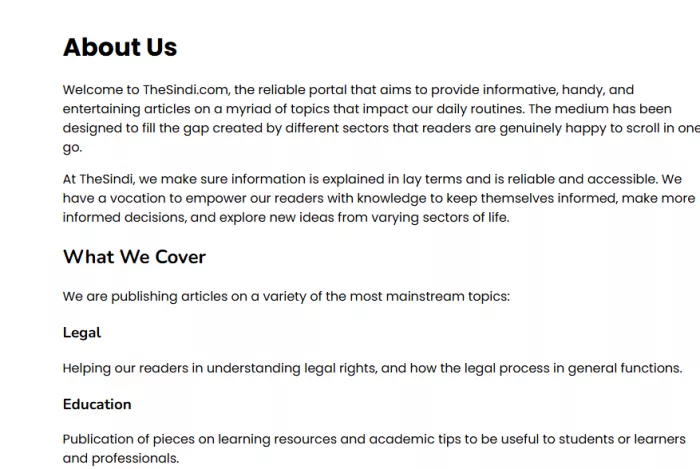
There are some friction points in the way these claims are presented. The About Us page contains visible grammatical issues and unusual phrasings, such as references to a vocation to empower readers and a passage about fashion and home warranty that does not parse cleanly. The page never names a founder, an editorial lead, an editorial team, a company entity or a registered address. There is no team photograph, no LinkedIn-style biographies and no statement of editorial standards.
More striking is the Disclaimer page, which is unusually candid about the limits of the site's content. It explicitly warns that the published material is general in nature, that readers may be exposed to out-of-date or imprecise information, and that using the information is, in the site's own words, completely risky. The page declines responsibility for accuracy across every category it covers, including law, finance, education, automotive, business, technology, lifestyle, travel, sports, and fashion. Legal articles are framed as not constituting legal application. Financial content is framed as not constituting financial or investment advice.
Notable wording on the site's own Disclaimer page The Disclaimer states that readers may lose out on accurate information by relying on the site, and that using the information provided is the reader's risk. This is the site's own framing, not the reviewer's. |
Modern web users have learned to look for a handful of signals when judging whether a content site can be trusted. These include verifiable authorship, identifiable ownership, working contact channels, a stated editorial process, and clean separation between editorial and commercial content. TheSindi.com performs well on basic infrastructure signals but poorly on the deeper trust signals that matter for regulated topics.
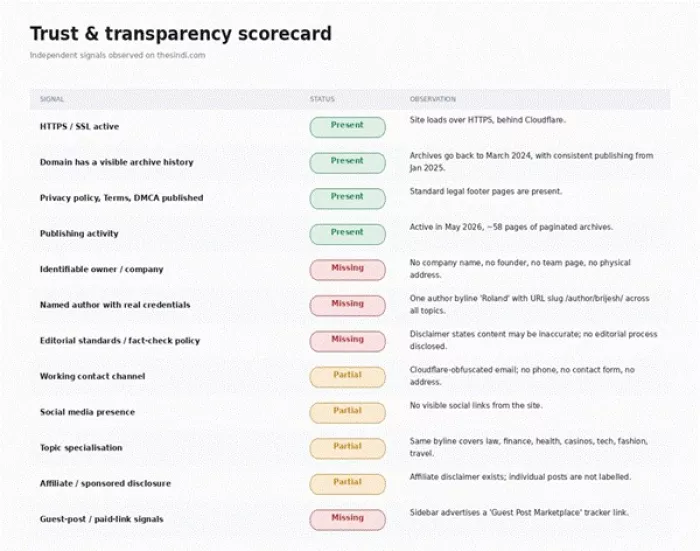
Figure. Trust and transparency signals observed on thesindi.com.
The site publishes a wide array of unrelated topics, suggesting it is not run by a single expert but likely prioritizes traffic or paid placements. Articles are readable, structured with bullet points and subheadings, and use a conversational, beginner-friendly tone. However, multiple outbound links, guest post advertising, and low-depth coverage indicate potential commercial bias rather than purely editorial content.
| Signal | Observation | Implication |
| Topic breadth | Covers trading, Bitcoin casinos, banking, personal care, medical devices, shipping, home improvement | Unlikely to be authored by a single expert; site aims for broad traffic |
| Writing style | Readable, structured, intro + subheadings + bullet points + closing paragraph | Beginner-friendly; skimmable but shallow |
| Citations & depth | Limited, weak sourcing | Low credibility for research-intensive readers |
| Outbound links | Multiple keyword-rich links to small or unknown sites | Possible paid placements; SEO-driven rather than editorial recommendation |
| Guest post advertising | Sidebar banner links to marketplace | Confirms monetization via content placements; commercial bias present |
What this means in practice When a site openly accepts guest posts and does not label them, the most reasonable assumption is that any given article that promotes a third-party tool, casino, exchange, lender or service may have been paid for. That does not make the article false, but it does mean it is not a neutral recommendation. |
Some of the categories covered on thesindi.com touch on regulated topics where bad information has real consequences. The site itself acknowledges this in its Disclaimer, but the warning sits on a separate page that most readers will never visit. Specific areas worth flagging:
Health and medical content. Articles about supplements, hair care, hormone-adjacent topics and senior medical alert devices read as general explainers. They are not written by named medical professionals and they should not substitute for advice from a qualified clinician.
Finance and trading. Posts on trading account types, buying Bitcoin and bank infrastructure read like introductory primers. The site's own Disclaimer states that nothing on the site is financial or investment advice. Readers should treat the articles as background reading at most.
Gambling-adjacent content. Posts about Roobet, Stake and how API integration supports casino content delivery are unusual fare for a general lifestyle blog. Online gambling content tends to involve affiliate commission. Readers should assume promotional intent unless the article explicitly says otherwise.
Software and tools coverage. Articles that recommend specific third-party platforms, especially smaller ones the reader has never heard of, deserve a quick safety check before clicking. The CracksTube piece is a useful example. The platform name and the link pattern around it warrant independent verification before any download, signup or payment.
Law. Legal content on the site is general and not jurisdiction-specific. The Disclaimer rules it out as legal advice. Any actual legal decision should be checked with a qualified lawyer.
TheSindi.com is a functioning multi-topic blog with standard security and legal pages, but lacks transparent authorship, editorial oversight, and social accountability. It is safe for casual reading but not authoritative for health, finance, legal, or technical decisions.
| Signal | Observation | Implication |
| Security | HTTPS + Cloudflare | Basic site safety in place |
| Ownership | No named founder or team | Limited accountability |
| Authorship | Single byline for diverse topics | Low subject-matter expertise |
| Editorial Oversight | No stated editorial policy | Articles may be shallow or commercial |
| Commercial Bias | Guest-post marketplace, outbound links |
The clearest external assessment of thesindi.com at the time of writing is a long-form review on AppCritica, dated April 2026. The reviewer spent time reading across categories and concluded that the site behaves like a legitimate content platform with the usual legal pages, no scammy behaviour and a consistent structure, but that it lacks named expert authors, citations to primary sources and an editorial masthead.
The AppCritica review's bottom line is similar to the one reached here: the site is acceptable as a first step into a topic, but should not be used as a single source for decisions that involve money, health or law. Searches for the domain on Trustpilot and other consumer-review platforms do not return a dedicated Trustpilot profile for the site, which is normal for a content-only blog with no commercial transactions, but it also means there is no community of reviewers vouching for the site's reliability.
This site is best read with realistic expectations about what it is. It is a one-person or small-team general-interest blog, monetised through ads and guest-post placements, that produces readable explainers across a wide range of topics. It is not a newsroom, it is not a regulator, it is not a research outlet, and the site itself does not claim to be.
TheSindi.com is a broad multi-topic blog, best approached as a casual learning resource rather than a trusted authority.
While its articles are readable, structured, and beginner-friendly, the wide range of topics, lack of named expert authors, and presence of guest-post monetization indicate that content should be cross-verified before relying on it for financial, medical, legal, or technical decisions. Use it as a starting point for quick orientation, but always consult stronger, specialized sources for actionable information.
| Parameter | Rating (1–5) | Notes |
| Topic Expertise | 2 | Covers many unrelated areas; unlikely a single expert author |
| Writing Quality | 4 | Readable, structured, conversational |
| Citations / Depth | 2 | Weak sourcing, low credibility for research-intensive content |
| Transparency & Ownership | 2 | No named team, limited contact info, unclear editorial policy |
| Commercial Bias | 3 | Multiple outbound links, guest-post marketplace; some potential bias |
| Safety / Security | 5 | HTTPS + Cloudflare; basic web safety measures in place |
| Overall Usefulness | 3 | Good for casual orientation, not for critical decisions |
Summary Score: 3/5 – Useful for general understanding, low accountability for regulated or high-stakes topics
One-line summary Useful for orientation, weak on accountability. Browse it casually if you find it useful, but do not make any money, health, legal or software decision based on a single article from this site. |

Marketing teams often need images before a product is ready for a phot...

Creating a logo that will grab customers' attention is one of the main...

Enterprise software has a well-known failure mode. The demo goes great...

Most people who produce video at any real scale hit the same wall even...

A cinematic AI video needs more than realistic skin, dramatic lighting...

Have you noticed how difficult it is not to watch spoilers of a sporti...
Discussion