
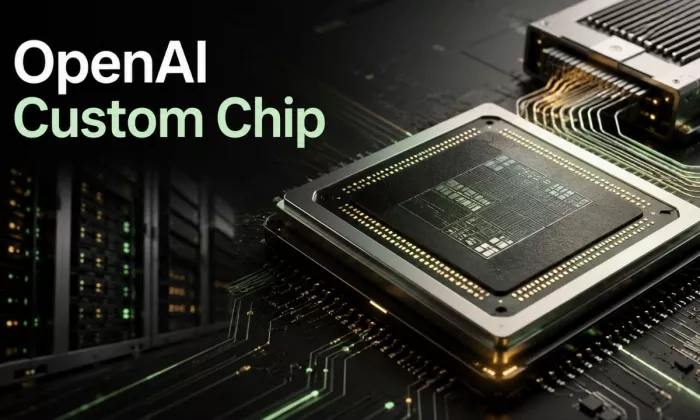
OpenAI has reportedly unveiled its first custom-designed AI chip, developed in collaboration with semiconductor giant Broadcom. The move marks a major step in OpenAI’s long-term strategy to reduce reliance on third-party hardware and gain tighter control over the infrastructure powering its large-scale AI systems.
The introduction of a custom chip signals a broader trend in the AI industry: leading companies are no longer just building models—they are also designing the hardware that runs them.
For OpenAI, this shift is about efficiency, cost control, and performance optimization. By designing its own silicon, the company can tailor hardware specifically for training and running large language models, rather than relying solely on general-purpose GPUs.
Broadcom’s role in the development is critical. Known for its expertise in networking and custom silicon solutions, Broadcom helps bridge the gap between AI model requirements and scalable chip manufacturing.
This partnership suggests that OpenAI is not entering semiconductor manufacturing alone, but instead working with established infrastructure players to accelerate deployment and reduce technical risk.
While technical specifications have not been fully disclosed, custom AI chips typically focus on:
In practical terms, this could translate into faster responses, more efficient model training, and lower operational costs for AI services.
The development comes at a time when major tech companies are aggressively investing in AI infrastructure. Companies like Google and Amazon have already built custom silicon for their cloud and AI systems, and OpenAI’s move brings it into the same competitive category.
This also highlights a larger industry trend: AI performance is increasingly limited not just by algorithms, but by hardware efficiency.
If OpenAI successfully scales its custom chip deployment, it could reduce dependency on external GPU suppliers and gain more control over the entire AI stack—from model design to hardware execution.
This could also influence pricing, speed, and availability of future AI tools built on OpenAI systems.
The unveiling of a custom chip developed with Broadcom signals a significant evolution in OpenAI’s infrastructure strategy. It shows a clear move toward vertical integration in AI, where companies don’t just build intelligence, but also the machines that power it.
If successful, this approach could reshape how large-scale AI systems are built, deployed, and optimized in the coming years.

Marketing teams often need images before a product is ready for a phot...

Creating a logo that will grab customers' attention is one of the main...

Enterprise software has a well-known failure mode. The demo goes great...

Most people who produce video at any real scale hit the same wall even...

A cinematic AI video needs more than realistic skin, dramatic lighting...

Have you noticed how difficult it is not to watch spoilers of a sporti...

Discussion