


At a quick glance, QuikConsole.com appears more polished than many low-effort content sites floating around today. The homepage is cleaner, the topics are more focused, and unlike some obvious SEO farm networks, it avoids stuffing the footer with gambling links or suspicious outbound spam.
In fact, compared to many similar sites, QuikConsole initially feels surprisingly restrained.
But after spending time going through its categories, author structure, disclaimers, and publishing patterns, the core issue becomes difficult to ignore. The website still operates like a large-scale search traffic project rather than a genuinely authoritative publication. It just happens to be a more organized version of the same model.
That distinction matters because modern SEO farms rarely look messy anymore. The newer generation is designed to appear professional enough to pass casual inspection while quietly prioritizing volume, keyword coverage, and discoverability above everything else.
QuikConsole fits that evolution almost perfectly.

One reason QuikConsole feels more credible than many multi-niche blogs is because the site maintains a relatively consistent visual identity. The categories are organized clearly, the homepage avoids excessive clutter, and the article titles sound more technical and intentional than the generic “ultimate guide” style content commonly found on lower-tier content farms.
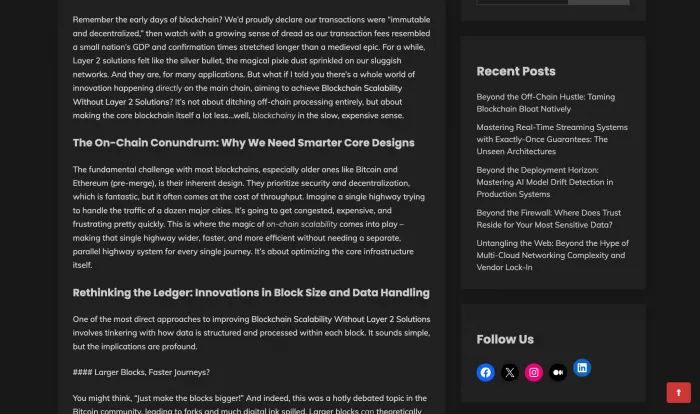
The Technology section especially stands out because the topics are surprisingly niche:
At first, this gives the impression that the site may actually specialize in advanced technical content.
But once you start reading the articles more closely, another pattern emerges. The writing often sounds informed on the surface while remaining strangely abstract underneath. Articles use sophisticated terminology and trendy industry phrases, but they frequently avoid deep implementation details, original reporting, or practical engineering insight.
In other words, the content sounds authoritative without consistently demonstrating real expertise.
That difference becomes important very quickly in technical niches where surface-level summaries are easy to produce but difficult to trust.
One of the strongest indicators of an SEO-driven content operation is publishing breadth combined with inconsistent authority. QuikConsole covers:
| Main Categories | Typical Content Style |
| Technology | Trend-focused explainers |
| Digital Marketing | SEO and CTR optimization topics |
| Finance | Beginner-friendly investment content |
| Education | Broad learning resources |
| Lifestyle | Generic self-improvement material |
| Travel | Basic travel advice |
| Law & Real Estate | Occasional informational posts |
The issue is not that the site covers many topics. Plenty of legitimate media brands do that successfully. The problem is how interchangeable the content feels once you move between categories.
A technical blockchain article and a lifestyle advice article are written in nearly identical rhythms. The same sentence structures, pacing, and generalized explanatory tone appear across every niche regardless of complexity.
That usually happens when the goal is scalable publishing rather than specialized expertise.

One of the fastest ways to damage trust online is pretending to have a community that does not actually exist.
QuikConsole prominently displays links for:
But according to your findings, these buttons redirect users to the main homepage of each platform instead of actual branded accounts.
That is not a small oversight.
Social proof matters enormously for online publications. Even smaller blogs usually maintain some form of audience interaction, content sharing, or community presence. Here, the social layer appears entirely cosmetic. The icons exist to simulate legitimacy rather than demonstrate it.
This creates a strange contradiction. The website wants to look like an active digital publication, but it does not appear interested in building the public-facing ecosystem that real publications depend on.
The About page may actually reveal the website’s underlying structure more clearly than the articles themselves.
Large sections of the text feel padded, repetitive, and awkwardly phrased. Sentences like:
“Balanced living is beyond age”
or:
“We are on the road to having it in production”
do not read like carefully edited brand messaging. They read like generated filler trying to sound inspirational and broad enough to apply to every niche simultaneously.
The bigger issue is not grammar alone. It is the complete absence of specificity.
A legitimate publication usually explains:
Who runs the site
Why it was created
What expertise the contributors bring
What editorial standards exist
QuikConsole instead focuses on vague mission language about “empowering readers” and “sharing practical knowledge” without offering any concrete evidence behind those claims.
That kind of ambiguity is extremely common across SEO farm ecosystems because the actual brand identity is secondary to the publishing operation itself.
To QuikConsole’s credit, the content quality is noticeably higher than many obvious content mills. The technical articles at least attempt to engage with current industry discussions rather than recycling beginner-level definitions endlessly.
However, the structure remains highly formulaic.
Most articles follow a predictable pattern:
| Common Structural Pattern | Purpose |
| Broad industry framing | Captures search intent |
| Mention of modern challenges | Adds perceived sophistication |
| Mid-level explanations | Keeps content accessible |
| Practical recommendations | Increases topical relevance |
| Safe conclusion | Avoids taking strong positions |
This creates an illusion of depth while staying broad enough to publish quickly and consistently across multiple categories.
The content is optimized to rank and appear useful, not necessarily to become a definitive resource.
Interestingly, the Disclaimer page is more honest than most of the site’s branding.
It openly states:
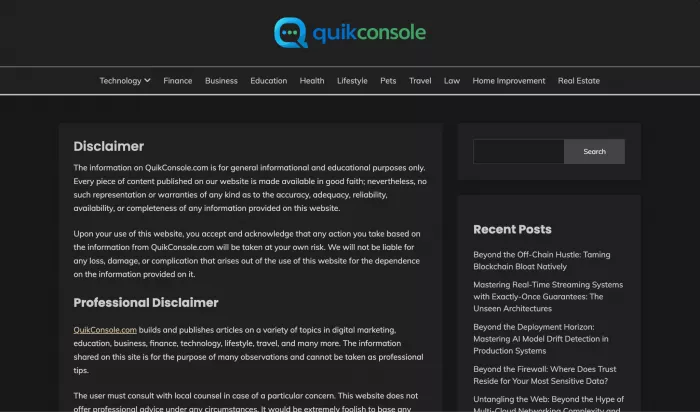
But from a reader perspective, it highlights an important contradiction. The site publishes articles covering finance, law, business strategy, health, and technology while simultaneously distancing itself from responsibility for the accuracy or reliability of that information.
That does not automatically make the content worthless, but it reinforces the idea that scale matters more than authority here.
Older SEO farms were easy to spot. They were cluttered with spammy ads, broken layouts, casino banners, and unreadable keyword stuffing.
Modern SEO farms evolved.
Now they look cleaner. They use better themes. They publish longer articles. They choose more sophisticated topics. Some even avoid obvious spam links entirely.
QuikConsole represents that newer version extremely well.
Here is the difference:
| Traditional SEO Farm | Modern SEO Farm |
| Obvious spam | Polished design |
| Aggressive keyword stuffing | Smarter semantic optimization |
| Thin content | Medium-depth generalized content |
| Gambling backlinks | Cleaner branding |
| Low readability | More professional tone |
The presentation improved. The underlying objective often did not.
QuikConsole.com is not the sloppiest SEO-driven site on the internet. In fact, that is precisely why it is interesting. It represents a more refined version of the same traffic-focused publishing model that now dominates huge portions of the web.
The site understands presentation. It understands modern SEO language. It understands how to package technical topics in ways that feel credible to casual readers. But underneath that polish, the same familiar issues appear repeatedly: weak editorial identity, fake social proof, broad multi-niche scaling, vague author authority, and content designed more for discoverability than expertise.
To be fair, some readers may still find useful introductory information there. Not every article is empty. But the platform consistently struggles to prove why it should be trusted beyond surface-level readability.
And that is ultimately the problem with many modern SEO farms. They are no longer trying to look spammy. They are trying to look “good enough” to blend into legitimate publishing ecosystems while operating on entirely different priorities behind the scenes.

Marketing teams often need images before a product is ready for a phot...

Creating a logo that will grab customers' attention is one of the main...

Enterprise software has a well-known failure mode. The demo goes great...

Most people who produce video at any real scale hit the same wall even...

A cinematic AI video needs more than realistic skin, dramatic lighting...

Have you noticed how difficult it is not to watch spoilers of a sporti...
Discussion