


Haiper was one of the first European entrants in the AI video race, and one of the first to exit it.
The first time I opened Haiper in a Chrome tab back in mid-2024, I typed in three words “otter eating sushi” and waited. Eighteen seconds later, a four-second clip rendered into the preview pane. The otter was holding its sushi roll the right way up, the chopsticks moved with something close to physical sense, and the water dripped off its whiskers in a way no template-based video tool could have faked. I remember laughing out loud. It felt like the kind of small magic trick that an AI video generator was supposed to deliver and almost never did.
_1752668356.png)
Eight months later, the same URL returned a 404.
This is a review I never quite expected to be writing in the past tense. Haiper AI once described as a "European challenger to OpenAI's Sora" quietly shuttered its consumer web app in February 2025, with no warning email, no migration window, and no way for paying subscribers to recover their saved projects. The story of why that happened matters at least as much as the story of what the product could do. So this piece covers both. I'll walk through what Haiper offered, how it actually performed in real use across the months I tested it, the pricing as it stood when the lights went out, the version history that shaped its short life, the founder exits and acquisitions that ended it, and the verdict any honest reviewer has to land on now: a capable product, a real cautionary tale, and a clear signal about how to treat any cloud-based AI tool in 2026.
Haiper Limited was founded in late 2021 in King's Cross, London. Its two co-founders, Dr. Yishu Miao and Dr. Ziyu Wang, both held PhDs in Machine Learning from Oxford University and had worked together as researchers at Google DeepMind. Miao had also done a stint as a tech lead manager at TikTok before starting his first company, MO Intelligence; Wang had been a staff research scientist at Google Brain. That résumé combination, DeepMind, Oxford, TikTok, Google Brain, is roughly the most relevant cocktail of credentials one can bring to AI video generation, and it's the reason Haiper was taken seriously from day one.
The company emerged from stealth in March 2024 with a $13.8 million seed round led by Octopus Ventures, bringing its total raised to roughly £15.1 million (around $32 million). It had Geoffrey Hinton, the so-called “godfather of AI”, listed as an advisor. By the time the consumer product was widely used, Haiper claimed roughly 4.5 million users worldwide. For a few months it genuinely looked like the European answer the AI video space had been waiting for.
Haiper was headquartered in King's Cross, part of London's growing AI cluster.
Setting aside the corporate story for a moment, what could the product actually do? In practice, four features did most of the work.
The headline feature. A user typed a prompt anywhere from three words to a paragraph, chose an aspect ratio, optionally picked a stylistic "Inspiration" preset (Rainbow, Playground, Volcano, etc.), and clicked Create. About 15 to 25 seconds later, a roughly four-second clip appeared. You could regenerate with the same prompt, tweak the wording, or branch off entirely. Compared to Runway or Pika at the time, Haiper's iteration loop was unusually tight.
_1752668622.png)
The feature I personally used most. Drag in a static image, type a short instruction describing the motion you wanted ("camera slowly pans left, hair blows in wind"), and Haiper would animate the still. The aspect ratio was inherited from the uploaded image rather than being set independently, which removed a tiny but real point of friction. For social-media creators turning product photography or illustrated stills into moving content, this was where Haiper genuinely competed with paid tools costing two to three times more.
Less mature but interesting. You uploaded an existing short clip and described how its aesthetics should change — different colors, different textures, a different subject. The output was hit-or-miss in my testing, but on a good roll it produced something that genuinely refreshed an asset rather than mangling it.
Haiper maintained a templates library segmented by mood (Hot, Meme, Portrait) and a "Spotlight" community page where users could publish and browse one another's generations. It functioned both as inspiration and as quiet prompt education, a smart product decision for a tool whose output depends heavily on how the user phrases a request.
Haiper's interface stayed deliberately minimal, prompt in, video out, no timeline.
Haiper's model pipeline moved fast. The original Haiper 1.0 handled basic text-to-video and image-to-video at modest quality. Haiper 2.0 launched on 21 October 2024 and was the version that earned the company most of its press attention — it introduced what the team called "hyper-realistic" generation with substantially better temporal coherence, meaning fewer of those AI-video moments where a person's hand morphs into something out of a Bosch painting between frames. Haiper 2.5, released on 18 December 2024, added API access and a partnership with VEED for in-editor integration, signalling the company's pivot toward making its model available inside other people's products rather than relying solely on its own consumer surface.
Three model releases in roughly twelve months is genuinely fast iteration for a foundation-model company. The technical work was real. The business case around it is what unravelled.
I want to be careful not to romanticize this. Plenty of clips I generated were unusable. Faces drifted. Hands sprouted extra fingers when the prompt asked for "hands holding a teacup". Anything involving fast camera motion or rapid subject movement tended to produce smeared, soup-like frames by second three. These are the same complaints anyone testing AI video in 2024 will recognize, and Haiper wasn't immune.
But on the prompts it did handle well, slow camera moves, atmospheric scenes, single subjects, product-style shots, animated illustrations, Haiper consistently produced clips that I could actually use. Specifically, here's where it performed best in my testing:
Slow atmospheric scenes. "Fog rolling through a pine forest at dawn" gave me an evocative four-second clip on the second attempt.
Product photography animation. Uploading a flat product shot and asking for subtle rotation or particle effects worked better than I expected, especially compared to Pika at the equivalent free tier.
Stylized illustration motion. A flat-art character with a "gentle breeze, hair moves slightly" prompt rendered cleanly. Useful for animated thumbnails and lightweight motion design.
Loops for social posts. The four-second cap was a constraint, but for Instagram Reels and TikTok loops, it was honestly enough.
Where it broke down: complex multi-subject scenes, anything with text in the frame (the text would morph into nonsense), and prompts asking for specific brand or celebrity likenesses. None of these are unique failures — they were industry-wide limitations at the time.
Beyond raw quality, there were structural weaknesses worth naming honestly.
No editing timeline. Once a clip was generated, your options were Download, Repaint, or Regenerate. There was no way to trim, splice, overlay text, or add audio inside Haiper itself. If you wanted any of that, you exported to CapCut, Premiere, or DaVinci. For solo creators this was an extra step rather than a dealbreaker; for any team trying to standardize a production workflow, it was a real limit.
Four-second ceiling. Clip length capped around four seconds for most generations, with an "Extension" priced function that bolted on a few more seconds at additional credit cost. For social loops this was fine; for anything narrative, it was a problem.
Watermarks on every plan below Pro. Both the Free and the $8 Explorer tier kept Haiper's watermark in the corner. That meant the only commercially viable tier was the $24/month Pro plan, which felt steep given the four-second ceiling.
No privacy on the free tier. Free-tier generations were public by default, they could appear in Spotlight and were used to train future models. Reasonable for hobbyists; problematic for anyone working on a client brief.
Reliability dipped in late 2024. Multiple Trustpilot reviews from the final months reported watermarks appearing on paid-tier exports, credits depleting faster than the stated allowance, and customer service taking days to respond. Whether these were normal scaling issues or early signs of resource constraints is hard to say from the outside, probably both.
For context, and because the search query "Haiper AI pricing" still pulls considerable traffic, here is what the tiers looked like in the company's final active months. All plans were labelled "beta", which in hindsight reads differently than it did at the time.
| Plan | Monthly Cost | Credits | Watermark | Commercial Use |
| Free (beta) | $0 | 10 daily creations · 300 non-expiring | Yes | No |
| Explorer (beta) | $8 (billed yearly) | 1,500 monthly | Yes | No |
| Pro (beta) | $24 (billed yearly) | 5,000 monthly | No | Yes |
| Enterprise API | Custom | Custom | No | Yes |
The Explorer plan was a strange middle tier, cheap, but lacking both watermark removal and commercial rights, which were the two features most paying users actually wanted. Most serious creators either stayed on the free plan to test or jumped straight to Pro. Here's how that pricing landed visually:
Public review data on Haiper is patchy because the company shut its consumer app before any single platform could accumulate a deep review base. That said, reviews across Trustpilot, Tekpon and futurepedia from the active period clustered into a fairly consistent pattern.
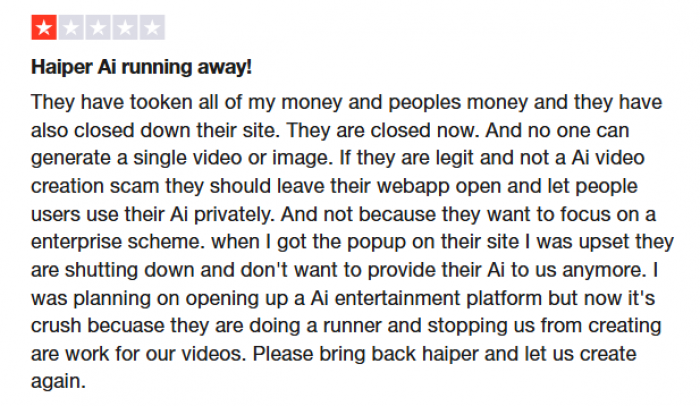
Positive reviews repeatedly praised the speed of generation, the genuinely-free Free tier (no credit card, no trial expiry), and the image-to-video feature in particular. Negative reviews from late 2024 concentrated on three issues: watermarks unexpectedly appearing on paid-tier exports, monthly credits draining faster than the stated allowance, and slow customer-service response when users tried to escalate either issue. A handful of yearly subscribers, having paid upfront, reported feeling stranded when the platform's reliability dropped and felt they had no recourse.
None of that was disqualifying for a fast-moving startup, but in retrospect those reports were probably the most visible surface-level symptom of the financial pressure described in the company's filings.
The end came faster than anyone outside the company expected. On 3 February 2025, the first social-media posts appeared from users discovering that the Haiper web app was returning 404 errors. There was no broadcast email, no in-app announcement, and no migration path. Projects stored in the cloud library became inaccessible. Users who had downloaded their clips earlier kept those files; everyone else lost their work.
In March 2025, both co-founders, Miao and Wang, updated their LinkedIn profiles to reflect that they had joined Microsoft AI as members of technical staff. Senior engineer Edward Hayes followed them. Miao's bio read, simply: "After 3 years startup life with Haiper, I'm starting a new journey at Microsoft AI building multimodal generative AI."
This was not a traditional acquisition. Microsoft did not buy Haiper; it hired the people who built it. The industry term for this is "acqui-hire", though even that softens what actually happened. By June 2025, NetMind.AI, a London-based decentralized AI compute platform, acquired Haiper's underlying video-generation models for an undisclosed sum and announced plans to fold the technology into B2B enterprise products. The consumer brand, the consumer app, and the consumer accounts were never restored.
The economics of a single-model consumer AI video app were brutal in 2024–25, and Haiper wasn't the only casualty.
Why did it happen? The honest answer is: competition and cash. Runway had raised over $200 million and had deep enterprise relationships. Kuaishou's Kling AI carried the backing of a $50-billion Chinese tech parent. Pika had raised roughly $80 million. Haiper's $32 million was simply not enough to sustain GPU costs, model training runs, and a generous free tier while competing against companies with five to ten times more capital. The product was good. The unit economics were not. And when Microsoft offered the founders a faster path with effectively unlimited resources, the result was almost predictable.
If you came to this article looking for Haiper, you almost certainly need to migrate. Based on which of Haiper's strengths mattered most to you, here is where most former users have moved in 2026.
If you mainly used image-to-video for social posts, Pika and Pollo AI are the closest analogs at a similar price point, both with usable free tiers. Pika's "Pikaffects" feature has matured into something genuinely useful for short stylized content.
If you valued Haiper's physics-aware motion on text prompts, Kling AI 3.0 from Kuaishou now leads on physical realism and consistency, starting at around $7/month, slightly cheaper than Haiper's old Explorer plan and substantially more capable.
If you wanted a polished editor-plus-generator workflow, Runway is the upgrade path. It's pricier (around $12/month and up), but it adds the editing timeline Haiper never had.
If you want maximum quality regardless of price, Google's Veo 3.1 has become the realism benchmark, accessible through Google AI Studio for free in limited daily quantities and through Gemini API for production use. It now sits at the top of most serious creator comparisons.
And one practical warning: after any popular consumer app shuts down, fake APK files and "Haiper AI download" pages tend to circulate. Anything claiming to be a Haiper mobile app or installer in 2026 should be treated as suspicious — the original company never shipped an official mobile app, and the new product listings on the App Store under similar names are unrelated developers using the keyword for SEO.
Here's how I scored Haiper based on roughly eight months of active testing through mid-2024 to early 2025, before the shutdown. These ratings reflect the product as it actually existed, useful context for anyone evaluating which surviving tool feels closest to what they used to like about Haiper.
Ease of Use
9.0
Generation Speed
8.5
Image-to-Video Quality
8.0
Text-to-Video Quality
7.0
Editing Controls
3.5
Long-Term Reliability
2.0
The last row is brutal but accurate. A tool that ceases to exist has, by definition, zero long-term reliability — and that single fact retroactively reshapes how you weight every other strength.
VERDICT
Overall: 6.3/10 · Recommended for: nobody, in 2026.
During its active period (March 2024 – January 2025), Haiper was a genuinely useful free tool for image-to-video animation and short social clips, particularly for creators on tight budgets. The image-to-video feature was its strongest surface, and the team's velocity, three model releases in twelve months was impressive. The shutdown was a real loss for independent creators.
That said, in 2026 there is no reason to seek out Haiper. The consumer product no longer exists; any URL or app claiming otherwise should be treated as suspect. Kling AI, Pika, Runway and Google Veo each cover what Haiper did, in most cases more capably.
The harder lesson, and the reason this story is worth telling now, is what Haiper tells us about how to use any AI tool. Four and a half million people built parts of their creative workflow on top of a product that disappeared in a single week, with no warning email and no export option. The users who navigated the shutdown with the least disruption were the ones who treated Haiper as a generator and not as a library , who downloaded every clip locally as soon as it was finished, who kept their prompts and source images in their own folders, and who used Haiper alongside one or two other tools rather than as a single point of failure.
That habit is worth carrying forward. Every AI tool you use in 2026 sits on top of some combination of expensive GPU compute, fragile unit economics, and a small founding team who could, in any given week, accept a job offer from a company with vastly more resources. Haiper wasn't a scam. It wasn't poorly built. It was simply a small, well-funded, technically capable startup that ran out of room. The lesson isn't to mistrust AI tools. The lesson is to use them — and to back up your work like you've been here before.
Marketing teams often need images before a product is ready for a phot...
Creating a logo that will grab customers' attention is one of the main...
Enterprise software has a well-known failure mode. The demo goes great...
Most people who produce video at any real scale hit the same wall even...
A cinematic AI video needs more than realistic skin, dramatic lighting...

Have you noticed how difficult it is not to watch spoilers of a sporti...
Discussion