

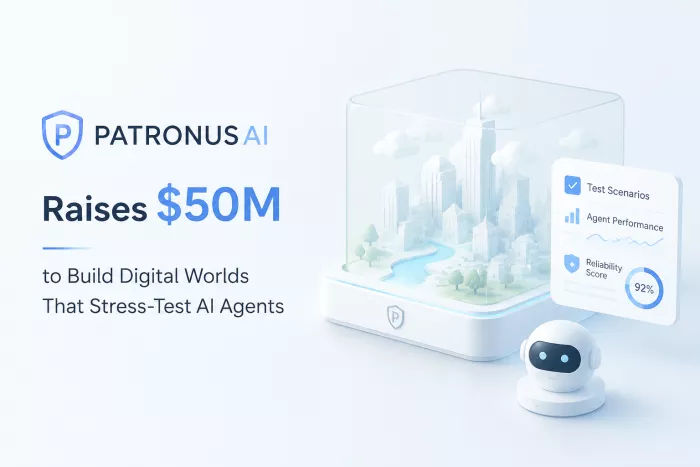
A growing focus in the AI industry is shifting from building smarter models to testing whether those models can actually perform reliably in complex environments. In this direction, Patronus AI has secured a $50 million Series B funding round, aiming to build large-scale digital environments that rigorously evaluate AI agents before real-world deployment.
The round, led by Greenfield Partners with participation from Lightspeed, Datadog, Samsung, and others, brings the company’s total funding to about $70 million, reflecting rising investor confidence in AI evaluation infrastructure.
Traditional AI benchmarks often test models on fixed datasets or short tasks, but Patronus argues that this approach is no longer enough for modern AI agents.
Instead, the company is building “digital world models”—simulated environments that replicate real software systems, websites, and workflows. In these environments, AI agents are placed in realistic scenarios where they must complete multi-step tasks, such as coding, financial analysis, or workflow automation.
The goal is to go beyond static testing and evaluate how agents behave in long-horizon, unpredictable conditions where failure is more realistic and harder to detect.
Patronus AI’s core idea is to treat AI agents like systems that must be stress-tested before deployment.
Within these simulated environments, agents are trained and evaluated using reinforcement learning, where successful task completion is rewarded and errors are penalized. This allows researchers to identify not just whether a model succeeds, but how it succeeds, and whether it is relying on shortcuts or unreliable reasoning.
The company’s approach is often compared to how autonomous driving systems were developed: by first testing them in virtual worlds before exposing them to real roads.
According to industry reports, Patronus AI is already working with multiple frontier AI labs and enterprise clients who are looking for more reliable evaluation systems.
The demand for such tools has grown rapidly as AI agents move from simple chat interfaces to systems capable of executing real-world actions, including managing workflows, writing code, and interacting with software tools autonomously.
The company also reports strong business growth, with revenue increasing significantly over the past year, indicating that AI evaluation is becoming a critical layer in the AI stack.
With the new funding, Patronus AI plans to expand its simulation infrastructure and build more advanced environments capable of supporting longer and more complex agent tasks.
The long-term vision is to create self-improving digital worlds where AI agents can continuously learn, adapt, and be evaluated across increasingly realistic conditions.
This positions Patronus not just as a testing platform, but as a foundational layer for the next generation of AI systems.
Patronus AI’s $50 million funding round highlights a major shift in AI development, from static evaluation to dynamic simulation. As AI agents become more autonomous, the ability to stress-test them in realistic digital worlds may become just as important as building the models themselves.

Marketing teams often need images before a product is ready for a phot...

Creating a logo that will grab customers' attention is one of the main...

Enterprise software has a well-known failure mode. The demo goes great...

Most people who produce video at any real scale hit the same wall even...

A cinematic AI video needs more than realistic skin, dramatic lighting...

Have you noticed how difficult it is not to watch spoilers of a sporti...
Discussion