

When I first encountered the phrase AI Insights DualMedia, it didn’t look like a single product, tool, or dashboard. Instead, it felt like a term that kept appearing across marketing blogs, AI forums, and enterprise case studies, always described slightly differently, but pointing toward the same idea.
So I stopped treating it like a buzzword and started treating it like a system.
After reviewing material from DualMedia itself, industry councils, AI marketing platforms, and technical discussions, one thing became clear to me: AI Insights DualMedia is not a standalone SaaS tool, it’s an AI-driven marketing and intelligence framework designed to merge digital and offline media into a single predictive engine.
This article breaks down exactly how that framework works, what makes it different, and why it’s being discussed as a serious shift in how AI is applied to real-world marketing and content strategy.
AI Insights DualMedia refers to an AI-driven marketing intelligence approach that connects digital and offline customer signals into one decision-making system. Instead of treating websites, ads, emails, print media, events, and in-store activity separately, it uses predictive analytics to understand behavior, segment audiences in real time, choose the best channel, and improve campaign timing. It is useful for data-heavy businesses, but it depends heavily on clean data, privacy compliance, and proper implementation.
This is the first thing that needs to be clarified.
AI Insights DualMedia is often used in two different ways.
The first meaning refers to DualMedia AI Insights as an AI-focused content and innovation section that tracks how artificial intelligence is being used in business, marketing, media, and technology.
The second meaning refers to AI Insights DualMedia as a broader marketing intelligence framework. In this sense, it means using AI to connect digital and offline media signals so businesses can make better targeting, content, and campaign decisions.
That is why the phrase can feel confusing.
Some sources talk about it like a knowledge hub.
Others describe it like an AI marketing strategy.
The most useful way to understand it is this:
AI Insights DualMedia is not just one dashboard. It is a system-level approach to using AI across both digital and physical customer touchpoints.
At its core, AI Insights DualMedia is built on a simple but powerful realization I kept seeing repeated across sources:
People do not live purely online or purely offline, but most marketing systems still treat them that way.
Traditional marketing stacks separate:
DualMedia’s AI approach does the opposite. It treats every interaction as part of one continuous behavioral signal, regardless of whether it happens on a screen or in the physical world.
The “AI Insights” layer exists to:
This is not automation for convenience. It’s automation for decision accuracy.
What stood out to me early is that “DualMedia” is not branding fluff, it’s a structural distinction.
Most AI marketing platforms optimize within digital ecosystems:
DualMedia’s AI works between ecosystems.
That means:
The AI doesn’t prioritize digital by default. Instead, it evaluates which medium is statistically most effective for the next step.
That’s the real departure from standard omnichannel marketing.
The system can be understood in eight steps.
| Step | What Happens | Why It Matters |
|---|---|---|
| 1. Data collection | Digital and offline signals are gathered | Creates a fuller customer view |
| 2. Data cleaning | Duplicate, incomplete, or messy data is fixed | Prevents bad predictions |
| 3. Identity matching | Signals are connected to users or segments | Links behavior across channels |
| 4. Behavioral analysis | AI looks for patterns and intent signals | Finds what users are likely to do |
| 5. Predictive scoring | The model estimates conversion, churn, or interest | Helps prioritize action |
| 6. Channel selection | AI recommends the best next medium | Reduces wasted outreach |
| 7. Campaign execution | The message is delivered through the selected channel | Turns insight into action |
| 8. Continuous learning | Results feed back into the model | Improves future decisions |
This is why AI Insights DualMedia is more than analytics.
Analytics explains.
DualMedia-style AI decides and adapts.
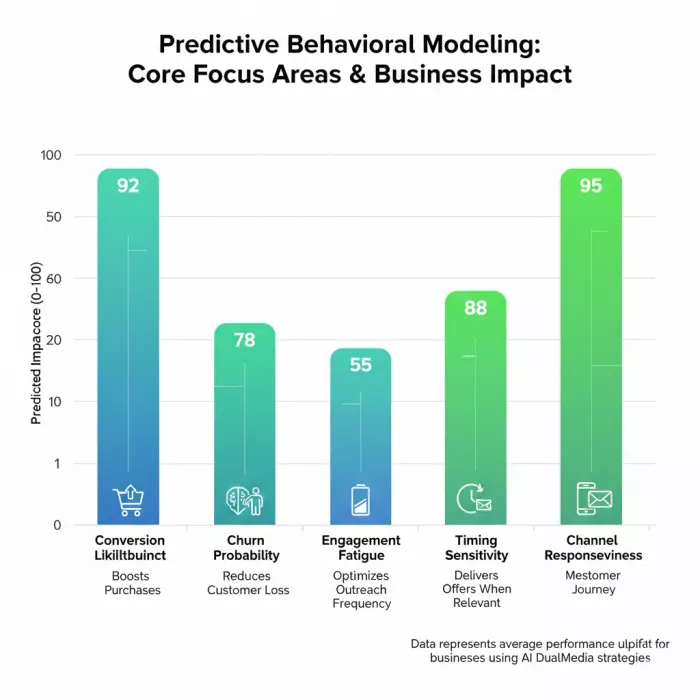
One of the most technically significant elements within AI Insights DualMedia is its use of predictive behavioral modeling. Instead of simply analyzing past campaign performance, the system continuously estimates forward-looking signals such as a user’s likelihood to convert, probability of churn, engagement fatigue risk, timing sensitivity, and responsiveness to specific channels. These are not fixed metrics assigned once and forgotten; they evolve dynamically as new behavioral data enters the system.
For example, if a user consistently ignores email campaigns but interacts with a printed QR code, the model recalibrates and increases the weight of offline touchpoints. If a customer engages after in-store exposure but avoids paid digital ads, the system deprioritizes ad spend for that profile. When repeated behavior indicates declining intent, the AI adjusts both the tone and delivery channel of messaging to prevent disengagement. This adaptive loop is what separates DualMedia from traditional reporting dashboards. It moves from passive analytics into active decision intelligence, where insights directly shape execution in real time.
One of the structural weaknesses in traditional marketing systems is their dependence on static customer personas built around fixed attributes such as age, gender, location, or job title. While these categories are easy to define and manage, they rarely capture real intent. Human behavior is dynamic, yet static segmentation assumes consistency. A user classified as a “mid-level professional in urban India” tells you very little about whether they are ready to buy, losing interest, or simply browsing.
AI Insights DualMedia replaces this rigid framework with real-time behavioral segmentation. Instead of locking individuals into predefined buckets, the system allows segments to form and dissolve dynamically based on observed activity. Engagement patterns, interaction frequency, channel response, purchase signals, and attention decay all influence how users are grouped at any given moment. As intent shifts, so does segmentation. There is no permanent label; there is only current behavioral probability.
This fluidity enables faster reactions to buying signals and reduces the inefficiency of repeatedly targeting disengaged audiences. It also allows personalization to extend beyond message wording into timing and channel selection. Rather than asking “Who is this user demographically?” the system asks “What is this user signaling right now?” From what I analyzed, this adaptive segmentation layer plays a central role in improving engagement and retention metrics when DualMedia-style AI systems are deployed. It reduces noise, sharpens relevance, and aligns outreach with actual intent rather than static identity assumptions.
A detail that genuinely surprised me was how often the AI chooses offline media even when digital options exist.
The system doesn’t ask:
“How do we follow up digitally?”
It asks:
“Which channel has the highest probability of conversion right now?”
Depending on the model’s confidence, the response could be:
This selective restraint is intentional. The AI is optimized not for volume, but for outcome efficiency.
One technical detail that consistently appeared across deeper analyses is the use of Bayesian marketing mix models.
Unlike traditional attribution models that rely on historical averages, Bayesian systems:
This allows DualMedia-style systems to:
From a strategic standpoint, this is what makes the system resilient instead of brittle.
Another important aspect is that AI Insights is not only operational, it’s also educational.
On the DualMedia side, AI Insights functions as a knowledge hub that translates complex AI developments (like LLMs and predictive models) into actionable insights for:
This reduces the gap between:
In practice, this matters because adoption fails when teams don’t trust or understand the system’s decisions.
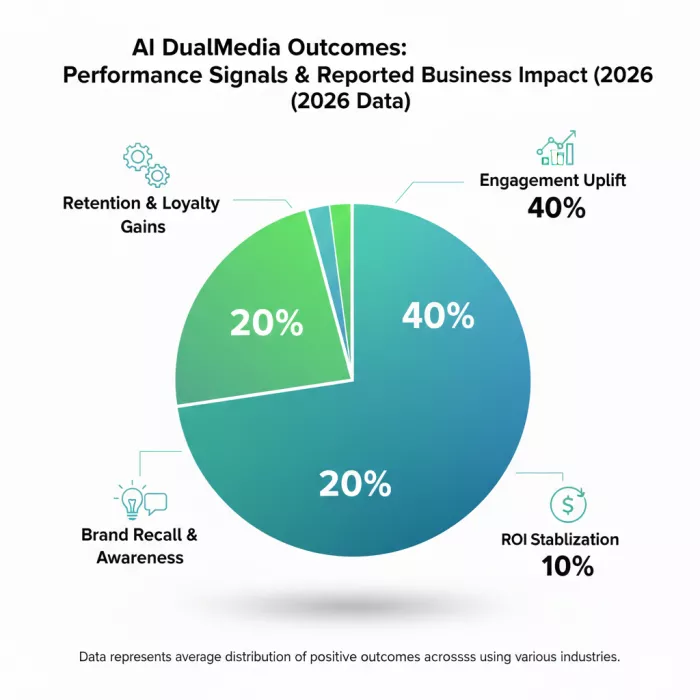
Across multiple implementation reports, one pattern appears consistently: businesses tend to see stronger engagement and retention when online and offline customer interactions work together instead of operating separately. The biggest advantage comes less from “more AI” and more from creating a coordinated system where targeting, messaging, and budget decisions continuously adapt based on real behavioral signals.
| Performance Area | Observed Impact |
|---|---|
| Customer Engagement | More consistent cross-channel interaction |
| Brand Recall | Improved through repeated coordinated touchpoints |
| Retention | Earlier churn detection helps reduce drop-offs |
| Budget Efficiency | Spending shifts dynamically toward stronger-performing channels |
| ROI Stability | More predictable performance over time |
| Core Advantage | Better strategic alignment rather than AI volume |
One thing that becomes noticeable while researching AI Insights DualMedia is how differently every source defines it. Some describe it as a marketing framework, others position it like a platform, while some treat it as an entire AI philosophy. That ambiguity makes it difficult to separate real implementation from conceptual branding
| Feature | What It Does | Business Value |
| Cross-channel data connection | Combines digital and offline signals | Better customer understanding |
| Predictive analytics | Estimates likely future behavior | Smarter campaign decisions |
| Dynamic segmentation | Updates audience groups in real time | More relevant targeting |
| Channel recommendation | Chooses the next best medium | Reduces wasted outreach |
| Performance tracking | Measures campaign impact | Improves ROI visibility |
| Budget optimization | Moves spend toward stronger channels | Reduces media waste |
| Privacy controls | Manages consent and data use | Reduces compliance risk |
| Continuous learning | Improves from new results | Makes the system adaptive |
One thing I appreciated is that most serious sources don’t pretend this is cheap or plug-and-play.
AI Insights DualMedia implementations generally fall into tiers:
The real cost isn’t just software, it’s:
This makes it unsuitable for teams looking for quick wins, but powerful for organizations ready to operate at system level.
After stepping back, here’s my honest conclusion:
AI Insights DualMedia is not about automating marketing tasks.
It’s about automating decisions across realities, digital and physical.
That’s why it keeps resurfacing in enterprise discussions and council publications. It solves a structural problem, not a tactical one.
Because AI Insights DualMedia relies heavily on behavioral prediction and cross-channel tracking, privacy concerns become unavoidable. Systems designed to connect digital actions with physical-world behavior raise questions around consent, customer profiling, and long-term data retention.
| Privacy Concern | Why It Matters |
|---|---|
| Cross-Channel Tracking | Users may not realize how much behavior is monitored |
| Behavioral Profiling | AI systems build predictive customer models |
| Data Retention | Large datasets increase long-term privacy risks |
| Consent Clarity | Many users do not fully understand tracking permissions |
I no longer view AI Insights DualMedia as a standalone platform, a checklist of features, or a passing industry buzzword. Instead, I see it as a design philosophy for applied AI, where insight directly drives action, context takes precedence over individual channels, and intelligence systematically replaces guesswork. The real shift is not technological but strategic, moving from isolated campaign execution to continuous behavioral understanding. That transition, from reacting to data toward orchestrating decisions around intent, is what makes DualMedia worth paying attention to.

Marketing teams often need images before a product is ready for a phot...
Creating a logo that will grab customers' attention is one of the main...

Enterprise software has a well-known failure mode. The demo goes great...

Most people who produce video at any real scale hit the same wall even...
A cinematic AI video needs more than realistic skin, dramatic lighting...
Have you noticed how difficult it is not to watch spoilers of a sporti...
Discussion